Question
A pendulum has a frequency of 5 vibrations per second. An observer starts the pendulum and fires a gun simultaneously. He hears echo from the cliff after 8 vibrations of the pendulum. If the velocity of sound in air is 340 m s-1, find the distance between the cliff and the observer.
Answer

5 vibrations by pendulum in 1 sec
So 8 vibrations in 8/5 seconds = 1.6 sec
Velocity = 2 × D/ time
340 = 2 × D/ 1.6
D = 340 × 1.6 / 2 = 272 m

Need a full question paper?

Generate a complete, print-ready paper with questions like this in minutes — across 16+ boards, with answer keys.

Start Generating Free

Similar questions

An electric bulb is rated '100 W, 250 V'. How much current will the bulb draw if connected to a 250 V supply ?

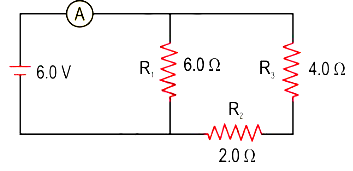
Three resistors of $6.0 ohm , 2.0 ohm$ and $4.0 ohm$ are joined to ammeter $A$ and a cell of emf $6.0 V$ as shown in following figure. Calculate:
(a) the efective resistance of the circuit.
(b) the reading of ammeter

Explain the following:

The surrounding become pleasantly warm when water in a lake starts freezing in cold countries ?

An observer stands at a certain distance away from a cliff and produces a loud sound. He hears the echo of the sound after $1.8$ s. Calculate the distance between the cliff and the observer if the velocity of sound in air is $340 m−^1.$
What is the function of a transformer in an a.c. circuit? How do the input and output powers in a transformer compare?
A mass of $50 g$ of a certain metal at $150^{\circ} C$ is immersed in $100 g$ of water at $11^{\circ} C$. The final temperature is $20^{\circ} C$. Calculate the specific heat capacity of the metal. Assume that the specific heat capacity of water is $4.2 Jg ^{-1} K^{-1}$.
Draw a diagram of a prism and label:
(i) the base,
(ii) the refracting surfaces,
(iii) the refracting edge,
(iv) the refracting angle in it.
Describe a simple Experiment to demonstrate that there Exists a magnetic field around a current-carrying conductor.

(a)An atomic nucleus A is composed of 84 protons and 128 neutrons. The nucleus A emits an α -particle and is transformed into a nucleus B. What is the composition of B?

(b)The nucleus B emits a β -particle and is transformed into a nucleus C. What is the composition of C?

(c)What is the mass number of nucleus A?

(d)Does the composition of nucleus C change if it emits a γ -radiation?

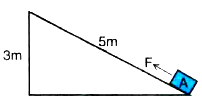
A block A, whose weight is 100 N, is pulled up a slope of length 5 m by means of a constant force (= 100 N) as illustrated in the following figure.

  1. What is the work done by force F in moving block A, 5 m along the slope?
  2. What is the increase in potential energy of the block A?
  3. Account for the difference in work done by the force and the increase in potential energy of the block.