A pendulum has time period $T$. If it is taken on to another planet having acceleration due to gravity half and mass $ 9 $ times that of the earth then its time period on the other planet will be
Easy


Download our appand get started for free
Experience the future of education. Simply download our apps or reach out to us for more information. Let's shape the future of learning together!No signup needed.*
Similar Questions
- 1The amplitude of a damped oscillator becomes one third in $2\, sec$. If its amplitude after $6\, sec$ is $1/n$ times the original amplitude then the value of $n$ isView Solution
- 2A mass $\mathrm{m}$ is suspended from a spring of negligible mass and the system oscillates with a frequency $f_1$. The frequency of oscillations if a mass $9 \mathrm{~m}$ is suspended from the same spring is $f_2$. The value of $\frac{f_1}{f_{.2}}$ is_____________.View Solution
- 3A particle is performing simple harmonic motion with amplitude A and angular velocity ${\omega }$. The ratio of maximum velocity to maximum acceleration isView Solution
- 4View SolutionIdentify correct statement among the following
- 5The variation of displacement with time of a particle executing free simple harmonic motion is shown in the figure. The potential energy ${U}({x})$ versus time $({t})$ plot of the particle is correctly shown in figure:View Solution
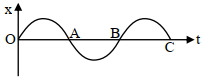
- 6A particle of mass $m$ is released from rest and follows a parabolic path as shown. Assuming that the displacement of the mass from the origin is small, which graph correctly depicts the position of the particle as a function of time $?$View Solution
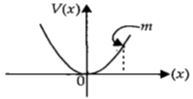
- 7The mass of a particle is $1\,\,kg$ and it is moving along $x-$ axis. The period of its small oscillation is $\frac {\pi }{2}$ . Its potential energy may beView Solution
- 8A simple pendulum of length $l$ and mass $m$ of the bob is suspended in a car that is travelling with a constant speed $v$ around a circular path of radius $R$. If the pendulum undergoes oscillations with small amplitude about its equilibrium position, the frequency of its oscillations will beView Solution
- 9The period of oscillation of a mass $M$ suspended from a spring of negligible mass is $T$. If along with it another mass $M$ is also suspended, the period of oscillation will now beView Solution
- 10A simple pendulum with length $L$ and mass $m$ of the bob is vibrating with an amplitude $A$. The maximum tension in the string isView Solution