The mass of a particle is $1\,\,kg$ and it is moving along $x-$ axis. The period of its small oscillation is $\frac {\pi }{2}$ . Its potential energy may be
Diffcult


Download our appand get started for free
Experience the future of education. Simply download our apps or reach out to us for more information. Let's shape the future of learning together!No signup needed.*
Similar Questions
- 1For a simple pendulum, a graph is plotted between its kinetic energy $(KE)$ and potential energy $(PE)$ against its displacement $d.$ Which one of the following represents these correctly ? (graphs are schematic and not drawn to scale)View Solution
- 2Two springs of force constants $300\, N/m$ (Spring $A$) and $400\, N/m$ (Spring $B$) are joined together in series . The combination is compressed by $8.75\, cm$. The ratio of energy stored in $A$ and $B$ is $\frac{{{E_A}}}{{{E_B}}}$. Then $\frac{{{E_A}}}{{{E_B}}}$ is equal toView Solution
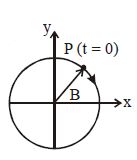
- 3Figure shows the circular motion of a particle. The radius of the circle, the period, sense of revolution and the initial position are indicated on the figure. The simple harmonic motion of the $x-$ projection of the radius vector of the rotating particle $P$ isView Solution
- 4A linear harmonic oscillator of force constant $2 \times 10^6\,Nm^{-1}$ and amplitude $0.01\, m$ has a total mechanical energy of $160\, J.$ ItsView Solution
- 5A $LCR$ circuit behaves like a damped harmonic oscillator. Comparing it with a physical springmass damped oscillator having damping constant $\mathrm{b}$, the correct equivalence would be:View Solution
- 6A particle executing a simple harmonic motion of period $2\ s$ . When it is at its extreme displacement from its mean position, it receives an additional energy equal to what it had in its mean position. Due to this , in its subsequent motion,View Solution
- 7A body is executing Simple Harmonic Motion. At a displacement $x$ its potential energy is ${E_1}$ and at a displacement y its potential energy is ${E_2}$. The potential energy $E$ at displacement $(x + y)$ isView Solution
- 8A particle moves such that its acceleration $a$ is given by $a = - bx$, where $x$ is the displacement from equilibrium position and b is a constant. The period of oscillation isView Solution
- 9A particle of mass $10\, gm$ moves in a field where potential energy per unit mas is given by expression $v = 8 \times 10^4\, x^2\, erg/gm$. If the total energy of the particle is $8 \times 10^7\, erg$ then the relation between $x$ and time $t$ isView Solution
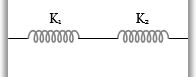
- 10View SolutionThe effective spring constant of two spring system as shown in figure will be