Question
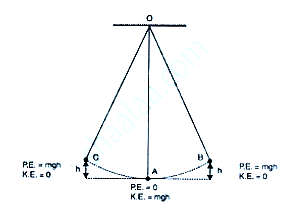
A pendulum is oscillating on either side of its rest position. Explain the energy changes that takes place in the oscillating pendulum. How does the mechanical energy remains constant in it? Draw the necessary diagram.
Answer

When the bob swings from A to B, the kinetic energy decreases and the potential energy becomes maximum at B where it is momentarily at rest.


From B to A, the potential energy again changes into the kinetic energy and the process gets repeated again and again. Thus while swinging, the bob has only the potential energy at the extreme position B or C and only the kinetic energy at the resting position A. At an intermediate position (between A and B or between A and C), the bob has both the kinetic energy and potential energy, and the sum of both the energies (i.e., the total mechanical energy) remains constant throughout the swing.

Need a full question paper?

Generate a complete, print-ready paper with questions like this in minutes — across 16+ boards, with answer keys.

Start Generating Free

Similar questions

A battery of $4$ cell, each of e.m.f. $1.5$ volt and internal resistance $0.5 Ω$ is connected to three resistances as shown in the figure. Calculate:
(i) The total resistance of the circuit.
(ii) The current through the cell.
(iii) The current through each resistance.
(iv) The p.d. across each resistance.
$1.0 kg$ of water is container in a $1.25 kW$ kettle. Calculate the time taken for the temperature of water to rise from $25^{\circ} C$ to its boiling point $100^{\circ} C$. Specific heat capacity of water $=4.2 J g ^{-1} K ^{-1}$.
In the alongside the figure of two pulleys shown a system in which one pulley is fixed and the other is movable. What is the velocity ratio of the system?
An effort of $600 \ N$ is needed to lift a weight of $1000 \ N$. What are the mechanical advantage and efficiency of the pulley system?
Comment on the statement ‘loudness of sound is a subjective quantity, while intensity is an objective quantity.
Derive an expression for the amount of heat given out or taken up, when its temperature falls or rises by t°C.
Give an experiment to verify the principle of moments.
Explain free and forced vibrations. Give an experimental arrangement to illustrate the phenomenon of resonance.
Two resistors of 2.0 Ω and 3.0 Ω are connected (a) in series (b) in parallel, with a battery of 6.0 V and negligible internal resistance. For each case draw a circuit diagram and calculate the current through the battery.
List any six forms of energy and write a short note on each of them.
A cell supplies a current of 1.2 A through two 2 Ω resistors connected in parallel. When the resistors are connected in series, it supplies a current of 0.4 A. Calculate: (i) the internal resistance and (ii) e.m.f. of the cell.