Questions

[5 Mark Question Answer]

🎯

Test yourself on this topic

4 questions · timed · auto-graded

Question 15 Marks
A pendulum is oscillating on either side of its rest position. Explain the energy changes that takes place in the oscillating pendulum. How does the mechanical energy remains constant in it? Draw the necessary diagram.
Answer
When the bob swings from A to B, the kinetic energy decreases and the potential energy becomes maximum at B where it is momentarily at rest.
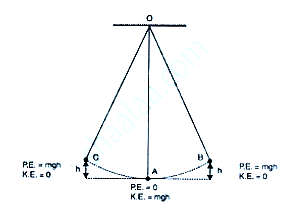

From B to A, the potential energy again changes into the kinetic energy and the process gets repeated again and again. Thus while swinging, the bob has only the potential energy at the extreme position B or C and only the kinetic energy at the resting position A. At an intermediate position (between A and B or between A and C), the bob has both the kinetic energy and potential energy, and the sum of both the energies (i.e., the total mechanical energy) remains constant throughout the swing.
View full question & answer
Question 25 Marks
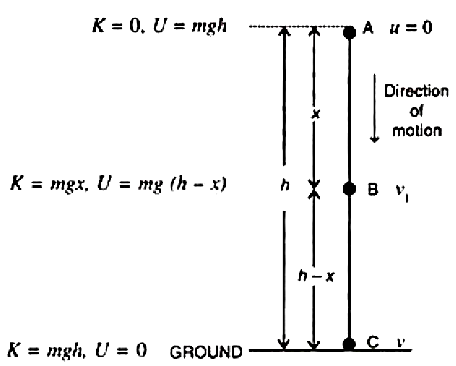
Show that the sum of kinetic energy and potential energy (i.e., total mechanical energy) is always conserves in the case of a freely falling body under gravity (with air resistance neglected) from a height h by finding it when (i) the body is at the top, (ii) the body has fallen a distance x, (iii) the body has reached the ground.
Answer
Let $a$ body of mass $m$ be falling freely under gravity from a height $h$ above the ground (i.e., from position A). Let us now calculate the sum of kinetic energy $K$ and potential energy $U$ at various positions, say at $A$ (at height $h$ above the ground), at $B$ (when it has fallen through a distance (x) and at $C$ (on the ground).


(i) At the position A (at height $h$ above the ground): Initial velocity of body $=0$ (since body is at rest at $A$ )
Hence, kinetic energy $K =0$
Potential energy $U = mgh$
Hence total energy $= K + U =0+ mgh = mgh$.. -----(i)
(ii) At the position B (when it has fallen a distance $x$ ):
Let $v _1$ be the velocity acquired by the body at $B$ after falling through a distance $x$. Then $u =$
$
0, S = x , a = g
$
From equation $v^2=u^2+2 A s$
$
v_1^2=0+2 gx =2 gx
$
Hence, Kinetic energy $K =\frac{1}{2} m v \frac{2}{1}$
Now at $B$, height of body above the ground $=h-x$
Hence, potential energy $U = mg ( h - x )$
Hence total energy $= K + U$
$
=m g x+m g(h-x)=m g h-------(i i)
$
(iii) At the position C (on the ground):
Let the velocity acquired by the body on reaching the ground be $v$.
Then $u =0$,
$
S = h , a = g
$
From equation: $v^2=u^2+2 a S$
$
\begin{aligned}
& v^2=0^2+2 g h \\
& v^2=2 g h
\end{aligned}
$
Hence, kinetic energy $K =\frac{1}{2} m v^2$
$
=1 / 2 m(2 g h)=m g h
$
And potentiall energy $U=0$ (a the ground when $h=0$ )
Hence total energy $= K + U = mgh +0= mgh$------ (iii)
Thus from equation (i), (ii) and (iii), we note that the total mechanical energy i.e., the sum of kinetic energy and potential energy always remain constant at each point of motion and is equal to initial potential energy at height $h$.

View full question & answer
Question 35 Marks
A body of mass m is moving with a uniform velocity u. A force is applied on the body due to
which its velocity changes from u to v. How much work is being done by the force.
Answer
Body of mass $m$ is moving with a uniform velocity $u$. A force is applied on the body due to
which its velocity changes from $u$ to $v$ and produces an acceleration a in moving a distance
S. Then,
Work done by the force $=$ force $\times$ displacement
$
W = F \times S --------( i )
$
From relation: $v^2=u^2+2$ a $S$
Displacement, $S =\frac{v^2-u^2}{2 a}$
And force, $F = ma$ From equation (i)
$
\begin{aligned}
W & =m a \times\left(\frac{v^2-u^2}{2 a}\right) \\
& =\frac{1}{2} m\left(v^2-u^2\right) \\
& = k _1- Kl
\end{aligned}
$
Where $K 1$ is the initial kinetic energy $=1 / 2 mu ^2$
And $K 1$ is the final kinetic energy $=1 / 2 m v^2$
Thus work done on the body = increase in kinetic energy
$
W=1 / 2 m\left(v^2-u^2\right)
$
View full question & answer
Question 45 Marks
 A boy of weight $40$ kgf climbs up the $15$ steps , each $15 \ cm$ high in $10 s$ and a girl of weight $20$ kgf does the same in $5 s .$
Compare:
i. the work done, and
ii. the power developed by them. Take $g =10 N kg ^{-1}$.
Answer
Weight of boy $=40 kgf$
No. of steps $=15 ;$ Each $=15 cm ;$ Time $=10 sec$
Force of gravity on boy -
$F _1= m _1 g =40 \times 10=400 N$
Force of gravity on girl -
$F_2=m_2 g=20 \times 10=200 N$
Total height climbed $( h )=15 \times 15=225 cm =2.25 m$
(i) Work done by boy -
$W _1= F _1 \times h =400 \times 2.25=900 J$
Work done by Girl -
$W_2=F_2 \times h=200 \times 2.25=450 J$
$W_1: W_2=\frac{900}{450}=\frac{2}{1}$
$W_1: W_2=2: 1$
$\begin{aligned} & \text { (ii) Power }=\frac{\text { work done }}{\text { Time taken }} \\ & t_1=10 sec ; t_2=5 sec \\ & P_1[\text { Boy }]=\frac{900 J }{10 s }=90 W \\ & P_2[ Girl ]=\frac{450 J }{5 s }=90 W \\ & P_1: P_2=90: 90=1: 1\end{aligned}$
View full question & answer
[5 Mark Question Answer] - Physics STD 10 Questions - Vidyadip