Question
A pendulum suspended from the ceiling of a train oscillates with a time period $2\,second$, when the train is accelerating at $10\,ms^{-2}$. What will be its time period when the train retards at $10\,ms^{-2}$ ? ..... $\sec$

Answer

Resultant acceleration remains unchanged so time period remains unchanged.

Need a full question paper?

Generate a complete, print-ready paper with questions like this in minutes — across 16+ boards, with answer keys.

Start Generating Free

Similar questions

Two metallic wires $P$ and $Q$ have same volume and are made up of same material. If their area of cross sections are in the ratio $4: 1$ and force $F_1$ is applied to $\mathrm{P}$, an extension of $\Delta l$ is produced. The force which is required to produce same extension in $Q$ is $\mathrm{F}_2$.The value of $\frac{\mathrm{F}_1}{\mathrm{~F}_2}$ is__________.
The displacement y of a particle executing periodic motion is given by $y = 4{\cos ^2}(t/2)\sin (1000t)$. This expression may be considered to be a result of the superposition of ........... independent harmonic motions
Cathode rays travelling from east to west enter into region of electric field directed towards north to south in the plane of paper. The deflection of cathode rays is towards
Two men with weights in the ratio $4:3$ run up a staircase in time in the ratio $12:11$. The ratio of power of the first to that of second is
Assertion : The stars twinkle while the planets do not.

Reason : The stars are much bigger in size than the planets.
A very tall vertical cylinder is filled with a gas of molar mass $M$ under isothermal conditions at temperature $T.$ The density and pressure of the gas at the base of the container is $\rho_0$ and $p_0$, respectively Choose the correct statement $(s)$ if gravity is assumed to be constant throughout the container
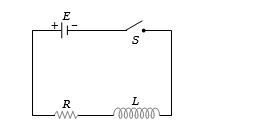
Switch $S$ of the circuit shown in figure. is closed at $t = 0$. If e denotes the induced emf in $L$ and i, the current flowing through the circuit at time $t $, which of the following graphs is correct
Two forces $P + Q$ and $P -Q$ make angle $2 \alpha$ with each other and their  resultant make $\theta$ angle with bisector of angle between them. Then :
The wavelength of the radiation emitted is $\lambda_0$ when an electron jumps from the second excited state to the first excited state of hydrogen atom. If the electron jumps from the third excited state to the second orbit of the hydrogen atom, the wavelength of the radiation emitted will be $\frac{20}{x} \lambda_0$. The value of $x$ is $........$
The isothermal bulk modulus of a gas at atmospheric pressure is