The displacement y of a particle executing periodic motion is given by $y = 4{\cos ^2}(t/2)\sin (1000t)$. This expression may be considered to be a result of the superposition of ........... independent harmonic motions
IIT 1992, Diffcult
Download our app for free and get started
(b)$y = 4{\cos ^2}\left( {\frac{t}{2}} \right)\sin 1000\;t$
$ \Rightarrow y = 2(1 + \cos t)\sin 1000\;t$
$ \Rightarrow y = 2\sin 1000\;t + 2\cos t\;\sin 1000t$
$ \Rightarrow y = 2\sin 1000\;t + \sin 999\;t + \sin 1001\;t$
It is a sum of three $S.H.M.$
$ \Rightarrow y = 2(1 + \cos t)\sin 1000\;t$
$ \Rightarrow y = 2\sin 1000\;t + 2\cos t\;\sin 1000t$
$ \Rightarrow y = 2\sin 1000\;t + \sin 999\;t + \sin 1001\;t$
It is a sum of three $S.H.M.$

Download our appand get started for free
Experience the future of education. Simply download our apps or reach out to us for more information. Let's shape the future of learning together!No signup needed.*
Similar Questions
- 1A particle executes simple harmonic motion according to equation $4 \frac{d^2 x}{d t^2}+320 x=0$. Its time period of oscillation is .........View Solution
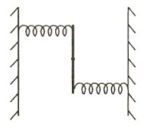
- 2A uniform rod of length $L$ and mass $M$ is pivoted at the centre. Its two ends are attached to two springs of equal spring constants $k$. The springs are fixed to rigid supports as shown in the figure, and the rod is free to oscillate in the horizontal plane. The rod is gently pushed through a small angle $\theta$ in one direction and released. The frequency of oscillation isView Solution
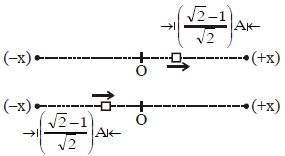
- 3Two bodies performing $SHM$ have same amplitude and frequency. Their phases at a certain instant are as shown in the figure. The phase difference between them isView Solution
- 4A particle executes simple harmonic motion according to equation $4 \frac{d^2 x}{d t^2}+320 x=0$. Its time period of oscillation is .........View Solution
- 5A bead of mass $m$ is attached to the mid-point of a tant, weightless string of length $l$ and placed on a frictionless horizontal table.Under a small transverse displacement $x$, as shown in above figure. If the tension in the string is $T$, then the frequency of oscillation isView Solution
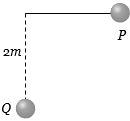
- 6A pendulum of length $2\,m$ lift at $P$. When it reaches $Q$, it losses $10\%$ of its total energy due to air resistance. The velocity at $Q$ is .... $m/sec$View Solution
- 7The kinetic energy and the potential energy of a particle executing $S.H.M.$ are equal. The ratio of its displacement and amplitude will beView Solution
- 8The angular frequency of the damped oscillator is given by, $\omega = \sqrt {\left( {\frac{k}{m} - \frac{{{r^2}}}{{4{m^2}}}} \right)} $ where $k$ is the spring constant, $m$ is the mass of the oscillator and $r$ is the damping constant. If the ratio $\frac{{{r^2}}}{{mk}}$ is $8\%$, the change in time period compared to the undamped oscillator is approximately as followsView Solution
- 9$Assertion :$ Resonance is a special case of forced vibration in which the natural frequency of vibration of the body is the same as the impressed frequency of external periodic force and the amplitude of forced vibration is maximum.View Solution
$Reason :$ The amplitude of forced vibrations of a body increases with an increase in the frequency of the externally impressed periodic force. - 10A $3\ kg$ sphere dropped through air has a terminal speed of $25\ m/s$. (Assume that the drag force is $-bv$.) Now suppose the sphere is attached to a spring of force constant $k = 300\ N/m$, and that it oscillates with an initial amplitude of $20\ cm$. What is the angular frequencu of its damped $SHM$? ..... $rad/s$View Solution