The $K.E.$ and $P.E.$ of a particle executing $SHM$ with amplitude $A$ will be equal when its displacement is
Medium


Download our appand get started for free
Experience the future of education. Simply download our apps or reach out to us for more information. Let's shape the future of learning together!No signup needed.*
Similar Questions
- 1Two particles $P$ and $Q$ start from origin and execute Simple Harmonic Motion along $X-$axis with same amplitude but with periods $3$ seconds and $6$ seconds respectively. The ratio of the velocities of $ P$ and $Q$ when they meet isView Solution
- 2The displacement $x$ (in metres) of a particle performing simple harmonic motion is related to time $t$ (in seconds) as $x = 0.05\cos \left( {4\,\pi \,t + \frac{\pi }{4}} \right)$. The frequency of the motion will be ..... $Hz$View Solution
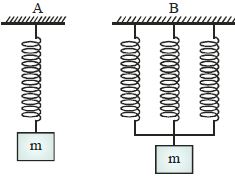
- 3The springs in figure. $A$ and $B$ are identical but length in $A$ is three times that in $B$. The ratio of period $T_A/T_B$ isView Solution
- 4The maximum velocity and the maximum acceleration of a body moving in a simple harmonic oscillator are $2\,m/s$ and $4\,m/{s^2}.$ Then angular velocity will be ..... $rad/sec$View Solution
- 5If a simple harmonic oscillator has got a displacement of $0.02\, m$ and acceleration equal to $2.0\,m{s^{ - 2}}$ at any time, the angular frequency of the oscillator is equal to .... $rad\,{s^{ - 1}}$View Solution
- 6View SolutionThe period of a simple pendulum is doubled, when
- 7A ring is suspended from a point $S$ on its rim as shown in the figure. When displaced from equilibrium, it oscillates with time period of $1\,second.$ The radius of the ring is ..... $m$ (take $g = \pi ^2$ )View Solution

- 8View SolutionIf a watch with a wound spring is taken on to the moon, it
- 9A point particle is acted upon by a restoring force $-k x^{3}$. The time-period of oscillation is $T$, when the amplitude is $A$. The time-period for an amplitude $2 A$ will beView Solution
- 10View SolutionMark the wrong statement