MCQ
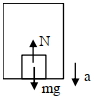
A person is standing in an elevator. In which situation, he experiences weight loss?
  • A
    When the elevator moves upward with constant acceleration
  • When the elevator moves downward with constant acceleration
  • C
    When the elevator moves upward with uniform velocity
  • D
    When the elevator moves downward with uniform velocity
Answer

Correct option: B.
When the elevator moves downward with constant acceleration
b
$mg - N = ma$

$\Rightarrow N = m ( g - a )$

$\therefore$ Person experiences weightloss, when acceleration of lift is downward.

Need a full question paper?

Generate a complete, print-ready paper with questions like this in minutes — across 16+ boards, with answer keys.

Start Generating Free

Similar questions

A cricketer can throw a ball to maximum horizontal distance of $100\,m$ . With the same speed how much high above the ground can the cricketer throw the same ball   ......... $m$
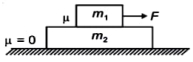
In the given arrangement the maximum value of $F$ for which there is no relative motion between the blocks
When $100\,g$ of a liquid $A$ at $100\,^oC$ is added to $50\,g$ of a liquid $B$ at temperature $75\,^oC$, the temperature of the mixture becomes $90\,^oC$. The temperature of the mixture, if $100\,g$ of liquid $A$ at $100\,^oC$ is added to $50\,g$ of liquid $B$ at $50\,^oC$, will be ........$^oC$
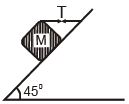
A block of mass $15 \,kg $ is resting on a rough inclined plane as shown in figure. The  block is tied up by a horizontal string which has tension of $50\,N$. The minimum  coefficient of friction between the surfaces of contact is $(g = 10\,m/s^2)$
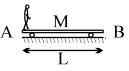
The figure shows a man of mass $m$ standing at the end $A$ of a trolley of mass $M$ placed at rest on a smooth horizontal surface. The man starts moving towards the end $B$ with a velocity urel with respect to the trolley. The length of the trolley is $L$. Choose the correct statement
A vibratory motion is represented by $x = 2\,A\,\cos \,\omega t + A\,\cos \,\left( {\omega t + \frac{\pi }{2}} \right) + A\,\cos \,\left( {\omega t + \pi } \right) + \frac{A}{2}\,\cos \,\left( {\omega t + \frac{{3\pi }}{2}} \right)$ The resultant amplitude of motion is
If displacement $x$ and velocity $v$ are related as $4v^2 = 16\, -\, x^2$ in a $SHM$ . Then time period of given $SHM$ is (consider $SI\,units$ )
The absolute zero is the temperature at which
The root mean square speed of the molecules of a gas is
When a particle moves in a uniform circular motion. It has