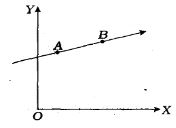
- A$20\,m/s$
- B$\frac{{20}}{{\sqrt 3 }}\,m/s$
- C$10\sqrt 3\,m/s $
- ✓$\frac{{10}}{{\sqrt 3 }}\,m/s$
$=\frac{20}{\sqrt{3}} \times \frac{1}{2}=\frac{10}{\sqrt{3}} \mathrm{m} / \mathrm{s}$
Generate a complete, print-ready paper with questions like this in minutes — across 16+ boards, with answer keys.
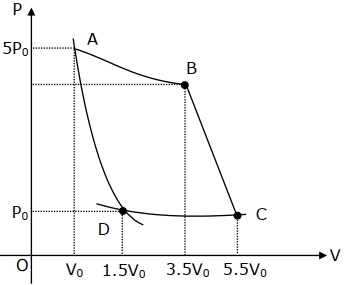
Choose the correct option out of the following for work done if processes $B C$ and $D A$ are adiabatic.

| Column $I$ | Column $II$ |
| $(A)$ The energy of the system is increased |
$(p)$ $System:$ A capacitor, initially uncharged $Process:$ It is connected to a battery |
| $(B)$ Mechanical energy is provided to the system, which is converted into energy of random motion of its parts |
$(q)$ $System:$ A gas in an adiabatic container fitted with an adiabatic piston $Process:$ The gas is compressed by pushing the piston |
| $(C)$ Internal energy of the system is converted into its mechanical energy |
$(r)$ $System:$ A gas in a rigid container $Process:$ The gas gets cooled due to colder atmosphere surrounding it |
| $(D)$ Mass of the system is decreased |
$(s)$ $System:$ A heavy nucleus, initially at rest $Process:$ The nucleus fissions into two fragments of nearly equal masses and some neutrons are emitted |
|
$(t)$ $System:$ A resistive wire loop $Process:$ The loop is placed in a time varying magnetic field perpendicular to its plane |