Question
A person standing between two vertical cliffs and is $640$ m away from the nearest cliff. He shouted and heard the first echo after $45s$ and the second echo after further $3s$. Calculate the speed of sound in air and the distance between the cliffs.
Answer

Given: $d_1 = 640m; t_1 = 4s$
$t_2 = 4 + 3 = 7$
First echo is heard from the nearest cliff.
Total distance travelled = 2d = 2 × 640 = 1280 m
$v=\frac{2 d _1}{ t _1}=\frac{1280}{4}=320 m / s$
Second echo is heard from the first cliff
$v =\frac{2 d _2}{ t _2}$
$\Rightarrow 320 ms ^{-1}=\frac{2 d _2}{7}$
$d _2=\frac{320 \times 7}{2}=1120 m$
hence, the distance between two cliff
$d_1 + d_2 = 640 + 1120 = 1760 m.$

Need a full question paper?

Generate a complete, print-ready paper with questions like this in minutes — across 16+ boards, with answer keys.

Start Generating Free

Similar questions

Draw a circuit diagram using the dual control switches to light a staircase electric light and explain its working.
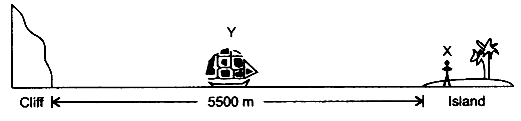
An observer $X$ is on an island $5500 m$ from a vertical cliff on the shore. A ship Y is anchored between the island and the Cliff. A blast on the ship's siren is heard twice by $X$, the interval being 5 s . [Velocity of sound $=330 ms-1$ ]

(i) Find the distance of the ship from the island.
(i) Find the distance of the cliff from the ship.
Two copper wires are of the same length, but one is thicker than the other.
  1. Which wire will have more resistance?
  2. Which wire will have more specific resistance?
(i) 50 g of ice at $0^{\circ} C$ is added to 300 g of a liquid at $30^{\circ} C$. What will be the final temperature of the mixture when all the ice has melted? The specific heat capacity of the liquid is $2.65 Jg ^{-19} C ^{-1}$ while that of water is $4.2 Jg ^{-1}{ }^{\circ} C ^{-1}$. Specific latent heat of fision of ice $=336 Jg ^{-1}$.
(ii) A metal drill of power 500 W , drills a bole in a metal cube of mass 0.25 kg in 6.5 s . If the specific heat capacity of metal cube is $130 Jkg ^{-1}{ }^{\circ} C ^{-1}$, calculate
(a) Energy generated by the drill in ls.
(b) Energy generated by the drill in 6.5 s.
(c) If $t^{\circ} C$ is the rise in temperature, state the amount of heat energy absorbed by metal cube in terms of $t$.
(d) Write down an equation and calculate the value of t .
(iii) Explain the following
(a) Water is used in hot water bottles for fomentation purposes.
(b) A wise farmer always waters his fields in the evening, if there is a forecast for frost.
(c) The specific heat of fusion of lead is $27 Jg ^{-1}$. What do you understand from the statement?
What is the purpose of fuse in an electrical circuit?
Why is specific heat capacity taken as a measure of thermal inertia?
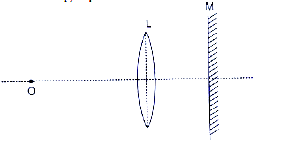
The following diagram shows the experimental set up for the determination of focal length of a lens using a plane mirror.


(i) draw two rays from the point O of the object to show the formation of image I at O itself.
(ii) What is the size of the image I?
(iii)State two more characteristics of the image I.
(iv) Name the distance of the objects O from the optical centre of the lens.
(v) To what point will the rays return if the mirror is moved away from the lens by a distance equal to the focal length of the lens ?
Name three factors on which resistance of a given wire depends and state how is it affected by the factors stated by you.
How will you verify the laws of refraction or how the refractive index of glass is determined in the laboratory?
(i) What is Earthing?
(ii) Draw a diagram showing (a) a bulb (b) a heater in a domestic household circuit, showing clearly the position of fuse, live wire, neutral wire and switches.
(iii) An electric circuit operating at 250 V has the following appliances connected in parallel and the energy cost ₹5.40 per kVAh. Calculate the monthly bill of a month of 30 days.
(a) 4 bulbs of 100 W each working 8 hours a day.
(b) Two room heaters of resistance $50 \Omega$ each, working 2 hours a day.
(c) Two air conditioners drawing current of 8 A , working 6 hours a day.