Electric Power and House hold Circuits — Physics STD 10 — Question
ICSE BoardEnglish MediumSTD 10PhysicsElectric Power and House hold Circuits5 Marks
Question
Draw a circuit diagram using the dual control switches to light a staircase electric light and explain its working.
✓
Answer
Dual control switches are the double pole type switches which are generally used at the top and bottom of a staircase, or at the opposite ends of a long corridor, etc. With such switches, the appliance (say, a bulb) can be switched on or off from, two different places.
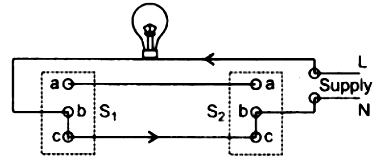
b) Bulb on through switch $S_1$
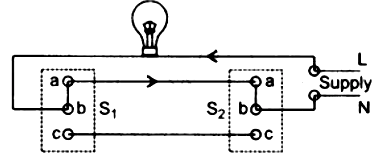
(c) Bulb on through switch $S_2$
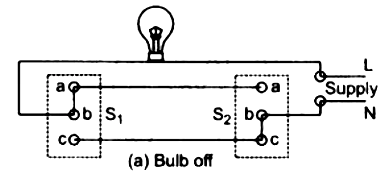
The working and circuits of a dual control switch are illustrated in Fig. a,b,c. Let a switch $S _1$ be fitted at the top of the staircase. Fig. (a) shows the off position of the bulb.
The bulb can now be switched on independently by either the switch $S _1$ or the switch $S _2$ If the switch $S _1$ is operated, the connection 'ab' is changed to 'bc', which completes the circuit and the bulb lights up [Fig. (b)]. Similarly, on operating the switch $S _2$, the connection 'bc' changes to 'ba', which again completes the circuit [Fig. (c)].
Similarly, if the bulb is in on position as shown in Fig. (b), one can switch off the bulb by changing the connections 'ab' to 'bc' either by the switch $S _1$ or the switch $S _2$.
In a staircase, while going up a person puts on the light by operating the switch $S_1$ so that the connection 'ab' changes to 'bc' and makes the current flow in the circuit. On reaching at the top of operates the switch $S _2$ to put off the light so that the connection 'cb' changes to 'ba' and the flow of current stops.
The same system is operative when a person puts on light by operating the switch $S _2$ to change the connection 'cb' to 'ba' and switch off the light by operating the switch $S _1$ to change the connection 'ab' to 'bc'.
Need a full question paper?
Generate a complete, print-ready paper with questions like this in minutes — across 16+ boards, with answer keys.