Question
A person trying to lose weight (dieter) lifts a $10kg$ mass, one thousand times, to a height of $0.5m$ each time. Assume that the potential energy lost each time she lowers the mass is dissipated.
  1. How much work does she do against the gravitational force?
  2. Fat supplies $3.8 \times 107J$ of energy per kilogram which is converted to mechanical energy with a $20\%$ efficiency rate. How much fat will the dieter use up?
Answer

Mass of the weight, m = 10kg Height to which the person lifts the weight, h = 0.5m Number of times the weight is lifted, n = 1000 Work done against gravitational force, = n(mgh) = 1000 × 10 × 9.8 × 0.5 = 49kJ Energy equivalent of 1kg of fat $= 3.8 \times 10^7J$ Efficiency rate = 20% Mechanical energy supplied by the person’s body, $=\frac{20}{100} × 3.8 × 107\text{J}$
$=\frac{1}{5} × 3.8 × 107\text{J}$ Equivalent mass of fat lost by the dieter, $=\Bigg[\frac{1}{\frac{1}{5}}× 3.8 × 10^7\Bigg]× 49 × 10^3$ $=\frac{245}{3.8}×10-4 = 6.45 × 10^{-3}\text{kg}$

Need a full question paper?

Generate a complete, print-ready paper with questions like this in minutes — across 16+ boards, with answer keys.

Start Generating Free

Similar questions

Use the formula $\text{v}=\sqrt{\frac{\gamma\text{P}}{\rho}}$ to explain why the speed of sound in air:
Is independent of pressure,
Demonstrate free forced and resonant oscillations.
A rod of length L has a total charge Q distributed uniformly along its length. It is bent in the shape of a semicircle. Find the magnitude of the electric field at the centre of curvature of the semicircle.
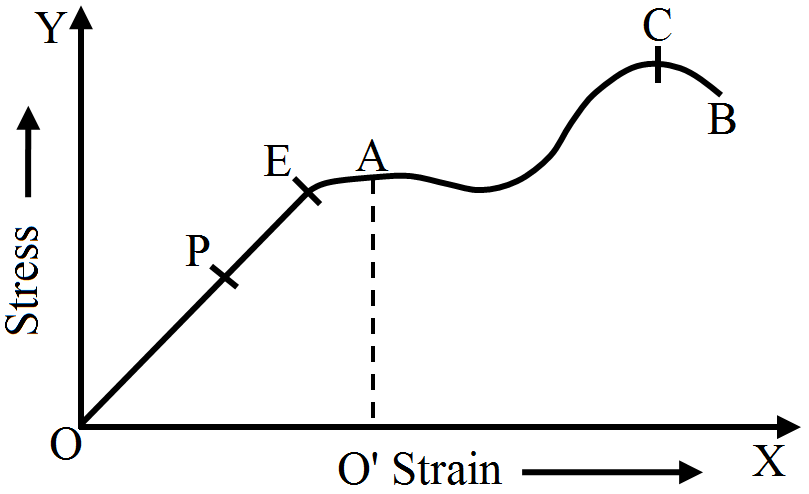
The Stress-Strain graph for a metal wire is shown in the figure upto the point E. The wire returns to its original state O along the curve EPO when it is gradually unloaded. Point B corresponds to the fracture of the wire:
  1. Upto what point of the curve is Hooke's law obeyed?
  2. Which point on the curve corresponds to the elastic limit or yield point of the wire?
  3. Indicate the elastic and plastic regions of the Stress-Strain graph.
  4. Describe what happens when the wire is loaded upto a stress corresponding to the point A on the graph, and then unloaded gradually. In particular, explain, the dotted curve.
  5. What is peculiar about the portion of the Stress-Strain graph from C to B? Upto what stress can the wire be subjected without causing fracture?
A satellite is projected vertically upwards from an earth station. At what height above the earth's surface will the force on the satellite due to the earth be reduced to half its value at the earth station? (Radius of the earth is 6400km.)
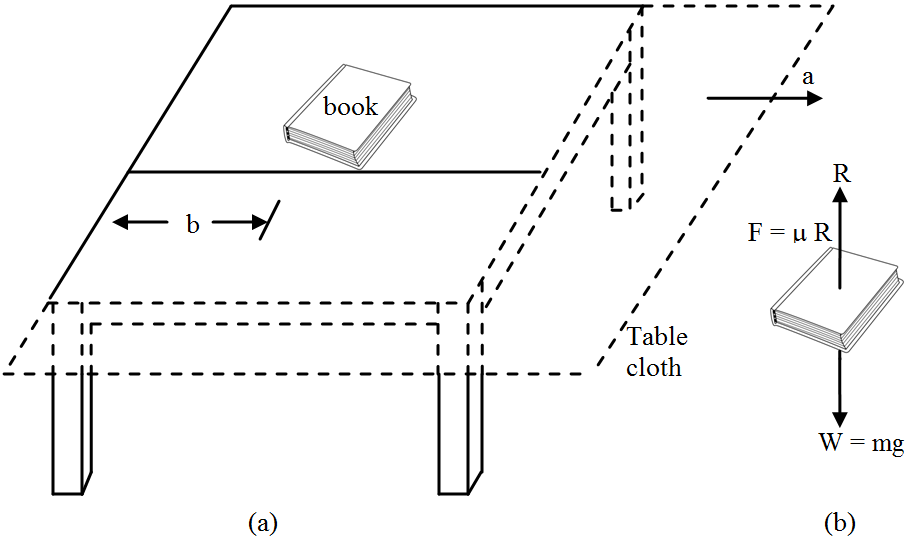
A book rests on a table cloth spread over a table as shown in Fig. The centre of the book is at a distance of b from the edge of the table at time t = 0; the table cloth is suddenly pulled at this instant with an acceleration a. Show that the cloth will slip from under the book if a > µ g, where u is the coefficient of sliding friction between the table cloth and the book. Assuming this condition to be satisfied. calculate:
  1. Time instant.
  2. The velocity.
  3. The distance of the centre of the book from the edge of the table when the edge of the table cloth passes over the centre of the book.
What are reversible and irreverssible processes? What are their essential conditions? Explain with examples.
A body of mass $12kg$ is suspended by coil spring of natural length $50cm$ and force constant $2.0 \times 10^3Nm^{-1}$. What is the stretched length of the spring? If the body is pulled down further strething the spring to a length of $5.9cm$ and then released, then what is the frequency of oscillation of the suspended mass? (Neglect the mass of the spring)
Establish the following vector inequalities geometrically or otherwise: $|\text{a}-\text{b}|\le|\text{a}|+|\text{b}|$ When does the equality sign above apply?
The half-life of ${ }^{40} \mathrm{~K}$ is $1.30 \times 10^9 \mathrm{y}$. A sample of 1.00 g of pure KCl gives 160 counts/s. Calculate the relative abundance of ${ }^{40} \mathrm{~K}$ (fraction of ${ }^{40} \mathrm{~K}$ present) in natural potassium.