Question
Use the formula $\text{v}=\sqrt{\frac{\gamma\text{P}}{\rho}}$ to explain why the speed of sound in air:
Is independent of pressure,

Answer

Take the relation:
$\text{v}=\sqrt{\frac{\gamma\text{P}}{\rho}}\ \dots(\text{i})$
where,
Density, $\rho=\frac{\text{Mass}}{\text{Volume}}=\frac{\text{M}}{\text{V}}$
M = Molecular weight of the gas
V = Volume of the gas
Hence, equation (i) reduces to:
$\text{v}=\sqrt{\frac{\gamma\text{PV}}{\text{M}}}\ \dots(\text{ii})$
Now from the ideal gas equation for n = 1:
PV = RT
For constant T, PV = Constant
Since both M and $\gamma$ are constants, v = Constant
Hence, at a constant temperature, the speed of sound in a gaseous medium is independent of the change in the pressure of the gas.

Need a full question paper?

Generate a complete, print-ready paper with questions like this in minutes — across 16+ boards, with answer keys.
Start Generating Free

Similar questions

Prove that when the vector sum of all external forces acting on a system is zero, then the center of mass remains constant.
A hoop of radius $2m$ weighs $100kg$. It rolls along a horizontal floor so that its centre of mass has a speed of $20cm/s$. How much work has to be done to stop it?
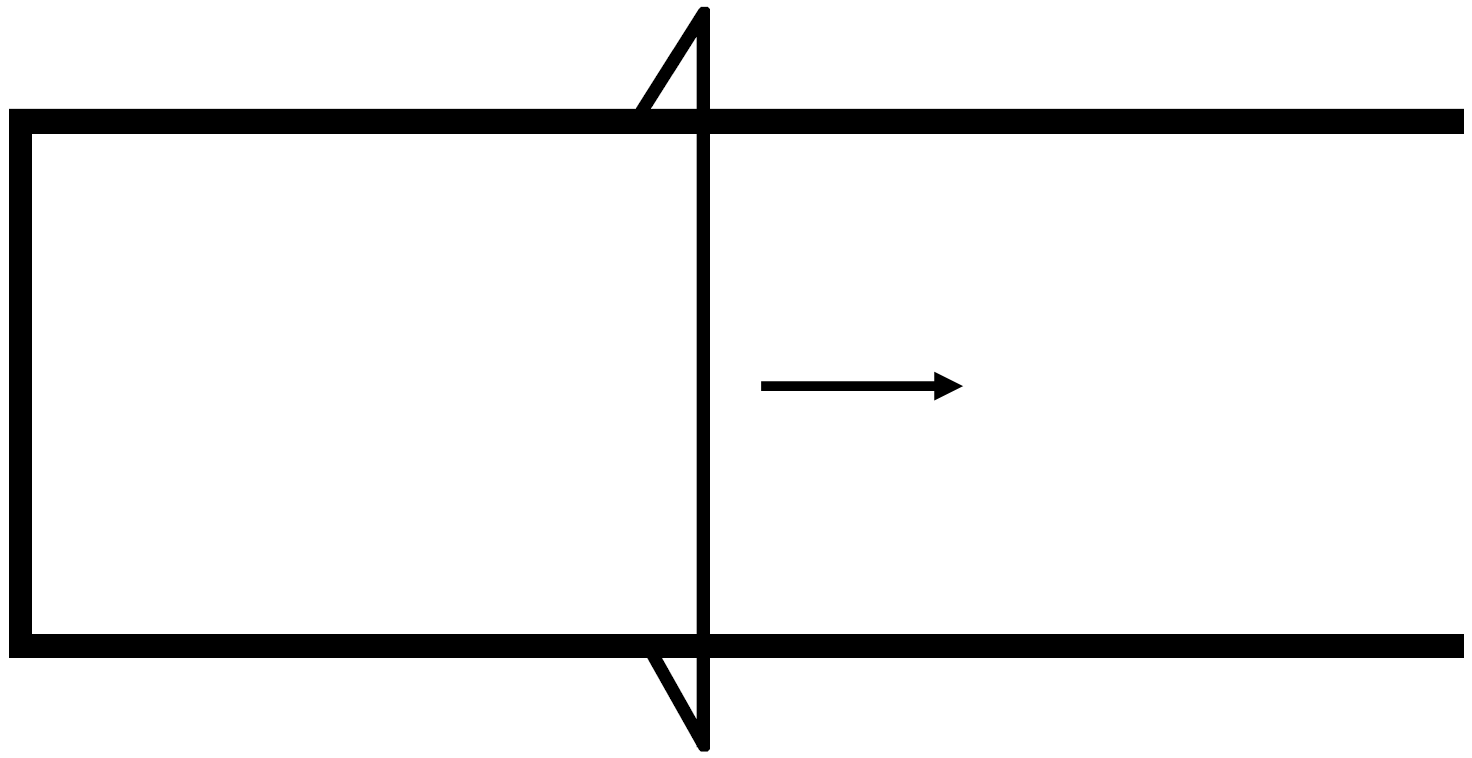
Figure shows a metallic wire of resistance $0.20\Omega$ sliding on a horizontal, U-shaped metallic rail. The separation between the parallel arms is $20cm$. An electric current of $2.0\mu\text{A}$ passes through the wire when it is slid at a rate of $20cms^{-1}$. If the horizontal component of the earth's magnetic field is $3.0 \times 10^{-5} T$, calculate the dip at the place.
A particle of mass m moving with an initial velocity u collides in elastically with a particle of mass M initially at rest. If the collision is completely inelastic, then find expressions for:
  1. Final velocity of combined entity and
  2. Loss in kinetic energy during collision.
Two small spheres, each having a mass of 20g, are suspended from a common point by two insulating strings of length 40cm each. The spheres are identically charged and the separation between the balls at equilibrium is found to be 4cm. Find the charge on each sphere.
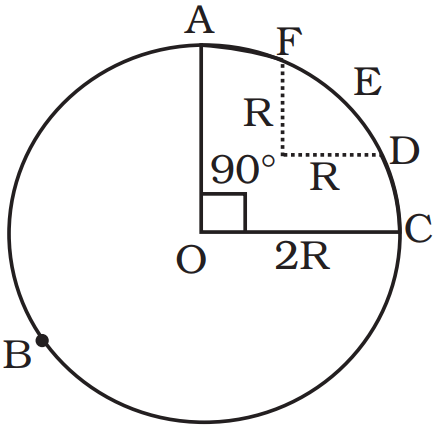
A racing car travels on a track (without banking) ABCDEFA ABC is a circular arc of radius 2 R. CD and FA are straight paths of length R and DEF is a circular arc of radius $R = 100 m$. The co-effecient of friction on the road is $\mu = 0.1.$ The maximum speed of the car is $50m s^{–1}$. Find the minimum time for completing one round.
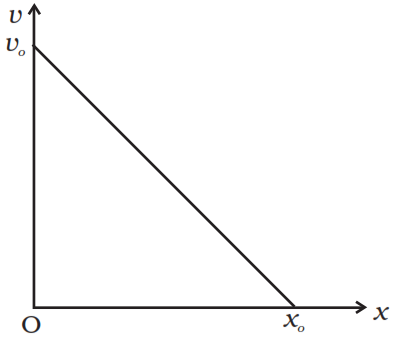
The velocity-displacement graph of a particle is shown in Fig.
  1. Write the relation between v and x.
  2. Obtain the relation between acceleration and displacement and plot it.
A stone of mass m tied to the end of a string revolves in a vertical circle of radius R. The net forces at the lowest and highest points of the circle directed vertically downwards are: [Choose the correct alternative]
 
Lowest Point
Highest Point
(a)
$mg - T_1$
$mg + T_2$
(b)
$mg + T_1$
$mg - T_2$
(c)
$mg + T_1 - (mv_1^2)/R$
$mg - T_2 + (mv_1^2)/R$
(d)
$mg - T_1 - (mv_1^2)/R$
$mg + T_2 + (mv_1^2)/R$
$T_1$ and $v_1$ denote the tension and speed at the lowest point. $T_2$ and $v_2$​​​​​​​ denote corresponding values at the highest point.
The ratio of the coefficients of thermal conductivity of two different materials is 4 : 3. If the thermal resistance of the rods of the same thickness of these materials is same, then what is the ratio of the lengths of these rods?
Solve the previous problem if the coefficient of restitution is e. Use $\theta=45^\circ,\ \text{e}=\frac{3}{4}$ and h = 5m