Two blocks $A$ and $B$ of masses $m_A = 1\,kg$ and $m_B = 3\,kg$ are kept on the table as shown in figure. The coefficient of friction between $A$ and $B$ is $0.2$ and between $B$ and the surface of the table is also $0.2.$ The maximum force $F$ that can be applied on $B$ horizontal, so that the block $A$ does not slide over the block $B$ is ........ $N$. [Take $g = 10\,m/s^2$ ]
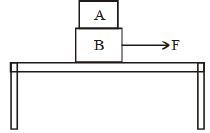
JEE MAIN 2019, Diffcult



Download our appand get started for free
Experience the future of education. Simply download our apps or reach out to us for more information. Let's shape the future of learning together!No signup needed.*
Similar Questions
- 1A coin placed on a rotating table just slips when it is placed at a distance of $1\,cm$ from the center. If the angular velocity of the table in halved, it will just slip when placed at a distance of from the centre $............\,cm$View Solution
- 2The coefficient of friction between the tyres and the road is $0.25$. The maximum speed with which a car can be driven round a curve of radius $40 \,m$ without skidding is ........ $ms^{-1}$ (assume $g = 10 \,ms^{-2}$)View Solution
- 3A block of mass $2\,kg$ moving on a horizontal surface with speed of $4\,ms ^{-1}$ enters a rough surface ranging from $x =0.5\,m$ to $x =1.5\,m$. The retarding force in this range of rough surface is related to distance by $F =- kx$ where $k =12\,Nm ^{-1}$. The speed of the block as it just crosses the rough surface will be ........... $\,ms ^{-1}$View Solution
- 4A marble block of mass $2\, kg$ lying on ice when given a velocity of $6\, m/s$ is stopped by friction in $10s$. Then the coefficient of friction is-View Solution
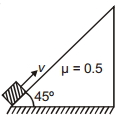
- 5A block of mass $1 \,kg$ is projected from the lowest point up along the inclined plane. If $g=10 \,ms ^{-2}$, the retardation experienced by the block is ............. $ms ^ {-2}$View Solution
- 6View SolutionA cube is resting on an inclined plane. What must be the value of coefficient of friction between cube and plane so that cube topples before sliding
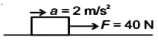
- 7A block of mass $10 \,kg$. moving with acceleration $2 \,m / s ^2$ on horizontal rough surface is shown in figure The value of coefficient of kinetic friction is ...........View Solution
- 8Abody is placed on a rough inclined plane of inclination $\theta$ .As the angle $\theta$ is increased from $0^o$ to $90^o$ the contact force between the block and the planeView Solution
- 9$Assertion$ : There is a stage when frictional force is not needed at all to provide the necessary centripetal force on a banked road.View Solution
$Reason$ : On a banked road, due to its inclination the vehicle tends to remain inwards without any chances of skidding. - 10A body of mass $\mathrm{m}$ is kept on a rough horizontal surface (coefficient of friction $=\mu$ ) A horizontal force is applied on the body, but it does not move. The resultant of normal reaction and the frictional force acting on the object is given by $\mathrm{F},$ where $\mathrm{F}$ isView Solution