MCQ
A photo cell is a device which:
- AAbsorbs light and produces a stream of electrons
- BAbsorb a stream of electron and produces light
- CConverts protons into photons
- DConverts photons into protons
Explanation:
Photocell is a device which converts light energy into electrical energy. In photocell concave metallic cathode absorbs photons from incident light waves and emits electron from the metal surface towards anode.
In other words, it absorbs light and produces a stream of electrons.
Generate a complete, print-ready paper with questions like this in minutes — across 16+ boards, with answer keys.
In Millikan's oil drop experiment an oil drop carrying a charge Q is held stationary by a potential difference 2400 V between the plates. To keep a drop of half the radius stationary the potential difference had to be made 600 V. What is the charge on the second drop
|
(a) |
(b) |
(c) Q |
(d) |
Six equal resistances are connected between points P, Q and R as shown in the figure. Then the net resistance will be maximum between

|
(a) P and Q |
(b) Q and R |
(c) P and R |
(d) Any two points |
The figures represent three cases of a ray passing through a prism of angle A. The case corresponding to minimum deviation is
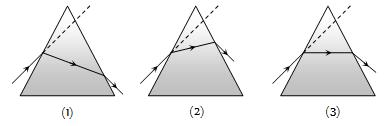
|
(a) 1 |
(b) 2 |
(c) 3 |
(d) None of these |
Which of the following has the mass closest in value to that of the positron (1 a.m.u = 931 Mev)
|
(a) Proton |
(b) Electron |
(c) Photon |
(d) Neutrino |
The output current versus time curve of a rectifier is shown in the figure. The average value of the output current in this case is
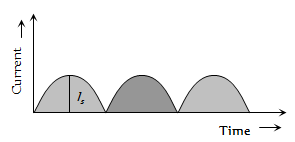
|
(a) 0 |
(b) i0/p |
(c) 2i0/p |
(d) i0 |


