MCQ
A photoelectric material having work-function $\phi_0$ is illuminated with light of wavelength $\lambda\left(\lambda<\frac{\mathrm{hc}}{\phi_0}\right)$. The fastest photoelectron has a de Broglie wavelength $\lambda_d$. A change in wavelength of the incident light by $\Delta \lambda$ results in change $\Delta \lambda_{\mathrm{d}}$ in $\lambda_{\mathrm{d}}$. then the ratio $\Delta \lambda_{\mathrm{d}} / \Delta \lambda$ is proportional to
  • A
    $\lambda_d / \lambda$
  • B
    $\lambda_{\mathrm{d}}^2 / \lambda$
  • C
    $\lambda_d^3 / \lambda$
  • $\lambda_{\mathrm{d}}^3 / \lambda^2$

Answer

Correct option: D.
$\lambda_{\mathrm{d}}^3 / \lambda^2$
d
$\frac{\mathrm{P}^2}{2 \mathrm{~m}}=\frac{\mathrm{hc}}{\lambda}-\phi_0$

$\frac{\mathrm{h}^2}{2 \mathrm{~m} \cdot \lambda_{\mathrm{D}}^2}=\frac{\mathrm{hc}}{\lambda}-\phi_0$

$-\frac{\mathrm{h}^2}{\mathrm{~m}} \frac{1}{\lambda_{\mathrm{D}}^3} \mathrm{~d} \lambda_{\mathrm{D}}=\frac{\mathrm{hc}}{\lambda^2} \mathrm{~d} \lambda$

$\frac{\Delta \lambda_{\mathrm{D}}}{\Delta \lambda} \propto \frac{\lambda_{\mathrm{D}}^3}{\lambda^2}.$

Need a full question paper?

Generate a complete, print-ready paper with questions like this in minutes — across 16+ boards, with answer keys.

Start Generating Free

Similar questions

Continuous spectrum is not due to
A plano-convex lens when silvered in the plane side behaves like a concave mirror of focal length 30cm. However, when silvered on the convex side it behaves like a concave mirror of focal length 10 cm. Then the refractive index of its material will be
The pressure in a liquid at two points in the same horizontal plane are equal. Consider an elevator accelerating upward and a car accelerating on a horizontal road. The above statement is correct in:
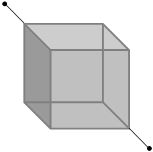
Twelve wires of equal length and same cross-section are connected in the form of a cube. If the resistance of each of the wires is $R$, then the effective resistance between the two diagonal ends would be
Why high temperature is required for Nuclear fusion?
Photon of $5.5 eV$ energy fall on the surface of the metal emitting photoelectrons of maximum kinetic energy $4.0 eV$. The stopping voltage required for these electrons are .......... $V$
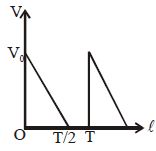
The average value of potential difference $V$ shown in figure is
A transistor is used in common emitter mode as an amplifier. Then
The rate of change of current needed to induce an emf of $8V$ in $0.1H$ coil is.
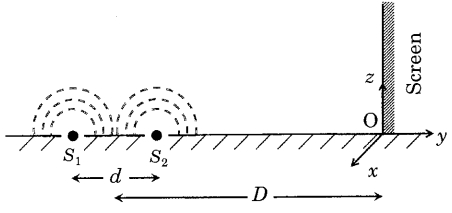
While conducting the Young's double slit experiment, a student replaced the two slits with a large opaque plate in the $x-y$ plane containing two small holes that act as two coherent point sources $\left(S_1, S_2\right)$ emitting light of wavelength $600 \mathrm{~nm}$. The student mistakenly placed the screen parallel to the $x-z$ plane (for $z>0$ ) at a distance $D=3 \mathrm{~m}$ from the mid-point of $S_1 S_2$, as shown schematically in the figure. The distance between the sources $d=0.6003 \mathrm{~mm}$. The origin $\mathrm{O}$ is at the intersection of the screen and the line joining $S_1 S_2$. Which of the following is(are) true of the intensity pattern on the screen?

($A$) Straight bright and dark bands parallel to the $x$-axis

($B$) The region very close to the point $O$ will be dark

($C$) Hyperbolic bright and dark bands with foci symmetrically placed about $\mathrm{O}$ in the $x$-direction

($D$) Semi circular bright and dark bands centered at point $\mathrm{O}$