MCQ
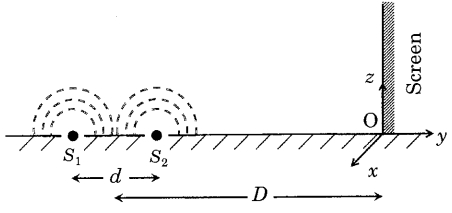
While conducting the Young's double slit experiment, a student replaced the two slits with a large opaque plate in the $x-y$ plane containing two small holes that act as two coherent point sources $\left(S_1, S_2\right)$ emitting light of wavelength $600 \mathrm{~nm}$. The student mistakenly placed the screen parallel to the $x-z$ plane (for $z>0$ ) at a distance $D=3 \mathrm{~m}$ from the mid-point of $S_1 S_2$, as shown schematically in the figure. The distance between the sources $d=0.6003 \mathrm{~mm}$. The origin $\mathrm{O}$ is at the intersection of the screen and the line joining $S_1 S_2$. Which of the following is(are) true of the intensity pattern on the screen?

($A$) Straight bright and dark bands parallel to the $x$-axis

($B$) The region very close to the point $O$ will be dark

($C$) Hyperbolic bright and dark bands with foci symmetrically placed about $\mathrm{O}$ in the $x$-direction

($D$) Semi circular bright and dark bands centered at point $\mathrm{O}$
  • $B,C$
  • B
    $B,D$
  • C
    $B,A$
  • D
    $A,C$

Answer

Correct option: A.
$B,C$
a
$(B)$ Seml clrcular bright and dark bands centred at polnt $O$

$(C)$ The reglon very close to the polnt $O$ will be dark

Since $S _1 S_2$ line is perpendicular to screen shape of pattern is concentric semicircle

$\text { At } O , \frac{2 \pi}{\lambda}\left( S _1 O - S _2 O \right)$

$=\frac{2 \pi \times 0.6003 \times 10^{-3}}{600 \times 10^{-9}}=2001 \pi$

$\therefore$ darkness close to $O$ .

Need a full question paper?

Generate a complete, print-ready paper with questions like this in minutes — across 16+ boards, with answer keys.

Start Generating Free

Similar questions

A charge q is moving in a magnetic field then the magnetic force does not depend upon
Four charges equal to – Q are placed at the four corners of a square and a charge q is at its centre. If the system is in equilibrium the value of q is
The difference between the mass of a nucleus and the combined mass of its nucleons is:
For a triode $\pi = 64$ and $gm =1600 \pi \, mho$. It is used as an amplifier and an input signal of $1V (rms)$ is applied. The signal power in the load of $40 k$ $\Omega$ will be......$mW$
The box of a pin hole camera, of length $L$, has a hole of radius $a$. It is assumed that when the hole is illuminated by a parallel beam of light of wavelength $\lambda$, the spread of the spot (obtained on the opposite wall of the camera) is the sum of its geometrical spread and the spread due to diffraction. The spot would then have its minimum size ( say $b_{min}$) when
Two electric dipoles of dipole moments $1.2 \times 10^{-30}\,cm$ and $2.4 \times 10^{-30}\,cm$ are placed in two difference uniform electric fields of strengths $5 \times 10^{4}\,NC ^{-1}$ and $15 \times 10^{4}\,NC ^{-1}$ respectively. The ratio of maximum torque experienced by the electric dipoles will be $\frac{1}{ x }$. The value of $x$ is $.....$
At neutral temperature, the thermoelectric power $\left(\frac{\mathrm{dE}}{\mathrm{dT}}\right)$ has the value
In order to quadruple the resistance of a uniform wire, a part of its length was uniformly stretched till the final length of the entire wire was 1.5 times the original length, the part of the wire was fraction equal to
Cyclotron is used to accelerate
A charged shell of radius $R$ carries a total charge $Q$. Given $\Phi$ as the flux of electric field through a closed cylindrical surface of height $h$, radius $r$ and with its center same as that of the shell. Here, center of the cylinder is a point on the axis of the cylinder which is equidistant from its top and bottom surfaces. Which of the following option(s) is/are correct ? $\in_0$ is the permittivity of free space]

$(1)$ If $h >2 R$ and $r > R$ then $\Phi=\frac{ Q }{\in_0}$

$(2)$ If $h <\frac{8 R }{5}$ and $r =\frac{3 R }{5}$ then $\Phi=0$

$(3)$ If $h >2 R$ and $r =\frac{4 K }{5}$ then $\Phi=\frac{ Q }{5 \in_0}$

$(4)$ If $h >2 R$ and $r =\frac{3 K }{5}$ then $\Phi=\frac{ Q }{5 \in_0}$