MCQ
A physical quantity $A$ is dependent on other four physical quantities $p, q, r$ and $s$ as given below $A=\frac{\sqrt{pq}}{r^2s^3} .$ The percentage error of measurement in $p, q, r$ and $s$  $1\%,$ $3\%,\,\, 0.5\%$ and $0.33\%$ respectively, then the maximum percentage error in $A$ is .......... $\%$
  • A
    $2$
  • B
    $0$
  • $4$
  • D
    $3$

Answer

Correct option: C.
$4$
c
$\frac{\Delta \mathrm{A}}{\mathrm{A}}=\frac{1}{2} \frac{\Delta \mathrm{P}}{\mathrm{P}}+\frac{1}{2} \frac{\Delta \mathrm{q}}{\mathrm{q}}+\frac{2 \Delta \mathrm{r}}{\mathrm{r}}+3 \frac{\Delta \mathrm{s}}{\mathrm{s}}$

$=0.5+1.5+1+1=4 \%$

Need a full question paper?

Generate a complete, print-ready paper with questions like this in minutes — across 16+ boards, with answer keys.

Start Generating Free

Similar questions

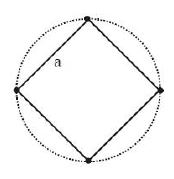
Four identical particles of mass $M$ are located at the corners of a square of side $‘a’$. What should be their speed if each of them revolves under the influence of other’s gravitational field in a circular orbit circumscribing the square?
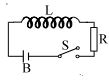
In figure, the switch $S$ is closed so that a current flows in the iron-core inductor which has inductance $L$ and the resistance $R$. When the switch is opened, $a$ spark is obtained in it at the contacts. The spark is due to
When a particle is restricted to move along $x$-axis between $x=0$ and $x=a$, where $a$ is of nanometer dimension, its energy can take only certain specific values. The allowed energies of the particle moving in such a restricted region, correspond to the formation of standing waves with nodes at its ends $x=0$ and $x=a$. The wavelength of this standing wave is related to the linear momentum $p$ of the particle according to the de Broglie relation. The energy of the particle of mass $m$ is related to its linear momentum as $E=\frac{p^2}{2 m}$. Thus, the energy of the particle can be denoted by a quantum number ' $n$ ' taking values $1,2,3, \ldots \quad(n=1$, called the ground state) corresponding to the number of loops in the standing wave.

Use the model described above to answer the following three questions for a particle moving in the line $x=0$ to $x=a$. Take $h=6.6 \times 10^{-34} \mathrm{~J} \mathrm{~s}$ and $e=1.6 \times 10^{-19} \mathrm{C}$.

$1.$ The allowed energy for the particle for a particular value of $n$ is proportional to

$(A)$ $a^{-2}$ $(B)$ $a^{-3 / 2}$ $(C)$ $a^{-1}$ $(D)$ $a^2$

$2.$ If the mass of the particle is $m=1.0 \times 10^{-30} \mathrm{~kg}$ and $a=6.6 \mathrm{~nm}$, the energy of the particle in its ground state is closest to

$(A)$ $0.8 \ \mathrm{meV}$ $(B)$ $8 \ \mathrm{meV}$ $(C)$ $80 \ \mathrm{meV}$ $(D)$ $800 \ \mathrm{meV}$

$3.$ The speed of the particle, that can take discrete values, is proportional to

$(A)$ $n^{-3 / 2}$ $(B)$ $n^{-1}$ $(C)$ $n^{1 / 2}$ $(D)$ $n$

Give the answer question $1, 2$ and $3.$
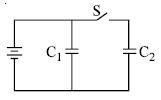
Two capacitors of equal capacitance $(C_1 = C_2)$ are shown in the figure. Initially, while the switch $S$ is open, one of the capacitors is uncharged and the other carries charge $Q_0$. The energy stored in the charged capacitor is $U_0$. Sometimes after the switch is closed, the capacitors $C_1$ and $C_2$ carry charges $Q_1$ and $Q_2$, respectively; the voltages across the capacitors are $ V_1$ and $V_2$; and the energies stored in the capacitors are $U_1$ and $U_2$. Which of the following statements is INCORRECT ? 
A long wire A carries a current of $10\, amp$. Another long wire $B$, Which is parallel to $A$ and separated by $0.1\,m$ from $A$, carries a current of $5\, amp$, in the opposite direction to that in $A$. what is the magnitude and nature of the force experienced per unit length of $B$ $({\mu _0} = 4\pi \times {10^{ - 7}}\,weber/amp{\rm{ - }}m)$
Calculate the maximum acceleration of a moving car so that a body lying on the floor of the car remains stationary. The coefficient of static friction between the body and the floor is 0.25
$\left( g =10 ms^{-2}\right)$
Which of the following must be known in order to determine the power output of an automobile?
The de Broglie wavelength of a molecule in a gas at room temperature $(300\,K )$ is $\lambda_1$. If the temperature of the gas is increased to $600\,K$, then the de Broglie wavelength of the same gas molecule becomes $..............$.
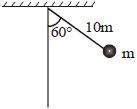
If pendulum is released from given position find velocity of Bob when it reaches the lowest position
In case of displacement method of lenses, the product of magnification in both cases is