MCQ
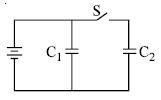
Two capacitors of equal capacitance $(C_1 = C_2)$ are shown in the figure. Initially, while the switch $S$ is open, one of the capacitors is uncharged and the other carries charge $Q_0$. The energy stored in the charged capacitor is $U_0$. Sometimes after the switch is closed, the capacitors $C_1$ and $C_2$ carry charges $Q_1$ and $Q_2$, respectively; the voltages across the capacitors are $ V_1$ and $V_2$; and the energies stored in the capacitors are $U_1$ and $U_2$. Which of the following statements is INCORRECT ? 
  • A
    $Q_0$ $=$ $\frac{1}{2}$ $(Q_1 + Q_2)$
  • B
    $Q_1 = Q_2$
  • C
    $V_1 = V_2$
  •  $U_0 = U_1 + U_2$

Answer

Correct option: D.
 $U_0 = U_1 + U_2$
d
In the above diagram, $C_{1}$ and $C_{2}$ are connected in parallel.

Hence, both get the same voltage. $\therefore V_{1}=V_{2}$ is correct.

We know that $Q_{1}=C_{1} V_{1}$ and $Q_{2}=C_{2} V_{2}$ $\because C_{1}=C_{2}, \quad Q_{1}=Q_{2}$

We know that energy $U_{1}=\frac{1}{2} C_{1} V_{1}^{2}$ and $U_{2}=\frac{1}{2} C_{2} V_{2}^{2}$

By closing the switch, the $C_{1}$ or $V_{1}$ doesn't get affected.

Hence $U_{0}=U_{1}$ and not $U_{1}+U_{2}$

Similarly, By closing the switch, the $Q_{1}$ or $V_{1}$ doesn't get affected.

Hence $Q_{0}=Q_{1}$

$\because Q_{0}=Q_{1}=Q_{2}, \quad Q_{0}=\frac{1}{2}\left(Q_{1}+Q_{2}\right)$

Thus $D$ is the only wrong statement.

Need a full question paper?

Generate a complete, print-ready paper with questions like this in minutes — across 16+ boards, with answer keys.

Start Generating Free

Similar questions

A heavy iron bar of weight $12 \mathrm{~kg}$ is having its one end on the ground and the other on the shoulder of a man. The rod makes an angle $60^{\circ}$ with the horizontal, the weight experienced by the man is :
A ring of mass $m$ and radius $r$ rotates about an axis passing through its centre and perpendicular to its plane with angular velocity $\omega$. Its kinetic energy is
Tube $A$ has both ends open while tube $B$ has one end closed, otherwise they are identical. The ratio of fundamental frequency of tube $A$ and $B$ is
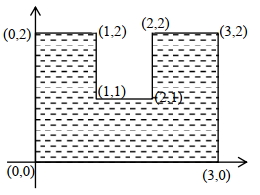
A uniform thin metal plate of mass $10 \mathrm{~kg}$ with dimensions is shown. The ratio of $x$ and $y$ coordinates of center of mass of plate in $\frac{n}{9}$. The value of $n$ is $\qquad$
A convex lens is dipped in a liquid whose refractive index is equal to the refractive index of the lens. Then its focal length will
An engine operating between the boiling and freezing points of water will have

$1.$ efficiency more than $27 \%$

$2.$ efficiency less than the efficiency a Carnot engine operating between the same two temperatures.

$3.$ efficiency equal to $27 \%$

$4.$ efficiency less than $27 \%$

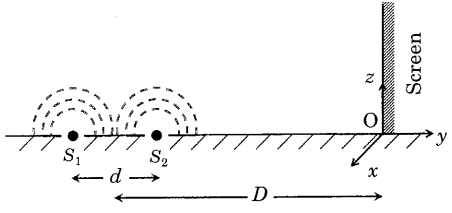
While conducting the Young's double slit experiment, a student replaced the two slits with a large opaque plate in the $x-y$ plane containing two small holes that act as two coherent point sources $\left(S_1, S_2\right)$ emitting light of wavelength $600 \mathrm{~nm}$. The student mistakenly placed the screen parallel to the $x-z$ plane (for $z>0$ ) at a distance $D=3 \mathrm{~m}$ from the mid-point of $S_1 S_2$, as shown schematically in the figure. The distance between the sources $d=0.6003 \mathrm{~mm}$. The origin $\mathrm{O}$ is at the intersection of the screen and the line joining $S_1 S_2$. Which of the following is(are) true of the intensity pattern on the screen?

($A$) Straight bright and dark bands parallel to the $x$-axis

($B$) The region very close to the point $O$ will be dark

($C$) Hyperbolic bright and dark bands with foci symmetrically placed about $\mathrm{O}$ in the $x$-direction

($D$) Semi circular bright and dark bands centered at point $\mathrm{O}$

The period of oscillation of a magnet of a vibration magnetometer is $2.45 \,s$ at one place and $4.9 \,s$ at the other. The ratio of the horizontal component of earth magnetic field at the two places is .........
Which of the following quantities has a unit but dimensionless?
$Assertion$ : The length of the day is slowly increasing.
$Reason$ : The dominant effect causing a slowdown in the rotation of the earth is the gravitational pull of other planets in the solar system.