MCQ
A physical quantity of the dimensions of length that can be formed out of $c, G$ and $\frac{e^2}{4\pi \varepsilon _0}$  is $[c$ is velocity of light, $G$ is the universal constant of gravitation and $e$ is charge $] $
  • A
    $\frac{1}{{{c^2}}}$$\sqrt {\frac{{{e^2}}}{{G4\pi \varepsilon_0}}} $
  • B
    $\frac{1}{{{c^{}}}}\frac{{G{e^2}}}{{4\pi \varepsilon_0}}$
  • $\frac{1}{{{c^2}}}$$\sqrt {\frac{{G{e^2}}}{{4\pi \varepsilon_0}}} $
  • D
    ${c^2}\;\sqrt {\frac{{G{e^2}}}{{4\pi \varepsilon_0}}} $
Answer

Correct option: C.
$\frac{1}{{{c^2}}}$$\sqrt {\frac{{G{e^2}}}{{4\pi \varepsilon_0}}} $
c
Dimensions of 
$\frac{{{e^2}}}{{4\pi {\varepsilon _0}}} = \left[ {F \times {d^2}} \right] = \left[ {M{L^3}{T^{ - 2}}} \right]$
Dimensions of $G = \left[ {{M^{ - 1}}{L^3}{T^{ - 2}}} \right]$
Dimensions of $c = \left[ {L{T^{ - 1}}} \right]$
$ l\, \propto \,{\left( {\frac{{{e^2}}}{{4\pi {\varepsilon _o}}}} \right)^p}{G^q}{c^r}$
$\therefore \left[ {{L^1}} \right] = {\left[ {M{L^3}{T^{ - 2}}} \right]^p}{\left[ {{M^{ - 1}}{L^3}{T^{ - 2}}} \right]^q}{\left[ {L{T^{ - 1}}} \right]^r}$

On comparing both sides and solving we get

$P = \frac{1}{2},\,q = \frac{1}{2}\,and\,r =  - 2$
$\therefore \,\,l = \frac{1}{{_c2}}{\left[ {\frac{{G{e^2}}}{{4\pi {\varepsilon _0}}}} \right]^{1/2}}$
 

Need a full question paper?

Generate a complete, print-ready paper with questions like this in minutes — across 16+ boards, with answer keys.

Start Generating Free

Similar questions

Two seconds after projection a projectile is travelling in a direction inclined at $30^o$ to  horizontal, after one more second it is travelling horizontally. What is the magnitude and  direction of its velocity at initial point
Two bodies of equal masses revolve in circular orbits of radii ${R_1}$ and ${R_2}$ with the same period. Their centripetal forces are in the ratio
A particle of mass $m$ is moving in a circular path of constant radius $r$ such that its centripetal acceleration $a_c$ is varying with time $t$ as, $a_c = k^2rt^2,$ the power delivered to the particle by the forces acting on it is
Two spheres of the same material have radii $1\; m$ and $4\; m$ and temperatures $4000 \;K$ and $2000 \;K$ respectively. The ratio of the energy radiated per second by the first sphere to that by the second is
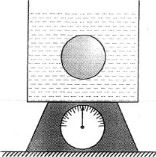
A container of mass $M$ containing liquid of mass $m_0$ is kept on weighing machine. A ball of mass $m$ is released from rest from given position. Then choose correct option just after ball is released
$70$ calories of heat are required to raise the temperature of $2$ moles of an ideal gas at constant pressure from $30°C$ to $35°C.$ The amount of heat required to raise the temperature of same gas through the same range $(30°C$ to $35°C)$ at constant volume ..... $cal$ $(R = 2 \,cal/mol/K)$
The equation of wave is given by $Y=10^{-2} \sin 2 \pi\left(160 t-0.5 x+\frac{\pi}{4}\right)$ Where $x$ and $Y$ are in $m$ and $t$ in $s$. The speed of the wave is $.....\,km h ^{-1}$
A satellite moves in a circle around the earth. The radius of this circle is equal to one half of the radius of the moon’s orbit. The satellite completes one revolution in
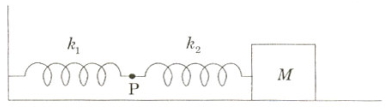
The mass $M$ shown in the figure oscillates in simple harmonic motion with amplitude $A$. The amplitude of the point $P$ is
A table tennis ball has radius $(3 / 2) \times 10^{-2} m$ and mass $(22 / 7) \times 10^{-3} kg$. It is slowly pushed down into a swimming pool to a depth of $d=0.7 m$ below the water surface and then released from rest. It emerges from the water surface at speed $v$, without getting wet, and rises up to a height $H$. Which of the following option(s) is (are) correct?

[Given: $\pi=22 / 7, g=10 ms ^{-2}$, density of water $=1 \times 10^3 kg m ^{-3}$, viscosity of water $=1 \times 10^{-3} Pa$-s.]

$(A)$ The work done in pushing the ball to the depth $d$ is $0.077 J$.

$(B)$ If we neglect the viscous force in water, then the speed $v=7 m / s$.

$(C)$ If we neglect the viscous force in water, then the height $H=1.4 m$.

$(D)$ The ratio of the magnitudes of the net force excluding the viscous force to the maximum viscous force in water is $500 / 9$.