MCQ
A physical quantity which has a direction
  • A
    must be a vector
  • B
    may be a vector
  • may be both scalar and vector
  • D
    none of the above

Answer

Correct option: C.
may be both scalar and vector
c
Time, pressure, surface tension, current, etc, are some such physical quantities which have direction but are not vectors. Hence, a physical quantity having a direction may or may not be a vector.

Need a full question paper?

Generate a complete, print-ready paper with questions like this in minutes — across 16+ boards, with answer keys.
Start Generating Free

Similar questions

In this reaction $C{H_3}CHO + HCN$$C{H_3}CH(OH)CN\xrightarrow{{{H^ + }/O{H^ - }}}C{H_3}CH(OH)COOH$ an asymmetric centre is generated. The acid obtained would be
A black hole is an object whose gravitational field is so strong that even light cannot escape from it. To what approximate radius would earth $($ mass $= 5 .98 \times \,10^{24}\, kg)$ have to be compressed to be a black hole?
Two identical charged spheres are suspended by strings of equal lengths. The strings make an angle of $30^o$ with each other. When suspended in a liquid of density $1\, g\, cm^{-3}$, the angle remains the same. If density of the material of the sphere is $4/3\, g\, cm^{-3}$, the dielectric constant of the liquid is
A small square loop of wire of side $l$ is placed inside a large circular loops of radius $r$. The loop are coplanar and their centre coincide. The mutual inductance of the system is proportional to
The threshold frequency of a metal with work function $6.63\  \mathrm{eV}$ is:
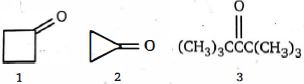
Rank the following in order of increasing value of the equilibrium constant for  hydration, $K_{hyd}$. (smallest value first).
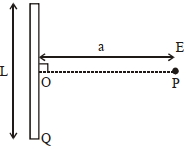
Find the electric field at point $P$ (as shown in figure) on the perpendicular bisector of a uniformly charged thin wire of length $L$ carrying a charge $Q.$ The distance of the point $P$ from the centre of the rod is $a=\frac{\sqrt{3}}{2} L$.
The energy spectrum of $\beta$-particles [number $N(E)$ as a function of $\beta$-energy $E$] emitted from a radioactive source is
If an alternating voltage is represented as $E = 141\,sin\, (628\,t),$ then the rms value of the voltage and the frequency are respectively
In a certain thermodynamical process, the pressure of a gas depends on its volume as $kV ^{3}$. The work done when the temperature changes from $100^{\circ} C$ to $300^{\circ} C$ will be .......... $nR$, where $n$ denotes number of moles of a gas.