Question
A black hole is an object whose gravitational field is so strong that even light cannot escape from it. To what approximate radius would earth $($ mass $= 5 .98 \times \,10^{24}\, kg)$ have to be compressed to be a black hole?

Answer

       Light cannot escape from a black hole, 

${v_{esc}} = c$

$\sqrt {\frac{{2GM}}{R}}  = c\,\,\,\,\,or\,\,\,\,\,\,\,R = \frac{{2GM}}{{{c^2}}}$

$R = \frac{{2 \times 6.67 \times {{10}^{ - 11}}N{m^2}k{g^{ - 2}} \times 5.98 \times {{10}^{24}}kg}}{{{{\left( {3 \times {{10}^8}\,m\,{s^{ - 1}}} \right)}^2}}}$

$ = 8.86 \times {10^{ - 3}}m \approx {10^{ - 2}}\,m$

Need a full question paper?

Generate a complete, print-ready paper with questions like this in minutes — across 16+ boards, with answer keys.
Start Generating Free

Similar questions

Two stars $P$ and $Q $ are observed at night. Star $P$ appears reddish while, star $Q$  is white. From this we conclude
An electron of charge $‘e’$ coulomb passes through a potential difference of $V$ volts. Its energy in ‘joules’ will be
A body falls freely from rest. It covers as much distance in the last second of its motion as covered in the first three seconds. The body has fallen for a time of........$s$
Time periods of oscillation of the same simple pendulum measured using four different measuring clocks were recorded as $4.62 \mathrm{~s}, 4.632 \mathrm{~s}, 4.6 \mathrm{~s}$ and $4.64 \mathrm{~s}$. The arithmetic mean of these reading in correct significant figure is.
Which one of the following statements is not correct
Ten tuning forks are arranged in increasing order of frequency in such a way that any two consecutive tuning forks produce $4$ beats per second. The highest frequency is twice that of the lowest. Possible highest and lowest frequencies (in $Hz$ ) are ................
Which of the following statements is not correct
An opera glass (Gallilean telescope) measures $9 \,cm$ from the objective to the eyepiece. The focal length of the objective is $15\, cm$. Its magnifying power is
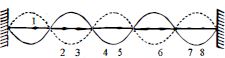
A stretched string is vibrating in its $5^{th}$ harmonic as shown. Consider a particle $1(figure)$. At an instant this particle is at mean positions and is moving towards its negative extreme. Which of the following set of particles, are in same phase with particle $1$
Two particles are executing $SHM$ in a straight line. Amplitude $'A'$ and time period $'T'$ of both the particles are equal. At time $t = 0$ one particle is at displacement $x_1 = +A$ and other at ${x_2} = \frac{{ - A}}{2}$ and they are approaching towards each other. Time after which they will cross each other is