A plane is in level flight at constant speed and each of its two wings has an area of $25 \;m ^{2}$ If the speed of the air is $180 \;km / h$ over the lower wing and $234\; km / h$ over the upper wing surface, determine the plane's mass in $kg$. (Take air density to be $1\; kg m ^{-3}$ ).
, Medium
Download our app for free and get started
The area of the wings of the plane, $A=2 \times 25=50 m ^{2}$
Speed of air over the lower wing, $V_{1}=180 km / h =50 m / s$
Speed of air over the upper wing, $V_{2}=234 km / h =65 m / s$
Density of air, $\rho=1 kg m ^{-3}$
Pressure of air over the lower wing $=P_{1}$
Pressure of air over the upper wing $=P_{2}$
The upward force on the plane can be obtained using Bernoulli's equation as:
$P_{1}+\frac{1}{2} \rho V_{1}^{2}=P_{2}+\frac{1}{2} \rho V_{2}^{2}$
$P_{1}-P_{2}=\frac{1}{2} \rho\left(V_{2}^{2}-V_{1}^{2}\right)$
The upward force ($F$) on the plane can be calculated as:
$\left(P_{1}-P_{2}\right) A$
$=\frac{1}{2} \rho\left(V_{2}^{2}-V_{1}^{2}\right) A$
$=\frac{1}{2} \times 1 \times\left((65)^{2}-(50)^{2}\right) \times 50$
$=43125 N$
Using Newton's force equation, we can obtain the mass $(m)$ of the plane as:
$F=m g$
$\therefore m=\frac{43125}{9.8}$
$=4400.51 kg$
$\sim 4400 kg$
Hence, the mass of the plane is about $4400\; kg$.

Download our appand get started for free
Experience the future of education. Simply download our apps or reach out to us for more information. Let's shape the future of learning together!No signup needed.*
Similar Questions
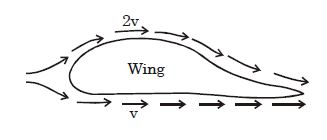
- 1The flow speeds of air on the lower and upper surfaces of the wing of an aeroplane are $v$ and $2v$ respectively. The density of air is $\rho $ and surface area of wing is $A$ . The dynamic lift on the wing isView Solution
- 2A water tank of height $10\,m$, completely filled with water is placed on a level ground. It has two holes one at $3\, m$ and the other at $7\, m$ from its base. The water ejecting fromView Solution
- 3Two stretched membranes of area $2\, cm^2$ and $3\, cm^2$ are placed in a liquid at the same depth. The ratio of pressures on them isView Solution
- 4A triangular lamina of area $A$ and height h is immersed in a liquid of density $\rho $ in a vertical plane with its base on the surface of the liquid. The thrust on the lamina isView Solution
- 5View SolutionIn Poiseuilli's method of determination of coefficient of viscosity, the physical quantity that requires greater accuracy in measurement is
- 6The terminal velocity of a copper ball of radius $5\,mm$ falling through a tank of oil at room temperature is $10\,cm\,s ^{-1}$. If the viscosity of oil at room temperature is $0.9\,kg\,m ^{-1} s ^{-1}$, the viscous drag force is :View Solution
- 7Acork of density $0.5\ gcm^{-3}$ floats on a calm swimming pool. The fraction of the cork’s volume which is under water is ........ $\%$View Solution
- 8Which of the following option correctly describes the variation of the speed $v$ and acceleration $'a'$ of a point mass falling vertically in a viscous medium that applies a force $F = -kv,$ where $'k'$ is a constant, on the body? (Graphs are schematic and not drawn to scale)View Solution
- 9View SolutionIn the case of a fluid, Bernoulli's theorem expresses the application of the principle of conservation of :
- 10The weight of a body in water is one third of its weight in air. The density of the body is ....... $g / cm ^3$View Solution