The terminal velocity of a copper ball of radius $5\,mm$ falling through a tank of oil at room temperature is $10\,cm\,s ^{-1}$. If the viscosity of oil at room temperature is $0.9\,kg\,m ^{-1} s ^{-1}$, the viscous drag force is :
NEET 2022, Easy
Download our app for free and get started
$F\,=6 \pi \eta rv$
$\quad =6 \times 3.14 \times 0.9 \times 5 \times 10^{-3} \times 10 \times 10^{-2}$
$\quad=847.8 \times 10^{-5}\,N$
$\quad=8.48 \times 10^{-3}\,N$

Download our appand get started for free
Experience the future of education. Simply download our apps or reach out to us for more information. Let's shape the future of learning together!No signup needed.*
Similar Questions
- 1A given shaped glass tube having uniform cross section is filled with water and is mounted on a rotatable shaft as shown in figure. If the tube is rotated with a constant angular velocity $\omega $thenView Solution
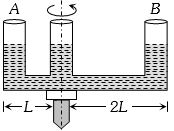
- 2The surface of water in a water tank of cross section area $750\,cm ^2$ on the top of a house is $h m$. above the tap level. The speed of water coming out through the tap of cross section area $500\,mm ^2$ is $30\,cm / s$. At that instant, $\frac{d h}{d t}$ is $x \times 10^{-3} m / s$. The value of $x$ will be $.............$.View Solution
- 3The weight of a body in water is one third of its weight in air. The density of the body is ....... $g / cm ^3$View Solution
- 4Two solid spheres $A$ and $B$ of equal volumes but of different densities $d_A$ and $d_B$ are connected by a string. They are fully immersed in a fluid of density $d_F$. They get arranged into an equilibrium state as shown in the figure with a tension in the string. The arrangement is possible only ifView Solution
$(A)$ $d_Ad_F$ $(B)$ $d_B > d_F$ $(C)$ $d_A>d_F$ $(D)$ $d_A+d_B=2 d_F$
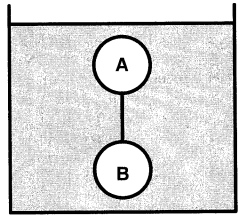
- 5Two bodies are in equilibrium when suspended in water from the arms of a balance. The mass of one body is $36 g $ and its density is $9 g / cm^3$. If the mass of the other is $48 g$, its density in $g / cm^3$ isView Solution
- 6A large tank is filled with water (density $=$ $10^3 $ $kg/m^3$).A small hole is made at a depth $10$ $m$ below water surface. The range of water issuing out of the hole is Ron ground. What extra pressure must be applied on the water surface so that the range becomes $2R $ (take $1$ $atm$ $=$ $10^5$ $Pa$ and $g$ $=$ $10$ $m/s^2):$ ...... $atm$View Solution
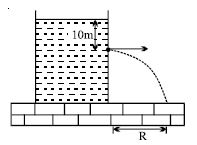
- 7In the figure shown, a liquid is flowing through a tube at the rate of $0.1\, m^3/sec$. The tube is branched into two semicircular tubes of cross-sectional area $A/3$ and $2A/3$. The velocity of liquid at $Q$ is ......... $ m/sec$ (The cross-section of the main tube $= A =10^{-2}\, m^2$ and $v_p = 20\, m/sec$)View Solution
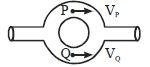
- 8View SolutionA cube of ice has a iron piece fronzen unside at. The cube floats un a beakerfilled with water, when the ice melts then, the level of water in beaker.
- 9A piston of cross-section area $100\, cm^2$ is used in a hydraulic press to exert a force of $107\, dynes$ on the water. The cross-sectional area of the other piston which supports an object having a mass $2000 \,kg$. isView Solution
- 10An aeroplane of mass $3 \times 10^4\, kg$ and total wing area of $120\, m^2$ is in a level flight at some height. The difference in pressure between the upper and lower surfaces of its wings in kilopascals is $(g=10\,m/s^2)$View Solution