MCQ
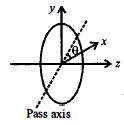
A plane polarized light is incident on a polariser with its pass axis making angle $\theta$ with $x-$ axis, as shown in the figure. At four different values of $\theta$, $\theta\, = 8^o, 38^o, 188^o$ and $218^o$, the observed intensities are same. What is the angle between the direction of polarization and $x-$ axis.....$^o$
  • $203$
  • B
    $45$
  • C
    $98$
  • D
    $128$

Answer

Correct option: A.
$203$
a
Let the angle between polarization direction and $x$ -axis be $\theta^{\prime}$

So angle between polarisation direction and pass axis of polariser is $\left(\theta^{\prime}-\theta\right)$

Given $\theta  = {8^o},{88^o},\,{188^o},\,\,{218^o}$

$\therefore I=I_{o} \cos ^{2}\,\left(\theta^{\prime}-\theta\right)$

For $\theta^{\prime}=203^o$ intensities are same

Need a full question paper?

Generate a complete, print-ready paper with questions like this in minutes — across 16+ boards, with answer keys.

Start Generating Free

Similar questions

An object has image thrice of its original size when kept at 8 cm and 16 cm from a convex lens. Focal length of the lens is
The nearest distance between two atoms in case of a $ bcc $ lattice is equal to
A loop of flexible wire of irregular shape carrying current is placed in an external magnetic field. Identify the effect of the field on the wire.
The plate current in a diode is zero. It is possible that:
An electron of mass m and charge q is travelling with a speed v along a circular path of radius r at right angles to a uniform of magnetic field B. If speed of the electron is doubled and the magnetic field is halved, then resulting path would have a radius of
The intensity of electric field required to balance a proton of mass $1.7 \times 10^{-27} \mathrm{~kg}$ and charge $1.6 \times 10^{-19} \mathrm{C}$ is nearly
In Young’s experiment, the distance between slits is $0.28 \,mm$ and distance between slits and screen is $1.4 \,m.$ Distance between central bright fringe and third bright fringe is $0.9 \,cm$. What is the wavelength of used light....$\mathop A\limits^o $
In the figure is shown Young's double slit experiment. Q is the position of the first bright fringe on the right side of O . P is the $11^{\text {th }}$ fringe on the other side, as measured from Q . If the wavelength of the light used is $6000 \times 10^{-10} m$ then $S_1 B$ will be equal to
Two metal spheres of capacitances $C_1$ and $C_2$ carry some charges. They are put in contact and then separated. The final charges $Q_1$ and $Q_2$ on them will satisfy:
A coil of wire having finite inductance and resistance has a conducting ring placed coaxially within it. The coil is connected to a battery at time t = 0, so that a time-dependent current $I_1(t)$ starts flowing through the coil. If $I_2(t)$ is the current induced in the ring. and B(t) is the magnetic field at the axis of the coil due to $I_1(t)$, then as a function of time (t > 0), the product $I_2$ (t) B(t)