MCQ 11 Mark
If the monochromatic source in Young's double slit experiment is replaced by white light, then
- A
There will be a central dark fringe surrounded by a few coloured fringes
- ✓
There will be a central bright white fringe surrounded by a few coloured fringes
- C
All bright fringes will be of equal width
- D
Interference pattern will disappear
AnswerCorrect option: B. There will be a central bright white fringe surrounded by a few coloured fringes
b
At central point on screen, path difference is zero for all wavelength. So, central bright fringe is white and other fringes depend on wavelength as $\beta=\frac{\lambda D}{d}$.
Therefore, other fringes will be coloured.
View full question & answer→MCQ 21 Mark
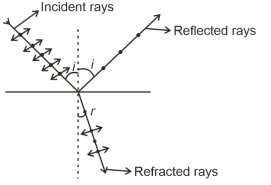
An unpolarised light beam strikes a glass surface at Brewster's angle. Then
- A
The refracted light will be completely polarised.
- B
Both the reflected and refracted light will be completely polarised.
- ✓
The reflected light will be completely polarised but the refracted light will be partially polarised.
- D
The reflected light will be partially polarised.
AnswerCorrect option: C. The reflected light will be completely polarised but the refracted light will be partially polarised.
c
According to Brewster's law, reflected rays are completely polarized and refracted rays are partially polarized.
View full question & answer→MCQ 31 Mark
For Young's double slit experiment, two statements are given below :
Statement $I:$ If screen is moved away from the plane of slits, angular separation of the fringes remains constant.
Statement $II:$ If the monochromatic source is replaced by another monochromatic source of larger wavelength, the angular separation of fringes decreases.
In the light of the above statements, choose the correct answer from the options given below :
- A
Statement $I$ is false but Statement $II$ is true
- B
Both Statement $I$ and Statement $II$ are true
- C
Both Statement $I$ and Statement $II$ are false
- ✓
Statement $I$ is true but Statement $II$ is false
AnswerCorrect option: D. Statement $I$ is true but Statement $II$ is false
d
Angular width, $\theta_w=\frac{\lambda}{d}$
$\theta_w$ independent of $D$ but depends on $\lambda$
View full question & answer→MCQ 41 Mark
In a Young's double slit experiment, a student observes $8$ fringes in a certain segment of screen when a monochromatic light of $600\,nm$ wavelength is used. If the wavelength of light is changed to $400\,nm$, then the number of fringes he would observe in the same region of the screen is:
Answerc
$y=(n \lambda)\left(\frac{D}{d}\right)$
$n _{1} \lambda_{1}= n _{2} \lambda_{2}$
$(8)$ $(600 nm )= n _{2}(400)$
$n _{2}=12$
View full question & answer→MCQ 51 Mark
If the screen is moved away from the plane of the slits in a Young's double slit experiment, then the
- A
angular separation of the fringes increases
- B
angular separation of the fringes decreases
- ✓
linear separation of the fringes increases
- D
linear separation of the fringes decreases
AnswerCorrect option: C. linear separation of the fringes increases
c
Linear fringe width is given as $=\frac{\lambda D}{d}$
When Screen is moving away from slits then $D$ increases, so that fringe width increases.
View full question & answer→MCQ 61 Mark
After passing through a polariser a linearly polarised light of intensity $I$ is incident on an analyser making an angle of $30^{\circ}$ with that of the polariser. The intensity of light emitted from the analyser will be
- A
$\frac{I}{2}$
- B
$\frac{ I }{3}$
- ✓
$\frac{3 I}{4}$
- D
$\frac{2 I}{3}$
AnswerCorrect option: C. $\frac{3 I}{4}$
c
According to Malus law
$I_2=I_1 \cos ^2 \theta$
Where $I_1$ is incident Polarised light
$I _2= I \cos ^2 30= I \left(\frac{\sqrt{3}}{2}\right)^2$
$I _2=\frac{3 I }{4}$
View full question & answer→MCQ 71 Mark
In Young's double slit experiment, if the separation between coherent sources is halved and the distance of the screen from the coherent sources is doubled, then the fringe width becomes:
Answerd
$\beta=\frac{\lambda D}{d}$
$\beta^{\prime}=\frac{\lambda D^{\prime}}{d^{\prime}}$
$D ^{\prime}=2 D , d ^{\prime}=\frac{ d }{2}$
$\beta^{\prime}=\frac{\lambda \times 2 D}{d / 2}=\frac{4 \lambda D}{d}$
$\beta^{\prime}=4 \beta$
Fringe with becomes $4$ times
View full question & answer→MCQ 81 Mark
The Brewsters angle ${i }_{b}$ for an interface should be
- A
$i _{ b }=90^{\circ}$
- B
$0^{\circ}< i _{ b }<30^{\circ}$
- C
$30^{\circ}< i _{ b }<45^{\circ}$
- ✓
$45^{\circ}< i_{ b }<90^{\circ}$
AnswerCorrect option: D. $45^{\circ}< i_{ b }<90^{\circ}$
d
$\tan i_b =\frac{\mu_{2}}{\mu_{1}}=\frac{\mu_{2}}{1}$
$\mu_{2}>1$
$\therefore \tan i _{ b }>1$
$\therefore 90^{\circ}> i _{ b }>45^{\circ}$
View full question & answer→MCQ 91 Mark
Two coherent sources of light interfere and produce fringe pattern on a screen. For central maximum, the phase difference between the two waves will be,
- A
$\frac {\pi}{2}$
- ✓
$0$
- C
$\pi$
- D
$\frac {3\pi}{2}$
Answerb
For central maximum, path difference is zero hence phase difference for coherent sources of light will be zero.
$\because 0=\frac{2 \pi}{\lambda} \Delta x$
where $\Delta x$ is path difference and $\phi$ is phase difference.
View full question & answer→MCQ 101 Mark
Assume that light of wavelength $600\, nm$ is coming from a star. The limit of resolution of telescope whose objective has a diameter of $2\, m$ is $......... \times 10^{-7}\;rad$
- A
$6.00$
- ✓
$3.66$
- C
$1.83$
- D
$7.32$
AnswerCorrect option: B. $3.66$
b
Limit of resolution $=\frac{1.22 \lambda}{ a }$
$=\frac{1.22 \times 6 \times 10^{-7}}{2}$
$=3.66 \times 10^{-7} rad$
View full question & answer→MCQ 111 Mark
In a double slit experiment, when light of wavelength $400\; nm$ was used, the angular width of the first minima formed on a screen placed $1 \;\mathrm{m}$ away, was found to be $0.2^{\circ} .$ What will be the angular width of the first minima, if the entire experimental apparatus is immersed in water.......$^o$ $(\mu_{water } =4 / 3 )$
- A
$0.266$
- ✓
$0.15$
- C
$0.05$
- D
$0.1$
AnswerCorrect option: B. $0.15$
b
$\theta^{\prime}=\theta / \mu$
$\therefore \theta^{\prime}=\frac{0.2^{\circ}}{4 / 3}=0.15^{\circ}$
View full question & answer→MCQ 121 Mark
Angular width of the central maxima the Fraunhofer diffraction for $\lambda=6000 \;\mathring A$ is $\theta_{0} .$ When the same slit Is lluminated by another monochromatic light, the angular wildth decreases by $30 \% .$ The wavelength of this light is.......$\mathring A$
- A
$1800$
- ✓
$4200$
- C
$6000$
- D
$420$
AnswerCorrect option: B. $4200$
b
Angular width $\propto \frac{\lambda}{\mathrm{d}} $
$\Rightarrow \frac{\theta_{0}}{0.7 \theta_{0}}=\frac{\frac{6000 {\mathring A}}{\mathrm{d}}}{\frac{\lambda}{\mathrm{d}}} $$\Rightarrow \lambda=4200 \mathring A$
View full question & answer→MCQ 131 Mark
In a Young's double slit experiment if there is no initial phase difference between the light from the two slits, a point on the screen corresponding to the fifth minimum has path difference
- A
$5 \frac{\lambda}{2}$
- B
$10 \frac{\lambda}{2}$
- ✓
$9 \frac{\lambda}{2}$
- D
$11 \frac{\lambda}{2}$
AnswerCorrect option: C. $9 \frac{\lambda}{2}$
c
Path difference for $n^{\text {th }}$ minima $=(2 n-1) \frac{\lambda}{2}$
For fifth minima $(n=5)=\frac{9 \lambda}{2}$
View full question & answer→MCQ 141 Mark
In Young's double slit experiment the separation $d$ between the slits is $2\,\, mm,$ the wavelength $\lambda$ of the light used is $5896 Å $ and distance $D$ between the screen and slits is $100\,\, cm.$ It is found that the angular width of the fringes is $0.20^o $ . To increase the fringe angular width to $0.21 ^o $ (with same $\lambda$ and $D$) the separation between the slits needs to be changed to ......$mm$
- A
$1.8 $
- ✓
$1.9$
- C
$1.7$
- D
$2.1$
Answerb
Angular width $=\frac{\lambda}{d}$
${0.20^\circ } = \frac{\lambda }{{2\,{\text{mm}}}}$ .... $(i)$ and ${0.21^\circ } = \frac{\lambda }{d}$ ..... $(ii)$
Dividing we get, $\frac{{0.20}}{{0.21}} = \frac{d}{{2\,{\text{mm}}}}$
$\therefore $ $d=1.9 \mathrm{mm}$.
View full question & answer→MCQ 151 Mark
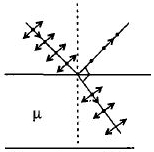
Unpolarised light is incident from air on a plane surface of a material of refractive index $\mu .$ At a particular angle of incidence $i,$ it is found that the reflected and refracted rays are perpendicular to each other. Which of the following options is correct for this situation?
AnswerCorrect option: B. Reflected light is polarised with its electric vector perpendicular to the plane of incidence
b
When reflected light and refracted light are perpendicular, reflected light is polarised with electric field vector perpendicular to the plane of incidence.
Also, $tan\,\,i=\,\,\mu $ (Brewster angle)
View full question & answer→MCQ 161 Mark
Two coherent sources of intensity ratio $\alpha$ interfere. The value of $\frac{{{I_{max}} - {I_{min}}}}{{{I_{max}} + {I_{min}}}}$ is
- ✓
$\frac{{2\sqrt \alpha }}{{1 + \alpha }}$
- B
$\;\frac{{1 + \alpha }}{{2\sqrt \alpha }}$
- C
$\;\frac{{1 + \alpha }}{{1 - \alpha }}$
- D
$2$$\sqrt {\frac{\alpha }{{1 + \alpha }}} $
AnswerCorrect option: A. $\frac{{2\sqrt \alpha }}{{1 + \alpha }}$
a
$\frac{I_{\max }-I_{\min }}{I_{\max }+I_{\min }}=\frac{\left(a_{1}+a_{2}\right)^{2}-\left(A_{1}-A_{2}\right)^{2}}{\left(A_{1}+A_{2}\right)^{2}+\left(A_{1}-A_{2}\right)^{2}}$
$I_{\max }=\left(A_{1}+A_{2}\right)^{2}, I_{\min }=\left(A_{1}-A_{2}\right)^{2}$ where
$A=$amplitude
$=\frac{4 A_{1} A_{2}}{2\left(A_{1}^{2}+A_{2}^{2}\right)}=\frac{2 A_{1} A_{2}}{A_{1}^{2}+A_{2}^{2}}$
Now, dividing the numerator and denominator by $A _{1} A _{2}$, we get
$\frac{I_{\max }-I_{\min }}{I_{\max }+I_{\min }}=\frac{2}{\left[\frac{A_{1}}{A_{2}}+\frac{A_{2}}{A_{1}}\right]}=\frac{2}{\left[\sqrt{\alpha}+\frac{1}{\sqrt{\alpha}}\right]}=\frac{2 \sqrt{\alpha}}{(\alpha+1)}$
View full question & answer→MCQ 171 Mark
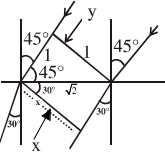
A light beam is incident on a denser medium whose refractive index is $1.414$ at an angle of incidence . Find the ratio of width of refracted beam in a medium to the width of the incident beam in air
AnswerCorrect option: D. $\;\sqrt 3 :\sqrt {2\;} $
d
$\cos 30=\frac{x}{\sqrt{2}}$
$x=\sqrt{2} \cdot \frac{\sqrt{3}}{2}$
$x=\frac{\sqrt{3}}{\sqrt{2}}$
$x: y=\sqrt{3}: \sqrt{2}$
View full question & answer→MCQ 181 Mark
Due to Doppler effect, the shift in wavelength observed is $0.1\;\mathring A $, for a star producing a wavelength $6000\;\mathring A $. The velocity of recession of the star will be ....... $km/sec$
Answerc
$\frac{\Delta \lambda}{\lambda}=\frac{v}{c}$
$\frac{0.1}{6000}=\frac{v}{3 \times 10^{8}}$
$v=5\; km / s$
View full question & answer→MCQ 191 Mark
The ratio of resolving powers of an optical microscope for two wavelengths $\lambda_1 = 4000\,\mathring A$ and $\lambda_2 = 6000 \,\mathring A$ is
- A
$9:4$
- ✓
$3:2$
- C
$16$$:81$
- D
$\;8:27$
Answerb
The resolving power of an optical microscope,
$\mathrm{RP}=\frac{2 \mu \sin \theta}{\lambda}$
For wavelength ${\lambda _1} = 4000\,\mathop {\text{A}}\limits^o $, resolving power will be
$\mathrm{RP}_{1}=\frac{2 \mu \sin \theta}{4000}$ ..... $(i)$
For wavelength ${\lambda _2} = 6000\,\mathop {\text{A}}\limits^o $, resolving power will be
$\mathrm{RP}_{2}=\frac{2 \mu \sin \theta}{6000}$ ..... $(ii)$
On dividing eqn. $(i)$ by eqn. $(ii)$
$=\frac{\mathrm{RP}_{1}}{\mathrm{RP}_{2}}=\frac{6000}{4000}=\frac{3}{2}$
View full question & answer→MCQ 201 Mark
Two polaroids $P_1$ and $P_2$ are placed with their axis perpendicular to each other. Unpolarised light $I_0$ is incident on $P_1$. A third polaroid $P_3$ is kept in between $P_1$ and $P_2$ such that its axis makes an angle $45^o $ with that of $P_1$ .The intensity of transmitted light through $P_2$ is
- A
$\frac{{I_0}}{4}$
- ✓
$\frac{{I_0}}{8}$
- C
$\frac{{I_0}}{{16}}$
- D
$\frac{{I_0}}{2}$
AnswerCorrect option: B. $\frac{{I_0}}{8}$
b
The intensity of transmitted light through $P_{1}$
$I_{1}=\frac{I_{0}}{2}$
The intensity of transmitted light through $P_{3}$
${I_2} = {I_1}{\cos ^2}{45^o} = $ $\frac{{{I_0}}}{2}{\left( {\frac{1}{{\sqrt 2 }}} \right)^2}$ $ = \frac{{{I_0}}}{2} \cdot \frac{1}{2} = \frac{{{I_0}}}{4}$
Angle between polaroids $P_{3}$ and $P_{2}=\left(90^{\circ}-45^{\circ}\right)$ $=45^{\circ}$
$\therefore \quad$ Intensity of transmitted light through $P_{2}$
${I_3} = {I_2}{\cos ^2}{45^o} = $ $\frac{{{I_o}}}{4}{\left( {\frac{1}{{\sqrt 2 }}} \right)^2} = \frac{{{I_o}}}{8}$
View full question & answer→MCQ 211 Mark
A parallel beam of light of wavelength $\lambda$ is incident normally on a single slit of width $d$. Diffraction bands are obtained on a screen placed at a distance $D$ from the slit. The second dark band from the central bright band will be at a distance given by
AnswerCorrect option: D. $\;\frac{{2\lambda D}}{d}$
d
The distance of $n^{th}$ dark band from the central bright band $=\frac{n \lambda D}{d}$ For $n=2$
distance $=\frac{2 \lambda D}{d}$
View full question & answer→MCQ 221 Mark
Young's double slit experiment is first performed in air and then in a medium other than air. It is found that $8^{th}$ bright fringe in the medium lies where $5^{th}$ dark fringe lies in air. The refractive index of the medium is nearly
- A
$1.59$
- B
$1.69$
- ✓
$1.78$ $\;$
- D
$\;1.25$
AnswerCorrect option: C. $1.78$ $\;$
c
Position of $8^{\text {th }}$ bright fringe in medium,
$x=\frac{8 \lambda_{m} D}{d}$
Position of $5^{\text {th }}$ dark fringe in air,
${x^{\prime}=\frac{\left(5-\frac{1}{2}\right) \lambda_{\operatorname{air}} D}{d}}$
${x^{\prime}=\frac{4.5 \lambda_{\operatorname{air}} D}{d}}$
Given $x=x^{\prime}$
$\therefore \,\,\frac{{8{\lambda _m}D}}{d} = \frac{{4.5{\lambda _{{\text{air}}}}D}}{d}$
${\mu _m} = \frac{{{\lambda _{{\text{air}}}}}}{{{\lambda _m}}} = \frac{8}{{4.5}} = 1.78$
View full question & answer→MCQ 231 Mark
A linear aperture whose width is $0.02\,\, cm$ is placed immediately in front of a lens of focal length $60\,\, cm.$ The aperture is illuminated normally by a parallel beam of wavelength $5 \times 10^{-5}\,\, cm.$ The distance of the first dark band of the diffraction pattern from the centre of the screen is .....$cm$
- A
$0.20$
- ✓
$0.15$
- C
$0.10$
- D
$0.25$
AnswerCorrect option: B. $0.15$
b
Here, $a=0.02\,cm\,=\,2 \times 10^{-4}\,m$
$\lambda=5 \times 10^{-5} \,\mathrm{cm}=5 \times 10^{-7}\, \mathrm{m}$
$D=60\, \mathrm{cm}=0.6\, \mathrm{m}$
Position of first minima on the diffraction pattern
${y_1} = \frac{{D\lambda }}{a} = $ $\frac{{0.6 \times 5 \times {{10}^{ - 7}}}}{{2 \times {{10}^{ - 4}}}}$ $ = 15 \times {10^{ - 4}}{\text{m}} = 0.15\,\,{\text{cm}}$
View full question & answer→MCQ 241 Mark
The intensity at the maximum in a Young's double slit experiment is $I_0$. Distance between two slits is $d = 5\lambda,$ where $\lambda$ is the wavelength of light used in the experiment. What will be the intensity in front of one of the slits on the screen placed at a distance $D = 10\,d\,?$
- A
$\frac{{{I_0}}}{4}$
- B
$\;\frac{3}{4}{I_0}$
- ✓
$\;\frac{{{I_0}}}{2}$
- D
$\;{I_0}$
AnswerCorrect option: C. $\;\frac{{{I_0}}}{2}$
c
Here, $d=5 \lambda$, $D=10\,d$, $y=\frac{d}{2}$ .
Resultant Intensity at $y=\frac{d}{2}, I_{y}=?$
The path difference between two waves at $y=\frac{d}{2}$
$\Delta x = d\tan \theta = $ $d \times \frac{y}{D} = $ $\frac{{d \times \frac{d}{2}}}{{10d}} = $ $\frac{d}{{20}} = \frac{{5\lambda }}{{20}} = \frac{\lambda }{4}$
Corresponding phase difference, $\phi=\frac{2 \pi}{\lambda} \Delta x=\frac{\pi}{2}$
Now, maximum intensity in Young's double slit experiment,
${I_{\max }} = {I_1} + {I_2} + 2{I_1}{I_2}$
${I_0} = 4I$ $(\because \,\,{I_1}\, = \,{I_2}\, = \,I)$
$\therefore I=\frac{I_{0}}{4}$
Required intensity,
${I_y} = {I_1} + {I_2} + 2{I_1}{I_2}\cos \frac{\pi }{2}$ $ = 2I = \frac{{{I_0}}}{2}$
View full question & answer→MCQ 251 Mark
In a diffraction pattern due to a single slit of width $a$, the first minimum is observed at an angle $30^o $ when light of wavelength $5000 \;\mathring A$ is incident on the slit. The first secondary maximum is observed at an angle of
- A
$sin^{-1}$ $\left( {\frac{2}{3}} \right)$
- B
$sin^{-1}$$\left( {\frac{1}{2}} \right)$
- ✓
$sin^{-1}$$\left( {\frac{3}{4}} \right)$
- D
$sin^{-1}$$\left( {\frac{1}{4}} \right)$
AnswerCorrect option: C. $sin^{-1}$$\left( {\frac{3}{4}} \right)$
c
For first minimum, the path difference between extreme waves,
$a \sin \theta=\lambda$
Here $\theta=30^{\circ} \Rightarrow \sin \theta=\frac{1}{2}$
$\therefore \quad a=2 \lambda$ ..... $(i)$
For first secondary maximum, the path difference between extreme waves
$a \sin \theta=\frac{3}{2} \lambda$ or $(2 \lambda) \sin \theta^{\prime}=\frac{3}{2} \lambda$ [Using eqn $(i)$]
or $\sin \theta^{\prime}=\frac{3}{4} \quad \therefore \theta^{\prime}=\sin ^{-1}\left(\frac{3}{4}\right)$
View full question & answer→MCQ 261 Mark
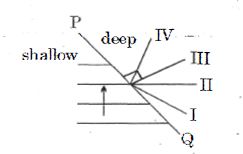
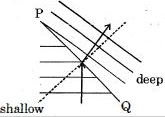
Figure, shows wave fronts in still water moving in the direction of the arrow towards the interface $PQ$ between a shallow region and a deep(denser) region. Which of the lines shown may represent one of the wave fronts in the deep region?
Answera
In deep region wave bend towards normal and wavefront is perpendicular to wavefront.
View full question & answer→MCQ 271 Mark
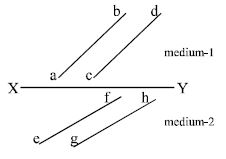
The figure shows a surface $XY$ separating two transparent media, medium - $1$ and medium- $2$. The lines $ab$ and $cd$ represent wavefronts of a light wave traveling in medium- $1$ and incident on $XY$. The lines $ef$ and $gh$ represent wavefronts of the light wave in medium- $2$ after refraction.
The phases of the light wave at $c, d, e$ and $f$ are $\phi_c,\phi_d, \phi_e$ and $\phi_f$ respectively. It is given that $\phi_c \neq \phi_f.$
- A
$\phi_c$ cannot be equal to $\phi_d$
- B
$\phi_d$ can be equal to $\phi_e$
- ✓
$(\phi_d -\phi_f)$ is equal to $(\phi_c -\phi_e)$
- D
$(\phi_d -\phi_c)$ is not equal to $(\phi_f -\phi_e)$
AnswerCorrect option: C. $(\phi_d -\phi_f)$ is equal to $(\phi_c -\phi_e)$
c
$\phi_{c}=\phi_{d}$
$\phi_{e}=\phi_{f}$
on subtracts
$\phi_{c}-\phi_{e}=\phi_{d}-\phi_{f}$
View full question & answer→MCQ 281 Mark
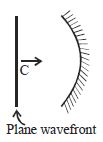
When a plane wave front incident on a concave mirror as shown in figure then shape of reflected wave front
MCQ 291 Mark
A plane wave passes through a convex lens. The geometrical shape of the wavefront that emerges is
Answerc
When a plane wave passes through a convex lens, the refracted wavefront is converging spherical wavefront.
View full question & answer→MCQ 301 Mark
If the amplitude ratio of two sources producing interference is $3 : 5$, the ratio of intensities at maxima and minima is
- A
$25:16$
- B
$5:3$
- ✓
$16:1$
- D
$25:9$
AnswerCorrect option: C. $16:1$
c
(c)$\frac{{{a_1}}}{{{a_2}}} = \frac{3}{5}$
$\therefore \frac{{{I_{\max }}}}{{{I_{\min }}}} = \frac{{{{({a_1} + {a_2})}^2}}}{{{{({a_1} - {a_2})}^2}}} = \frac{{{{(3 + 5)}^2}}}{{{{(3 - 5)}^2}}} = \frac{{16}}{1}$
View full question & answer→MCQ 311 Mark
If two light waves having same frequency have intensity ratio $4 : 1$ and they interfere, the ratio of maximum to minimum intensity in the pattern will be
- ✓
$9:1$
- B
$3:1$
- C
$25:9$
- D
$16:25$
Answera
(a)$\frac{{{I_{\max }}}}{{{I_{\min }}}} = {\left( {\frac{{\sqrt {\frac{{{I_1}}}{{{I_2}}}} + 1}}{{\sqrt {\frac{{{I_1}}}{{{I_2}}}} - 1}}} \right)^2} = {\left( {\frac{{\sqrt {\frac{4}{1}} + 1}}{{\sqrt {\frac{4}{1}} - 1}}} \right)^2} = \frac{9}{1}$
View full question & answer→MCQ 321 Mark
Two waves having intensity in the ratio $25 : 4$ produce interference. The ratio of the maximum to the minimum intensity is
- A
$5:2$
- B
$7:3$
- ✓
$49:9$
- D
$9:49$
AnswerCorrect option: C. $49:9$
c
(c)$\frac{{{I_{\max }}}}{{{I_{\min }}}} = {\left( {\frac{{\sqrt {\frac{{{I_1}}}{{{I_2}}}} + 1}}{{\sqrt {\frac{{{I_1}}}{{{I_2}}}} - 1}}} \right)^2} = {\left( {\frac{{\sqrt {\frac{{25}}{4}} + 1}}{{\sqrt {\frac{{25}}{4}} - 1}}} \right)^2} = \frac{{49}}{9}$
View full question & answer→MCQ 331 Mark
If the ratio of amplitude of two waves is $4 : 3$, then the ratio of maximum and minimum intensity is
- A
$16:18$
- B
$18:16$
- ✓
$49:1$
- D
$94:1$
AnswerCorrect option: C. $49:1$
c
(c)$\frac{{{I_{\max }}}}{{{I_{\min }}}} = {\left( {\frac{{\frac{{{a_1}}}{{{a_2}}} + 1}}{{\frac{{{a_1}}}{{{a_2}}} - 1}}} \right)^2} = {\left( {\frac{{\frac{4}{3} + 1}}{{\frac{4}{3} - 1}}} \right)^2} = \frac{{49}}{1}$
View full question & answer→MCQ 341 Mark
Two coherent sources have intensity in the ratio of $\frac{{100}}{1}$. Ratio of (intensity) max/(intensity) min is
- A
$\frac{1}{{100}}$
- B
$\frac{1}{{10}}$
- C
$\frac{{10}}{1}$
- ✓
$\frac{3}{2}$
AnswerCorrect option: D. $\frac{3}{2}$
d
(d)$\frac{{{I_1}}}{{{I_2}}} = \frac{{100}}{1}$
Now $\frac{{{I_{\max }}}}{{{I_{\min }}}} = {\left( {\frac{{\sqrt {\frac{{{I_1}}}{{{I_2}}}} + 1}}{{\sqrt {\frac{{{I_1}}}{{{I_2}}}} - 1}}} \right)^2} = {\left( {\frac{{\sqrt {100} + 1}}{{\sqrt {100} - 1}}} \right)^2} = \frac{{121}}{{81}} \approx \frac{3}{2}$
View full question & answer→MCQ 351 Mark
If two waves represented by ${y_1} = 4\sin \omega t$ and ${y_2} = 3\sin \left( {\omega t + \frac{\pi }{3}} \right)$ interfere at a point, the amplitude of the resulting wave will be about
Answerb
(b)$\phi = \pi /3,\;{a_1} = 4,\;{a_2} = 3$
So, $A = \sqrt {a_1^2 + a_2^2 + 2{a_1}.{a_2}\cos \phi } \Rightarrow A \approx 6$
View full question & answer→MCQ 361 Mark
Two coherent sources of intensities, $I_1$ and $I_2$ produce an interference pattern. The maximum intensity in the interference pattern will be
AnswerCorrect option: D. ${(\sqrt {{I_1}} + \sqrt {{I_2}} )^2}$
d
(d)Resultant intensity ${I_R} = {I_1} + {I_2} + 2\sqrt {{I_1}{I_2}} \,\cos \phi$
For maximum ${I_R},$ $\phi= {0^o}$
==> ${I_R} = {I_1} + {I_2} + 2\sqrt {{I_1}{I_2}} = {\left( {\sqrt {{I_1}} + \sqrt {{I_2}} } \right)^2}$
View full question & answer→MCQ 371 Mark
Light waves producing interference have their amplitudes in the ratio $3 : 2$. The intensity ratio of maximum and minimum of interference fringes is
- A
$36:1$
- B
$9:4$
- ✓
$25:1$
- D
$6:4$
AnswerCorrect option: C. $25:1$
c
(c)$\frac{{{I_{\max }}}}{{{I_{\min }}}} = {\left( {\frac{{\frac{{{a_1}}}{{{a_2}}} + 1}}{{\frac{{{a_1}}}{{{a_2}}} - 1}}} \right)^2} = \frac{{25}}{1}$
View full question & answer→MCQ 381 Mark
Two coherent sources of different intensities send waves which interfere. The ratio of maximum intensity to the minimum intensity is $25$. The intensities of the sources are in the ratio
- A
$25:1$
- B
$5:1$
- ✓
$9:4$
- D
$25:16$
Answerc
(c)$\frac{{{I_{\max }}}}{{{I_{\min }}}} = {\left( {\frac{{\sqrt {\frac{{{I_1}}}{{{I_2}}}} + 1}}{{\sqrt {\frac{{{I_1}}}{{{I_2}}}} - 1}}} \right)^2} \Rightarrow \frac{{{I_1}}}{{{I_2}}} = \frac{9}{4}$
View full question & answer→MCQ 391 Mark
Two waves have their amplitudes in the ratio $1 : 9$. The maximum and minimum intensities when they interfere are in the ratio
- ✓
$\frac{{25}}{{16}}$
- B
$\frac{{16}}{{26}}$
- C
$\frac{1}{9}$
- D
$\frac{9}{1}$
AnswerCorrect option: A. $\frac{{25}}{{16}}$
a
(a)$\frac{{{I_{\max }}}}{{{I_{\min }}}} = {\left( {\frac{{\frac{{{a_1}}}{{{a_2}}} + 1}}{{\frac{{{a_1}}}{{{a_2}}} - 1}}} \right)^2} = {\left( {\frac{{\frac{1}{9} + 1}}{{\frac{1}{9} - 1}}} \right)^2} = {\left( {\frac{5}{4}} \right)^2} = \frac{{25}}{{16}}.$
View full question & answer→MCQ 401 Mark
If an interference pattern have maximum and minimum intensities in $36 : 1$ ratio then what will be the ratio of amplitudes
Answerd
(d)$\frac{{{I_{\max }}}}{{{I_{\min }}}} = {\left( {\frac{{\frac{{{a_1}}}{{{a_2}}} + 1}}{{\frac{{{a_1}}}{{{a_2}}} - 1}}} \right)^2} \Rightarrow \frac{{{a_1} + {a_2}}}{{{a_1} - {a_2}}} = 6$
$\frac{{{a_2}}}{{{a_1}}} = 7:5$
View full question & answer→MCQ 411 Mark
Intensities of the two waves of light are $I$ and $4\,I$. The maximum intensity of the resultant wave after superposition is
- A
$5\, I$
- ✓
$9 \,I$
- C
$16\, I$
- D
$25\, I$
AnswerCorrect option: B. $9 \,I$
b
(b)${I_{\max }} = {I_1} + {I_2} + 2\sqrt {{I_1}{I_2}} $
So, ${I_{\max }} = I + 4I + 2\sqrt {I.4I} = 9I$
View full question & answer→MCQ 421 Mark
Two waves of intensity $ I $ undergo Interference. The maximum intensity obtained is
Answerd
(d)For maximum intensity $\phi = 0^\circ $
$I = {I_1} + {I_2} + 2\sqrt {{I_1}{I_2}} \cos \phi $$ = I + I + 2\sqrt {I\,I} \cos 0^\circ = 4I$
View full question & answer→MCQ 431 Mark
Two coherent sources of intensity ratio $1 : 4$ produce an interference pattern. The fringe visibility will be
Answerb
(b)$\frac{{{I_1}}}{{{I_2}}} = \frac{1}{4} \Rightarrow {I_1} = k$ and ${I_2} = 4k$
$\therefore $ Fringe visibility $V = \frac{{2\sqrt {{I_1}{I_2}} }}{{({I_1} + {I_2})}} = \frac{{2\sqrt {k \times 4k} }}{{(k + 4k)}} = 0.8$
View full question & answer→MCQ 441 Mark
Four light waves are represented by
(i) $y = a_1\, sin\omega\, t$
(ii) $y = {a_2}\sin (\omega \,t + \phi )$
(iii) $y = {a_1}\sin 2\omega \,t$
(iv) $y = {a_2}\sin 2(\,\omega \,t + \phi )$
Interference fringes may be observed due to superposition of
- A
$(i)$ and $(ii)$
- B
$(i)$ and $(iii)$
- C
$(iii)$ and $(iv)$
- ✓
$(a)$ and $ (c) $ both
AnswerCorrect option: D. $(a)$ and $ (c) $ both
d
(d) These waves are of same frequencies and they are coherent
View full question & answer→MCQ 451 Mark
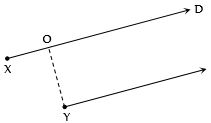
Two point sources $X$ and $Y$ emit waves of same frequency and speed but $Y$ lags in phase behind $X$ by $2 \pi l$ radian. If there is a maximum in direction $D$ the distance $XO$ using n as an integer is given by
AnswerCorrect option: B. $\lambda (n + l)$
b
(b) For maxima $2\pi \,n = \frac{{2\pi }}{\lambda }(XO) - 2\pi \,l$
or $\frac{{2\pi }}{\lambda }(XO) = 2\pi (n + l)$ or $(XO) = \lambda (n + l)$
View full question & answer→MCQ 461 Mark
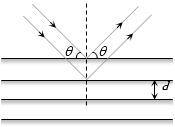
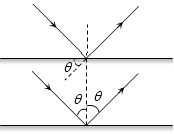
A beam with wavelength $\lambda$ falls on a stack of partially reflecting planes with separation d. The angle $\theta$ that the beam should make with the planes so that the beams reflected from successive planes may interfere constructively is (where $n =1, 2, ……$)
- A
${\sin ^{ - 1}}\left( {\frac{{n\lambda }}{d}} \right)$
- B
${\tan ^{ - 1}}\left( {\frac{{n\lambda }}{d}} \right)$
- ✓
${\sin ^{ - 1}}\left( {\frac{{n\lambda }}{{2d}}} \right)$
- D
${\cos ^{ - 1}}\left( {\frac{{n\lambda }}{{2d}}} \right)$
AnswerCorrect option: C. ${\sin ^{ - 1}}\left( {\frac{{n\lambda }}{{2d}}} \right)$
c
(c) Path difference $ = 2d\sin \theta $
$\therefore $ For constructive interference
$2d\sin \theta = n\lambda $
$ \Rightarrow \theta = {\sin ^{ - 1}}\left( {\frac{{n\lambda }}{{2\,d}}} \right)$
View full question & answer→MCQ 471 Mark
The two coherent sources of equal intensity produce maximum intensity of $100$ units at a point. If the intensity of one of the sources is reduced by $36\% $ by reducing its width then the intensity of light at the same point will be
Answerd
(d) Intensity of each source $ = {I_0} = \frac{{100}}{4} = 25\,unit$
If the intensity of one of the source is reduced by $36\%$ then ${I_1} = 25\,unit$ and ${I_2} = 25 - 25 \times \frac{{36}}{{100}} = 16\,(unit)$
Hence resultant intensity at the same point will be $I = {I_1} + {I_2} + 2\sqrt {{I_1}{I_2}} = 25 + 16 + 2\sqrt {25 \times 16} = 81\,unit$
View full question & answer→MCQ 481 Mark
The path difference between two interfering waves of equal intensities at a point on the screen is $\frac{\lambda }{4}.$ The ratio of intensity at this point and that at the central fringe will be
- A
$1 : 1$
- ✓
$1 : 2$
- C
$2 : 1$
- D
$1 : 4$
AnswerCorrect option: B. $1 : 2$
b
(b) By using $I = 4{I_0}{\cos ^2}\left( {\frac{\phi }{2}} \right) = 4{I_0}{\cos ^2}\left( {\frac{{\pi \Delta }}{\lambda }} \right)$
$\left\{ {\because \phi = \frac{{2\pi }}{\lambda }\Delta } \right\}$
==> $\frac{{{I_1}}}{{{I_2}}} = \frac{{{{\cos }^2}\left( {\frac{{\pi {\Delta _1}}}{\lambda }} \right)}}{{{{\cos }^2}\left( {\frac{{\pi {\Delta _2}}}{\lambda }} \right)}} = \frac{{{{\cos }^2}\left( {\frac{{\pi .\frac{\lambda }{4}}}{\lambda }} \right)}}{{{{\cos }^2}(0)}} = \frac{1}{2}$
View full question & answer→MCQ 491 Mark
Two waves of equal amplitude and frequency interfere each other. The ratio of intensity when the two waves arrive in phase to that when they arrive $90^\circ $ out of phase is
- A
$1 : 1$
- B
$\sqrt 2 $ $: 1$
- ✓
$2 : 1$
- D
$4 : 1$
AnswerCorrect option: C. $2 : 1$
c
(c) Resultant intensity $I = 4{I_0}{\cos ^2}(\phi /2)$
==> $\frac{{{I_1}}}{{{I_2}}} = \frac{{{{\cos }^2}({\phi _1}/2)}}{{{{\cos }^2}({\phi _2}/2)}} = \frac{{{{\cos }^2}0}}{{{{\cos }^2}(90/2)}} = \frac{2}{1}$
View full question & answer→MCQ 501 Mark
To observe a stationary interference pattern formed by two light waves, it is not necessary that they must have :
AnswerCorrect option: D. Both $(B)$ and $(C)$
d
For a stationary interference, there is maxima and minima at a Stationary Position.
For that Phase difference Should be constant, and Pattern will not be constant
As there is no change, it should be conerent So it should have Same frequency.
When Amplitude is same, the minime that is formed is completely dark but it is not necessary Condition.we know I $\alpha(\text { Amplitade })^2$
View full question & answer→


