A plane wave is represented by $x = 1.2\sin (314\,t + 12.56y)$Where $x$ and $y$ are distances measured along in $x$ and $y$ direction in meters and $t$ is time in seconds. This wave has
Medium
Download our app for free and get started
(c) The given equation representing a wave travelling along $-y$ direction (because $‘+’$ sign is given between $t$ term and $x$ term).
On comparing it with $x = A\sin \,\left( {\omega \,t + ky} \right)$
We get $k = \frac{{2\pi }}{\lambda } = 12.56$ ==> $\lambda = \frac{{2 \times 3.14}}{{12.56}} = 0.5\,m$

Download our appand get started for free
Experience the future of education. Simply download our apps or reach out to us for more information. Let's shape the future of learning together!No signup needed.*
Similar Questions
- 1A transverse wave propagating along $x-$ axis is represented by $y (x,t)= 8.0 sin$ $\left( {0.5\pi x - 4\pi t - \frac{\pi }{4}} \right)$ where $x$ is in metres and $t$ is in seconds. The speed of the wave is ..... $m/s$View Solution
- 2View SolutionA tuning fork produces waves in a medium. If the temperature of the medium changes, then which of the following will change
- 3An observer receives waves directly from a source of sound distant $120\,m$ in a big hall. He also receives waves reflected from the mid-point of $25\,m$ high ceiling. The wavelength of sound for constructive interference to take place between two waves, must be :View Solution
- 4A glass tube $1.5 m$ long and open at both ends, is immersed vertically in a water tank completely. A tuning fork of $660 Hz$ is vibrated and kept at the upper end of the tube and the tube is gradually raised out of water. The total number of resonances heard before the tube comes out of water, taking velocity of sound air $330 m/sec$ isView Solution
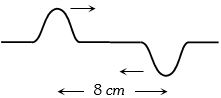
- 5Two pulses in a stretched string whose centres are initially $8 cm$ apart are moving towards each other as shown in the figure. The speed of each pulse is $2 cm/s$. After $2$ seconds, the total energy of the pulses will beView Solution
- 6A train moves towards a stationary observer with speed $34\, m/s$. The train sounds a whistle and its frequency registered by the observer is $f_1$. If the speed of the train is reduced to $17\, m/s$, the frequency registered is $f_2$. If speed of sound is $340\, m/s$, then the ratio $f_1/f_2$ isView Solution
- 7The displacement of a particle is given by $x = 3\sin (5\pi \,t) + 4\cos (5\pi \,t)$The amplitude of the particle isView Solution
- 8A student plotted the following four graphs representing the variation of velocity of sound in a gas with the pressure $P$. Which one is correctView Solution
- 9The speed of sound in hydrogen at $NTP$ is $1270\,m/s$ . Then, the speed in a mixture of hydrogen and oxygen in the ratio $4 : 1$ by volume will be ..... $m/s$View Solution
- 10A travelling wave in a stretched string is described by the equation $y = A\sin (kx - \omega t)$. The maximum particle velocity isView Solution