A glass tube $1.5 m$ long and open at both ends, is immersed vertically in a water tank completely. A tuning fork of $660 Hz$ is vibrated and kept at the upper end of the tube and the tube is gradually raised out of water. The total number of resonances heard before the tube comes out of water, taking velocity of sound air $330 m/sec$ is
Medium
Download our app for free and get started
(b) Suppose $N$ resonance occurred before tube coming out.
Hence by using $l = \frac{{(2N - 1)v}}{{4n}}$
==>$1.5 = \frac{{(2N - 1) \times 330}}{{4 \times 660}}$ ==> $N \approx 6$.

Download our appand get started for free
Experience the future of education. Simply download our apps or reach out to us for more information. Let's shape the future of learning together!No signup needed.*
Similar Questions
- 1A second harmonic has to be generated in a string of length $l$ stretched between two rigid supports. The point where the string has to be plucked and touched areView Solution
- 2A source is moving towards an observer with a speed of $20 m/s$ and having frequency of $240 Hz.$ The observer is now moving towards the source with a speed of $20 m/s$. Apparent frequency heard by observer, if velocity of sound is $340 m/s$, is ... $Hz$View Solution
- 3Two tuning forks have frequencies $450\, Hz$ and $454\, Hz$ respectively. On sounding these forks together, the time interval between successive maximum intensities will be .... $sec$View Solution
- 4A tuning fork of frequency $340\, Hz$ is vibrated just above the tube of $120\, cm$ height. Water is poured slowly in the tube. What is the minimum height of water necessary for the resonance ... $cm$ ? (speed of sound in air $= 340\, m/s$)View Solution
- 5View Solutionstationary source is emitting sound at a fixed frequency $f_0$, which is reflected by two cars approaching the source. The difference between the frequencies of sound reflected from the cars is $1.2\%$ of $f_0$. What is the difference in the speeds of the cars (in $km$ per hour) to the nearest integer ..... $km/hr$ ? The cars are moving at constant speeds much smaller than the speed of sound which is $330$ $ms^{-1}$.
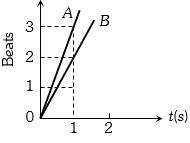
- 6Two tuning forks $P$ and $Q$ are vibrated together. The number of beats produced are represented by the straight line $OA$ in the following graph. After loading $Q$ with wax again these are vibrated together and the beats produced are represented by the line $OB.$ If the frequency of $P$ is $341Hz,$ the frequency of $Q$ will be ... $ Hz$View Solution
- 7The correct graph between the frequency $n$ and square root of density ($\rho$) of a wire, keeping its length, radius and tension constant, isView Solution
- 8Two open organ pipes of length $60 \mathrm{~cm}$ and $90 \mathrm{~cm}$ resonate at $6^{\text {th }}$ and $5^{\text {th }}$ harmonics respectively. The difference of frequencies for the given modes is . . . . . $\mathrm{Hz}$.View Solution
(Velocity of sound in air $=333 \mathrm{~m} / \mathrm{s}$ )
- 9A resonating air column shows resonance with a tuning fork of frequency $256\, Hz$ at column lengths $33.4\, cm$ and $101.8\, cm$. The speed of sound in air is ...... $ms^{-1}$View Solution
- 10A stationary source is emitting sound at a fixed frequency $\mathrm{f}_0$, which is reflected by two cars approaching the source. The difference between the frequencies of sound reflected from the cars is $1.2 \%$ of $f_0$. What is the difference in the speeds of the cars (in $\mathrm{km}$ per hour) to the nearest integer? The cars are moving at constant speeds much smaller than the speed of sound which is $330 \mathrm{~ms}^{-1}$.View Solution