Question
A planet moving around the sun is a good illustration of the law of conservation of energy. Explain.

Answer

At all stages during motion of the planet around sun, the sum of kinetic and potential energies is constant. When the planet is farthest from the sun, it is slowest. In other words, it has minimum kinetic energy and hence maximum potential energy.

Need a full question paper?

Generate a complete, print-ready paper with questions like this in minutes — across 16+ boards, with answer keys.
Start Generating Free

Similar questions

Two trains of lengths 109 m and 91 m are moving in opposite directions with velocities $34 \mathrm{~km} \mathrm{~h}^{-1}$ and $38 \mathrm{~km} / \mathrm{h}^{-1}$ respectively. In what time the two trains will completely cross each other? Choose the most logical reference point for time measurement.
Two cylinders A and B of equal capacity are connected to each other via a stopcock. A contains a gas at standard temperature and pressure. B is completely evacuated. The entire system is thermally insulated. The stopcock is suddenly opened. Answer the following: Do the intermediate states of the system (before settling to the final equilibrium state) lie on its P-V-T surface?
Obtain an expression for apparent frequency of sound when the source is moving with a velocity $v_s$ towards the stationary listener.
hat is the relation between angular momentum, moment of inertia and angular velocity?
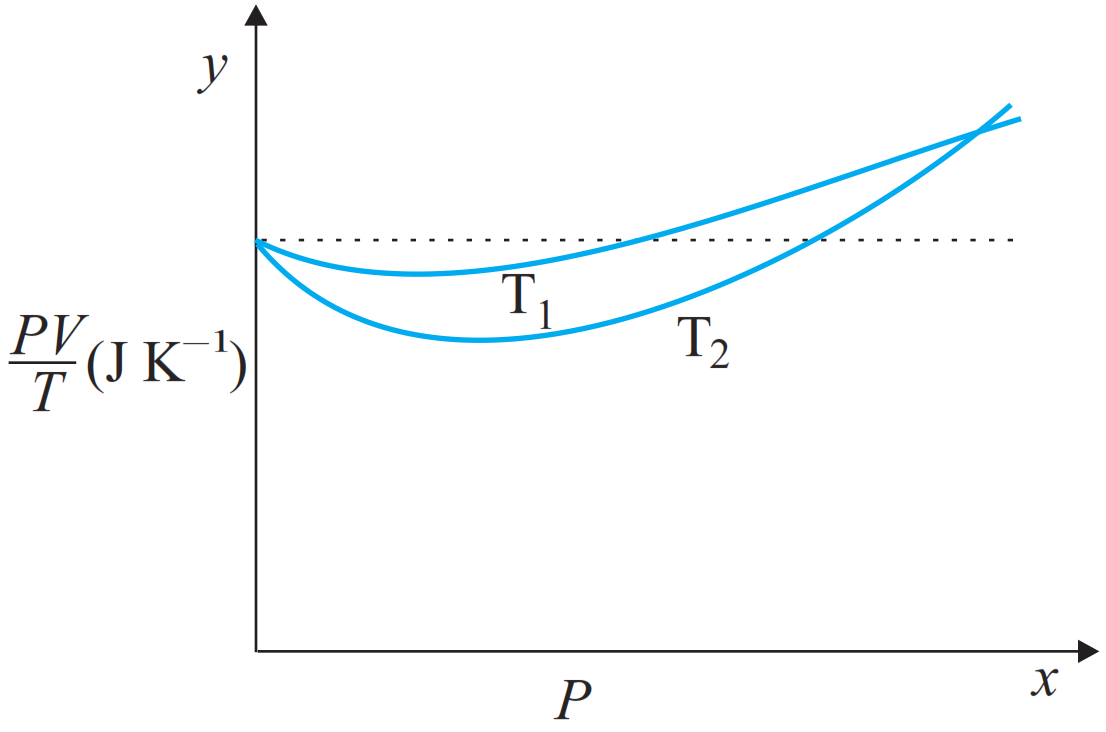
Shows plot of $\frac{\text{PV}}{\text{T}}$ versus P for $1.00 \times 10^{-3} \mathrm{~kg}$ of oxygen gas at two different temperatures. What does the dotted plot signify?
Two large glass plates are placed vertically and parallel to each other inside a tank of water with separation between the plates equal to 1mm. Find the rise of water in the space between the plates. Surface tension of water = 0.075N/m.
Apply the first law of thermodynamics to a resistor carrying a current i. Identify which of the quantities $\Delta\text{Q},\ \Delta\text{U}$ and $\Delta\text{W}$ are zero, which are positive and which are negative.
If the length of a wire is cut to half then
(i) What would be the effect on its increase in length within the given weight?
(ii) What would be the effect on the maximum weight which it bears?
Two circular discs $A$ and $B$ of the same mass and same thickness are made of two different metals whose densities are $d_A$ and $d_B\left(d_A>d_B\right)$. Their moments of inertia about the axes passing through their centres of gravity and perpendicular to their planes are $\mathrm{I}_A$ and $\mathrm{I}_{\mathrm{B}}$. Which is greater $\mathrm{I}_{\mathrm{A}}$ or $\mathrm{I}_{\mathrm{B}}$ ?
Given below are some functions of x and t to represent the displacement of an elastic wave.
$\text{y}=5\cos(4\times)\sin(20\text{t})$