MCQ
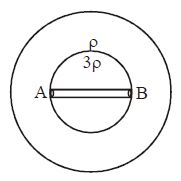
A planet of core density $3 \rho$ and outer crust of density $\rho$ has small tunnel in core. A small particle of mass $m$ is released from end $A$ then time required to reach end $B$
  • A
    $\sqrt {\frac{\pi }{{\rho G}}} $
  • $\frac{1}{2}\sqrt {\frac{\pi }{{\rho G}}} $
  • C
    $\pi \sqrt {\frac{1}{{\rho G}}} $
  • D
    $2\pi \sqrt {\frac{1}{{\rho G}}} $

Answer

Correct option: B.
$\frac{1}{2}\sqrt {\frac{\pi }{{\rho G}}} $
b
at some distance from centre inside core

$\mathrm{F}=-\left(\frac{G \frac{4}{3} \pi r^{3}(3 \rho) m}{r^{2}}\right)$

$\mathrm{ma}=-4 \pi G \rho m r$

$\mathrm{a}=-4 \pi G \rho r$

so $\omega=\sqrt{4 \pi G \rho}=\frac{2 \pi}{T}$

or $\mathrm{T}=2 \pi \cdot \sqrt{\frac{1}{4 \pi G \rho}}=\sqrt{\frac{\pi}{G \rho}}$

now time for $A$ to $B$ $\frac{1}{2} \sqrt{\frac{\pi}{G \rho}}$

Need a full question paper?

Generate a complete, print-ready paper with questions like this in minutes — across 16+ boards, with answer keys.

Start Generating Free

Similar questions

In the below graph, point $B$ indicates
If radius of earth contracted by $0.1 \%$, its mass remaining same, then weight of the body at earth's surface will increase by ..............$\%$ 
A neutron having mass of $1.67 \times {10^{ - 27}}kg$ and moving at ${10^8}m/s$ collides with a deutron at rest and sticks to it. If the mass of the deutron is$3.34 \times {10^{ - 27}}kg$then the speed of the combination is
Wire $A$ and $B$ are made from the same material $A$ has twice the diameter and three times the length of $B$. If the elastic limits are not reached, when each is stretched by the same tension, the ratio of energy stored in $A$ to that in $B$ is:
Dimensions of gravitational constant are:
Answer the following by appropriately matching the lists based on the information given in the paragraph.

A musical instrument is made using four different metal strings, $1,2,3$ and $4$ with mass per unit length $\mu, 2 \mu, 3 \mu$ and $4 \mu$ respectively. The instrument is played by vibrating the strings by varying the free length in between the range $L _0$ and $2 L _0$. It is found that in string-$1$ $(\mu)$ at free length $L _0$ and tension $T _0$ the fundamental mode frequency is $f _0$.

$List-I$ gives the above four strings while $list-II$ lists the magnitude of some quantity.

$List-I$ $List-II$
$(I)$ String-1( $\mu$ ) $(P) 1$
$(II)$ String-2 $(2 \mu)$ $(Q)$ $1 / 2$
$(III)$ String-3 $(3 \mu)$ $(R)$ $1 / \sqrt{2}$
$(IV)$ String-4 $(4 \mu)$ $(S)$ $1 / \sqrt{3}$
  $(T)$ $3 / 16$
  $(U)$ $1 / 16$

($1$) If the tension in each string is $T _0$, the correct match for the highest fundamental frequency in $f _0$ units will be,

$(1)$ $I \rightarrow P , II \rightarrow R , III \rightarrow S , IV \rightarrow Q$

$(2)$ $I \rightarrow P , II \rightarrow Q , III \rightarrow T , IV \rightarrow S$

$(3)$ $I \rightarrow Q , II \rightarrow S , III \rightarrow R , IV \rightarrow P$

$(4)$ I $\rightarrow Q , II \rightarrow P , III \rightarrow R$, IV $\rightarrow T$

($2$) The length of the string $1,2,3$ and 4 are kept fixed at $L _0, \frac{3 L _0}{2}, \frac{5 L _0}{4}$ and $\frac{7 L _0}{4}$, respectively. Strings $1,2,3$ and 4 are vibrated at their $1^{\text {tt }}, 3^{\text {rd }}, 5^{\text {m }}$ and $14^{\star}$ harmonics, respectively such that all the strings have same frequency. The correct match for the tension in the four strings in the units of $T _0$ will be.

$(1)$ $I \rightarrow P , II \rightarrow Q , III \rightarrow T , IV \rightarrow U$

$(2)$ $I \rightarrow T , II \rightarrow Q , III \rightarrow R$, IV $\rightarrow U$

$(3)$ $I \rightarrow P , II \rightarrow Q , III \rightarrow R , IV \rightarrow T$

$(4)$ I $\rightarrow P , II \rightarrow R , III \rightarrow T , IV \rightarrow U$
A projectile is moving at $20\,m/sec$ at its highest point where it breaks into two equal parts due to an internal explosion. One part moves vertically up at $30\,m/sec$ . Then the other part will move at ............. $\mathrm{m}/ \mathrm{s}$
A sample of ideal gas $(\gamma = 1.4)$ is heated at constant pressure. If an $100\, J$ is supplied to gas, the work done by the gas is ...... $J$
A boy ties a stone of mass $100 \,g$ to the end of a $2$ $m$ long string and whirls it around in a horizontal plane. The string can withstand the maximum tension of $80 \,N$. If the maximum speed with which the stone can revolve is $\frac{ K }{\pi} rev$. / $min$. The value of $K$ is (Assume the string is massless and unstretchable)
$A$ pulley is hinged at the centre and a massless thread is wrapped around it. The thread is pulled with a constant force $F$ starting from rest. As the time increases,