MCQ
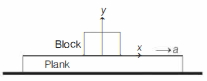
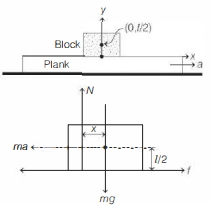
A plank is moving in a horizontal direction with a constant acceleration $\alpha \hat{ i }$. A uniform rough cubical block of side $l$ rests on the plank and is at rest relative to the plank. Let the centre of mass of the block be at $(0, l / 2)$ at a given instant. If $\alpha =g / 10$, then the normal reaction exerted by the plank on the block at that instant acts at
  • A
    $(0,0)$
  • $(-l / 20,0)$
  • C
    $(-l / 10,0)$
  • D
    $(l / 10,0)$

Answer

Correct option: B.
$(-l / 20,0)$
b
$(b)$ Given situation is Forces acting on the block are

In above diagram, ma=pseudo force due to acceleration of plank,

$f=$ force of static friction, $m g=$ weight of block and $N=$ normal reaction.

Here, we must note that due to motion of plank, normal reaction force does not passes through centre of mass.

If line of action of normal force at a distance $x$ from centre, then for equilibrium of block, net torque about centre of mass must be zero.

$\Rightarrow \quad \tau_{\substack{\text { Normal } \\ \text { reaction }}}=\tau_{\text {Friction }}$

$m g$ and $m a$ does not produces any torque about centre of mass as their line of action passes through centre of mass.

$\Rightarrow N \cdot x=f \cdot l / 2$

$\Rightarrow m g x=m a \frac{l}{2}$

${[\because N=m g \text { and } f=m a]}$

$\Rightarrow x=\left(\frac{a}{g}\right) \frac{l}{2}$

$\text { or } x=\frac{1}{10} \cdot \frac{l}{2} \quad\left[\because a=\frac{g}{10}\right]$

$\text { or } x=\frac{l}{20}$

So, coordinates of point from which reaction passes are $\left(-\frac{l}{20}, 0\right)$.
Need a full question paper?

Generate a complete, print-ready paper with questions like this in minutes — across 16+ boards, with answer keys.

Start Generating Free

Similar questions

The ratio of the wavelengths for $2 → 1$ transition in $Li++, He+$ and $H$ is
Assertion : Balmer series lies inthe visible region of the electromagnetic spectrum.
Reason : $\frac{1}{\lambda } = R\,\left[ {\frac{1}{{{2^2}}} - \frac{1}{{{n^2}}}} \right]$ , where $n = 3, 4, 5$
If the difference between $(n+1)^{\text {th }}$ Bohr radius and $n^{\text {th }}$ Bohr radius is equal to the $(n-1)^{\text {th }}$ Bohr radius then find the value of $n$
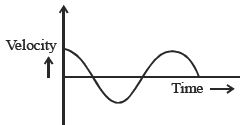
The graph in figure represents
An $\alpha$ particle and a carbon $12$ atom has same kinetic energy $K$. The ratio of their de-Broglie wavelength $\left(\lambda_{a}: \lambda_{C 12}\right)$ is
Which of the following statements are correct.
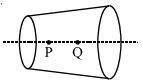
A wire has a non-uniform cross-section as shown in figure.A steady current flows through it. The drift speed of electrons at points $P$ and $q$ is $v_P$ and $v_Q$.
Given : $\vec A\, = \,2\hat i\, + \,p\hat j\, + q\hat k$ and $\vec B\, = \,5\hat i\, + \,7\hat j\, + 3\hat k,$ if $\vec A\,||\,\vec B,$ then the values of $p$ and $q$ are, respectively
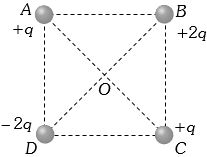
Four charges are arranged at the corners of a square $ABCD$, as shown in the adjoining figure. The force on the charge kept at the centre $O$ is
A motor car has a width $1.1$ m between wheels. Its centre of gravity is $0.62$ m above the ground and the coefficient of friction between the wheels and the road is $0.8$. ...... $m/s$  is the maximum possible speed, if the centre of gravity inscribes a circle of radius $15$ m ? (Road surface is horizontal)