MCQ
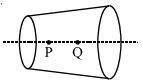
A wire has a non-uniform cross-section as shown in figure.A steady current flows through it. The drift speed of electrons at points $P$ and $q$ is $v_P$ and $v_Q$.
  • A
    $v_P = v_Q$
  • B
    $v_P < v_Q$
  • $v_P > v_Q$
  • D
    Data insufficient

Answer

Correct option: C.
$v_P > v_Q$
c
The drift speed of electrons is inversely proportional to the radius of cross section. Thus here the cross sectional area at point $P$ is smaller than the cross sectional area at point $Q$. Hence, the drift velocity is large for smaller area and small for larger area. The drift speed will relate as per the relation given below

$v_{P}>v_{Q}$

Need a full question paper?

Generate a complete, print-ready paper with questions like this in minutes — across 16+ boards, with answer keys.

Start Generating Free

Similar questions

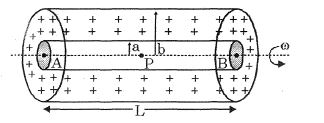
A thick uniformly charged hollow cylinder of inner radius $a$ and outer radius $b$ rotates with constant angular speed $\omega $ about its axis $APB$, charge density$  = \rho $

Given that $L >>> a$ $L >>> b$ and $P$ is mid point of $AB$. Choose the incorrect option
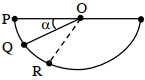
A ball is released from rest from point $P$ of a smooth semi-spherical vessel as shown in figure. The ratio of the centripetal force and normal reaction on the ball at point $Q$ is $A$ while angular position of point $Q$ is $\alpha$ with respect to point $P$. Which of the following graphs represent the correct relation between $A$ and $\alpha$ when ball goes from $Q$ to $R$ ?
What is the power gain in a $CE$ amplifier, where input resistance is $3 \,k \Omega$ and load resistance $24 \,k \Omega$ given $\beta=6 ?$
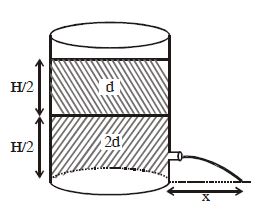
A container of large uniform cross-sectional area $A$ is resting on a horizontal surface holds two immiscible, non-viscous and incompressible liquids of densities $d$ and $2d$ each of height $\frac{H}{2}$ as shown. The lower density of liquid is open to atmosphere. A small hole is made on the wall of container at height $h\left( {h < \frac{H}{2}} \right)$. The initial speed of efflux of the liquid at the hole is
A coil of $40$ $\Omega$ resistance has $100$ turns and radius $6\, mm$ is connected to ammeter of resistance of $160 ohms$. Coil is placed perpendicular to the magnetic field. When coil is taken out of the field, $32$ ? $C$ charge flows through it. The intensity of magnetic field will be
A closed vessel contains $8\,gm$ of oxygen and $7\,gm$ of nitrogen. The total pressure is $10\, atm$ at a given temperature. If now oxygen is absorbed by introducing a suitable absorbent the pressure of the remaining gas in atm will be
$A$ particle of mass m is constrained to move on $x$ -axis. $A$ force $F$ acts on the particle. $F$ always points toward the position labeled $E$. For example, when the particle is to the left of $E, F$ points to the right. The magnitude of $F$ is a constant $F$ except at point $E$ where it is zero. The system is horizontal. $F$ is the net force acting on the particle. The particle is displaced a distance $A$ towards left from the equilibrium position $E$ and released from rest at $t = 0.$ Find minimum time it will take to reach from $x = - \frac{A}{2}$ to $0$.
A block with mass $M$ is connected by a massless spring with stiffiess constant $k$ to a rigid wall and moves without friction on a horizontal surface. The block oscillates with small amplitude $A$ about an equilibrium position $x_0$. Consider two cases: ($i$) when the block is at $x_0$; and ($ii$) when the block is at $x=x_0+A$. In both the cases, a perticle with mass $m$ is placed on the mass $M$ ?

($A$) The amplitude of oscillation in the first case changes by a factor of $\sqrt{\frac{M}{m+M}}$, whereas in the second case it remains unchanged

($B$) The final time period of oscillation in both the cases is same

($C$) The total energy decreases in both the cases

($D$) The instantaneous speed at $x_0$ of the combined masses decreases in both the cases

Which of the following statements is not true ? In the case of a simple pendulum for small amplitudes the period of oscillation is
A balloon carries a total load of $185\; {kg}$ at normal pressure and temperature of $27^{\circ} {C}$. What load will the balloon carry on rising to a height at which the barometric pressure is $45\; {cm}$ of ${Hg}$ and the temperature is $-7^{\circ} {C}$. Assuming the volume constant? (in ${kg}$)