MCQ
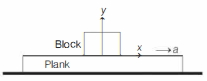
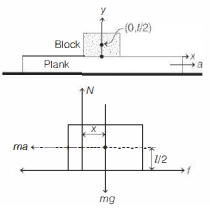
A plank is moving in a horizontal direction with a constant acceleration $\alpha \hat{ i }$. A uniform rough cubical block of side $l$ rests on the plank and is at rest relative to the plank. Let the centre of mass of the block be at $(0, l / 2)$ at a given instant. If $\alpha =g / 10$, then the normal reaction exerted by the plank on the block at that instant acts at
  • A
    $(0,0)$
  • $(-l / 20,0)$
  • C
    $(-l / 10,0)$
  • D
    $(l / 10,0)$

Answer

Correct option: B.
$(-l / 20,0)$
b
$(b)$ Given situation is Forces acting on the block are

In above diagram, ma=pseudo force due to acceleration of plank,

$f=$ force of static friction, $m g=$ weight of block and $N=$ normal reaction.

Here, we must note that due to motion of plank, normal reaction force does not passes through centre of mass.

If line of action of normal force at a distance $x$ from centre, then for equilibrium of block, net torque about centre of mass must be zero.

$\Rightarrow \quad \tau_{\substack{\text { Normal } \\ \text { reaction }}}=\tau_{\text {Friction }}$

$m g$ and $m a$ does not produces any torque about centre of mass as their line of action passes through centre of mass.

$\Rightarrow N \cdot x=f \cdot l / 2$

$\Rightarrow m g x=m a \frac{l}{2}$

${[\because N=m g \text { and } f=m a]}$

$\Rightarrow x=\left(\frac{a}{g}\right) \frac{l}{2}$

$\text { or } x=\frac{1}{10} \cdot \frac{l}{2} \quad\left[\because a=\frac{g}{10}\right]$

$\text { or } x=\frac{l}{20}$

So, coordinates of point from which reaction passes are $\left(-\frac{l}{20}, 0\right)$.
Need a full question paper?

Generate a complete, print-ready paper with questions like this in minutes — across 16+ boards, with answer keys.

Start Generating Free

Similar questions

A man is standing at a spring platform. Reading of spring balance is $60\, kg$ wt. If man jumps outside platform, then reading of spring balance
The required height of a TV tower which can cover the population of $6.03$ lakh is $h$. If the average population density is $100$ per square $km$ and the radius of earth is $6400\,km$, then the value of $h$ will be $...m .$
A heater of $220\, V$ heats a volume of water in $5\,\min$ time. A heater of $110\, V$ heats the same volume of water in ............... $min$
When unpolarised light beam is incident from air onto glass $(n = 1.5)$ at the polarising angle
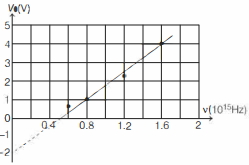
In a photocell circuit the stopping potential $V_0$ is a measure of the maximum kinetic energy of the photoelectrons. The following graph shows experimentally measured values of stopping potential versus frequency $v$ of incident light. The values of Planck's constant and the work function as determined from the graph are (taking, the magnitude of electronic charge to be $e=1.6 \times 10^{-19} C$ )
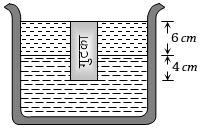
A cubical block of wood $10 \,cm$ on a side floats at the interface between oil and water with its lower surface horizontal and $4\, cm$ below the interface. The density of oil is $0.6gc{m^{ - 3}}$. The mass of block is ...... $gm$
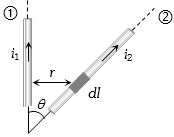
Wires $1$ and $2$ carrying currents ${i_1}$ and ${i_2}$respectively are inclined at an angle $\theta $ to each other. What is the force on a small element $dl$ of wire $2$ at a distance of $r$ from wire $1$ (as shown in figure) due to the magnetic field of wire $1$
In the below circuit, $C\, = \,\frac{{\sqrt 3 }}{2}\,\mu F,\,R = 20\,\,\Omega ,\,L = \frac{{\sqrt 3 }}{{10}}H$ and ${R_1} = 10\,\,\Omega .$ Current in $L-R_1$ path is $I_1$ and $C-R_2$ path is $I_2.$ The voltage of $A.C$ source is given by, $V\, = \,200\sqrt 2 \,\sin \,(100\,t)\,volts.$ The phase difference between $I_1$ and $I_2$ is
A body is projected up with a speed $'u'$ and the time taken by it is $T$ to reach the maximum height $H$. Pick out the correct statement
The fringe width in Young’s double slit experiment increases when