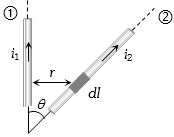
Wires $1$ and $2$ carrying currents ${i_1}$ and ${i_2}$respectively are inclined at an angle $\theta $ to each other. What is the force on a small element $dl$ of wire $2$ at a distance of $r$ from wire $1$ (as shown in figure) due to the magnetic field of wire $1$
AIEEE 2002,AIIMS 2013, Medium


Download our appand get started for free
Experience the future of education. Simply download our apps or reach out to us for more information. Let's shape the future of learning together!No signup needed.*
Similar Questions
- 1$20$ $ampere$ current is flowing in a long straight wire. The intensity of magnetic field at a distance $20\, cm$ from the wire will beView Solution
- 2This question has Statement $1$ and Statement $2$ . Of the four choices given after the Statements, choose the one that best describes the two Statements.View Solution
Statement $1$: A charged particle is moving at right angle to a static magnetic field . During the motion the kinetic energy of the charge remains unchanged.
Statement $2$: Static magnetic field exert force on a moving charge in the direction perpendicular to the magnetic field.
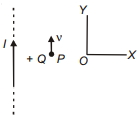
- 3A charge $Q$ moves parallel to a very long straight wire carrying a current $l$ as shown. The force on the charge isView Solution
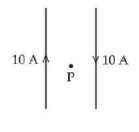
- 4Two long, straight wires carry equal currents in opposite directions as shown in figure. The separation between the wires is $5.0 \mathrm{~cm}$. The magnitude of the magnetic field at a point $P$ midway between the wires is __________$\mu \mathrm{T}$ (Given : $\mu_0=4 \pi \times 10^{-7} \mathrm{TmA}^{-1}$ )View Solution
- 5A uniform magnetic field $\vec B\,\, = \,\,{B_0}\,\hat j$ exists in a space. A particle of mass $m$ and charge $q$ is projected towards negative $x$-axis with speed $v$ from the a point $(d, 0, 0)$. The maximum value $v$ for which the particle does not hit $y-z$ plane isView Solution
- 6A proton, a deuteron and an $\alpha-$particle with same kinetic energy enter into a uniform magnetic field at right angle to magnetic field. The ratio of the radii of their respective circular paths isView Solution
- 7A current $I$ flows along the length of an infinitely long, straight, thin walled pipe. ThenView Solution
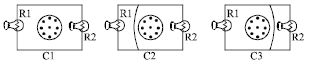
- 8A solenoid is oriented end-on so that its opening is perpendicular to the circuit containing the two light bulbs as drawn in figure $C_1.$ For figure $C_2$ and $C_3,$ a shorting wire of negligible resistance is added as shown. Assume that the magnetic field from the solenoid, shown coming out of the plane of the page, decreases uniformly with time at the same rate for each circuit. Rank the circuits for the brightness of the bulb labeled $R_1$ from brightest to dimmest.View Solution
- 9An electron is allowed to move with constant velocity along the axis of current carrying straight solenoid.View Solution
$A.$ The electron will experience magnetic force along the axis of the solenoid.
$B.$ The electron will not experience magnetic force.
$C.$ The electron will continue to move along the axis of the solenoid.
$D.$ The electron will be accelerated along the axis of the solenoid.
$E.$ The electron will follow parabolic path-inside the solenoid.
Choose the correct answer from the options given below:
- 10View SolutionA magnetic field