MCQ
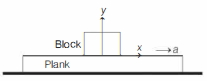
A plank is moving in a horizontal direction with a constant acceleration $\alpha \hat{ i }$. A uniform rough cubical block of side $l$ rests on the plank and is at rest relative to the plank. Let the centre of mass of the block be at $(0, l / 2)$ at a given instant. If $\alpha =g / 10$, then the normal reaction exerted by the plank on the block at that instant acts at
  • A
    $(0,0)$
  • $(-l / 20,0)$
  • C
    $(-l / 10,0)$
  • D
    $(l / 10,0)$

Answer

Correct option: B.
$(-l / 20,0)$
b
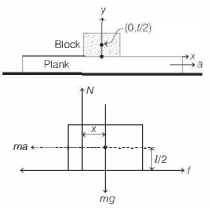
$(b)$ Given situation is Forces acting on the block are

In above diagram, ma=pseudo force due to acceleration of plank,

$f=$ force of static friction, $m g=$ weight of block and $N=$ normal reaction.

Here, we must note that due to motion of plank, normal reaction force does not passes through centre of mass.

If line of action of normal force at a distance $x$ from centre, then for equilibrium of block, net torque about centre of mass must be zero.

$\Rightarrow \quad \tau_{\substack{\text { Normal } \\ \text { reaction }}}=\tau_{\text {Friction }}$

$m g$ and $m a$ does not produces any torque about centre of mass as their line of action passes through centre of mass.

$\Rightarrow N \cdot x=f \cdot l / 2$

$\Rightarrow m g x=m a \frac{l}{2}$

${[\because N=m g \text { and } f=m a]}$

$\Rightarrow x=\left(\frac{a}{g}\right) \frac{l}{2}$

$\text { or } x=\frac{1}{10} \cdot \frac{l}{2} \quad\left[\because a=\frac{g}{10}\right]$

$\text { or } x=\frac{l}{20}$

So, coordinates of point from which reaction passes are $\left(-\frac{l}{20}, 0\right)$.
Need a full question paper?

Generate a complete, print-ready paper with questions like this in minutes — across 16+ boards, with answer keys.

Start Generating Free

Similar questions

A particle is projected horizontally from a tower with velocity $10\,m / s$. Taking $g=10\,m / s ^2$. Match the following two columns at time $t=1\,s$.
Column $I$ Column $II$
$(A)$ Horizontal component of velocity $(p)$ $5$ SI unit
$(B)$ Vertical component of velocity $(q)$ $10$ SI unit
$(C)$ Horizontal displacement $(r)$ $15$ SI unit
$(D)$ Vertical displacement $(s)$ $20$ SI unit
A block of mass $m$ is kept on a platform which starts from rest with constant acceleration $g/2$ upward, as shown in figure. Work done by normal reaction on block in time $t$ is
If $v$ is the speed of sound in air then the shortest length of the closed pipe which resonates to a frequency $n$
A block of mass $m$ moving with speed $v$ compresses a spring through distance $x$ before its speed is halved. What is the value of spring constant ?
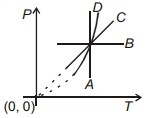
Following figure shows $P-T$ graph for four processes $A, B, C$ and $D$. Select the correct alternative.
A particle moves in a straight line and its position $x$ at time $t$ is given by $x^2=2+t$. Its acceleration is given by
A body of mass $2\, {kg}$ moving with a speed of $4\, {m} / {s}$. makes an elastic collision with another body at rest and continues to move in the original direction but with one fourth of its initial speed. The speed of the two body centre of mass is $\frac{x}{10} \,{m} / {s}$. Then the value of $x$ is ..... .
A planet in a distant solar system is $10$ times more massive than the earth and its radius is $10$ times smaller. Given that the escape velocity from the earth is $11$ $km/s$, the escape velocity from the surface of the planet would be ........  $kms^{-1}$.
If a particle of mass $m$ is moving in a horizontal circle of radius $r$ with a centripetal force $( - k/{r^2})$, the total energy is
With what velocity a ball be projected vertically so that the distance covered by it in $5^{th}$ second is twice the distance it covers in its $6^{th}$ second.........$m/s$ $(g = 10\,m/{s^2})$