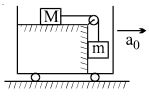
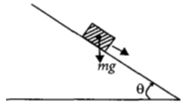
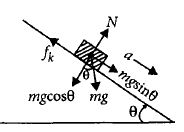
A plank with a box on it at one end is gradually raised about the other end. As the angle of inclination with the horizontal reaches $30^o $, the box starts to slip and slides $4.0\, m $ down the plank in $4.0\, s.$ The coefficients of static and kinetic friction between the box and the plank will be, respectively
AIPMT 2015, Diffcult


Download our appand get started for free
Experience the future of education. Simply download our apps or reach out to us for more information. Let's shape the future of learning together!No signup needed.*
Similar Questions
- 1The upper half of an inclined plane of inclination $\theta$ is perfectly smooth while the lower half is rough. A body starting from the rest at top comes back to rest at the bottom if the coefficient of friction for the lower half is given byView Solution
- 2A given object takes $n$ times the time to slide down $45^{\circ}$ rough inclined plane as it takes the time to slide down an identical perfectly smooth $45^{\circ}$ inclined plane. The coefficient of kinetic friction between the object and the surface of inclined plane is :View Solution
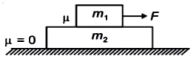
- 3In the given arrangement the maximum value of $F$ for which there is no relative motion between the blocksView Solution
- 4A car is moving on a circular level road of curvature $300\,metres.$ If the coefficient of friction is $0.3$ and acceleration due to gravity is $10\,m/s^2,$ the maximum speed the car can have is ........ $km/hr$View Solution
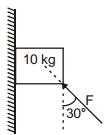
- 5A block of mass $10 \,kg$ is held at rest against a rough vertical wall $[\mu=0.5]$ under the action a force $F$ as shown in figure. The minimum value of $F$ required for it is ............ $N$ $\left(g=10 \,m / s ^2\right)$View Solution
- 6View SolutionA passenger inside a bus moving with uniform speed suddenly finds that a ball at rest, starts moving towards his left. It means that the bus now is
- 7A box of mass $m\, kg$ is placed on the rear side of an open truck accelerating at $4\, m/s^2$. The coefficient of friction between the box and the surface below it is $0.4$. The net acceleration of the box with respect to the truck is zero. The value of $m$ is :- $[g = 10\,m/s^2]$View Solution
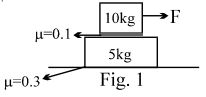
- 8The maximum acceleration of $5\, kg$ block ...... $m/s^2$View Solution
- 9$A$ block of mass $M$ is placed on $a$ horizontal surface and it is tied with an inextensible string to $a$ block of mass, as shown in figure. A block of mass $m_0$ is also placed on $M$ If there is no friction between any two surfaces, thenView Solution

- 10Imagine the situation in which the given arrangement is placed inside a trolley that can move only in the horizontal direction, as shown in figure. If the trolley is accelerated horizontally along the positive $x$ -axis with $a_0$, then Identify the correct statement $(s)$ related to the tension $T$ in the stringView Solution