A plate oscillated with time period $‘T’$. Suddenly, another plate put on the first plate, then time period
Easy
Download our app for free and get started
(c)Time period is independent of mass of pendulum.

Download our appand get started for free
Experience the future of education. Simply download our apps or reach out to us for more information. Let's shape the future of learning together!No signup needed.*
Similar Questions
- 1A simple harmonic wave having an amplitude a and time period $T$ is represented by the equation $y = 5\sin \pi (t + 4)m.$ Then the value of amplitude $(a)$ in $(m)$ and time period $(T) $ in second areView Solution
- 2There is a simple pendulum hanging from the ceiling of a lift. When the lift is stand still, the time period of the pendulum is $T$. If the resultant acceleration becomes $g/4,$ then the new time period of the pendulum isView Solution
- 3The period of a simple pendulum measured inside a stationary lift is found to be $T$. If the lift starts accelerating upwards with acceleration of $g/3,$ then the time period of the pendulum isView Solution
- 4Two springs of force constants $300\, N / m$ (Spring $A$) and $400$ $N / m$ (Spring $B$ ) are joined together in series. The combination is compressed by $8.75\, cm .$ The ratio of energy stored in $A$ and $B$ is $\frac{E_{A}}{E_{B}} .$ Then $\frac{E_{A}}{E_{B}}$ is equal toView Solution
- 5A particle of mass $m$ is attached to one end of a mass-less spring of force constant $k$, lying on a frictionless horizontal plane. The other end of the spring is fixed. The particle starts moving horizontally from its equilibrium position at time $t=0$ with an initial velocity $u_0$. When the speed of the particle is $0.5 u_0$, it collies elastically with a rigid wall. After this collision :View Solution
$(A)$ the speed of the particle when it returns to its equilibrium position is $u_0$.
$(B)$ the time at which the particle passes through the equilibrium position for the first time is $t=\pi \sqrt{\frac{ m }{ k }}$.
$(C)$ the time at which the maximum compression of the spring occurs is $t =\frac{4 \pi}{3} \sqrt{\frac{ m }{ k }}$.
$(D)$ the time at which the particle passes througout the equilibrium position for the second time is $t=\frac{5 \pi}{3} \sqrt{\frac{ m }{ k }}$.
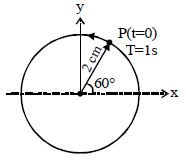
- 6Figure shows the circular motion of a particle. The radius of the circle, the period, sense of revolution and the initial position are indicated in the figure. The simple harmonic motion of the $x-$ projection of the radius vector of the rotating particle $P$ isView Solution
- 7View SolutionSelect wrong statement about simple,harmonic motion
- 8View SolutionA tunnel has been dug through the centre of the earth and a ball is released in it. It will reach the other end of the tunnel after
- 9A particle of mass m is under the influence of a force $F$ which varies with the displacement $x$ according to the relation $F = - kx + {F_0}$ in which $k$ and ${F_0}$ are constants. The particle when disturbed will oscillateView Solution
- 10Which of the following expressions corresponds to simple harmonic motion along a straight line, where $x$ is the displacement and $a, b, c$ are positive constants?View Solution