The period of a simple pendulum measured inside a stationary lift is found to be $T$. If the lift starts accelerating upwards with acceleration of $g/3,$ then the time period of the pendulum is
Medium
Download our app for free and get started
(c) For stationary lift ${T_1} = 2\pi \sqrt {\frac{l}{g}} $
For ascending lift with acceleration a, ${T_2} = 2\pi \sqrt {\frac{l}{{g + a}}} $
$ \Rightarrow \frac{{{T_1}}}{{{T_2}}} = \sqrt {\frac{{g + a}}{g}} $
$\Rightarrow \frac{{{T_1}}}{{{T_2}}} = \sqrt {\frac{{g + \frac{g}{3}}}{g}} = \sqrt {\frac{4}{3}}$
$\Rightarrow {T_2} = \frac{{\sqrt 3 }}{2}T$

Download our appand get started for free
Experience the future of education. Simply download our apps or reach out to us for more information. Let's shape the future of learning together!No signup needed.*
Similar Questions
- 1An oscillator of mass $M$ is at rest in its equilibrium position in a potential $V\, = \,\frac{1}{2}\,k{(x - X)^2}.$ A particle of mass $m$ comes from right with speed $u$ and collides completely inelastically with $M$ and sticks to it . This process repeats every time the oscillator crosses its equilibrium position .The amplitude of oscillations after $13$ collisions is: $(M = 10,\, m = 5,\, u = 1,\, k = 1 ).$View Solution
- 2If a simple pendulum oscillates with an amplitude of $50\, mm$ and time period of $2\, sec$, then its maximum velocity is .... $m/s$View Solution
- 3When a mass $m$ is attached to a spring, it normally extends by $0.2\, m$. The mass $m$ is given a slight addition extension and released, then its time period will beView Solution
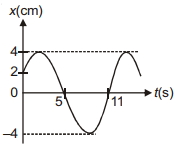
- 4Figure shows the position-time graph of an object in $S.H.M.$ The correct equation representing this motion is ..........View Solution
- 5A uniform cylinder of length $L$ and mass $M$ having cross-sectional area $A$ is suspended, with its length vertical, from a fixed point by a massless spring, such that it is half submerged in a liquid of density $\sigma $ at equilibrium position. When the cylinder is given a downward push and released, it starts oscillating vertically with a small amplitude. The time period $T$ of the oscillations of the cylinder will beView Solution
- 6Assume that a tunnel is dug along a chord of the earth, at a perpendicular distance $( R / 2)$ from the earth's centre, where $'R'$ is the radius of the Earth. The wall of the tunnel is frictionless. If a particle is released in this tunnel, it will execute a simple harmonic motion with a time periodView Solution
- 7A particle executes simple hormonic motion between $x =\, -A$ and $x = +A$ . It starts from $x = 0$ moves in $+x-$ direction. The time taken for it to move from $x = 0$ to $x = \frac {A}{2}$ is $T_1$ and to move from $\frac {A}{2}$ to $\frac {A}{\sqrt 2}$ is $T_2$ , thenView Solution
- 8View SolutionFor a particle executing simple harmonic motion, which of the following statements is not correct
- 9Two waves executing simple harmonic motion travelling in the same direction with same amplitude and frequency are superimposed. The resultant amplitude is equal to the $\sqrt{3}$ times of amplitude of individual motions. The phase difference between the two motions is $.....(degree)$View Solution
- 10A uniform rod of mass $m$ and length $I$ is suspended about its end, Time period of small angular oscillations is ..........View Solution