MCQ
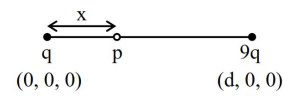
A point charge + q is placed at the origin. A second point charge +9 q is placed at $( d , 0,0)$ in Cartesian coordinate system. The point in between them where the electric field vanishes is :
  • A
    $(4 d / 3,0,0)$
  • $( d / 4,0,0)$
  • C
    $(3 d / 4,0,0)$
  • D
    $( d / 3,0,0)$

Answer

Correct option: B.
$( d / 4,0,0)$
(B) $( d / 4,0,0)$
Explanation:
Image
Let $E _{ p }=0$
$\begin{array}{l}\therefore \frac{kq}{x^2}=\frac{k 9 q}{(d-x)^2} \\
\Rightarrow \frac{d-x}{x}=3 \Rightarrow x=\frac{d}{4}\end{array}$
$\therefore$ co-ordinate of P is $\left(\frac{ d }{4}, 0,0\right)$

Need a full question paper?

Generate a complete, print-ready paper with questions like this in minutes — across 16+ boards, with answer keys.

Start Generating Free

Similar questions

When two monochromatic lights of frequency, $v$ and $\frac{v}{2}$ are incident on a photoelectric metal, their stopping potential becomes $\frac{V_{S}}{2}$ and $V_{s}$ respectively. The threshold frequency for this metal is :
In Millikan's oil drop experiment, what is viscous force acting on an uncharged drop of radius $2.0 \times 10^{-5}\, {m}$ and density $1.2 \times 10^{3} \,{kgm}^{-3}$ ? Take viscosity of liquid $=1.8 \times 10^{-5}\, {Nsm}^{-2} .$ (Neglect buoyancy due to air).
The source producing sound and an observer both are moving along the direction of propagation of sound waves. If the respective velocities of sound, source and an observer are $v,  {v_s}$ and ${v_o}$, then the apparent frequency heard by the observer will be ($n =$ frequency of sound)
Diode is used as a/an
The minimum energy required by a hydrogen atom in ground state to emit radiation in Balmer series is nearly :
A light spring of length $20\, cm$ and force constant $2\, kg/cm$ is placed vertically on a table. A small block of mass $1\, kg$. falls on it. The length $h$ from the surface of the table at which the ball will have the maximum velocity is ............... $\mathrm{cm}$
A proton and a deutron ( $\mathrm{q}=+\mathrm{e}, m=2.0 \mathrm{u})$ having same kinetic energies enter a region of uniform magnetic field $\vec{B}$, moving perpendicular to $\vec{B}$. The ratio of the radius $r_d$ of deutron path to the radius $r_p$ of the proton path is:
Three blocks $A$, $B$ and $C$ are pulled on a horizontal smooth surface by a force of $80 \mathrm{~N}$ as shown in figure

The tensions $T_1$ and $T_2$ in the string are respectively

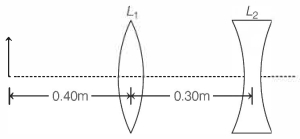
An object is placed $0.40 \,m$ from one of the two lenses $L_1$ and $L_2$ of focal lengths $0.20 \,m$ and $0.10 \,m$ respectively, as depicted in the figure. The separation between the lenses is $0.30 \,m$.The final image formed by these two lenses system is at
The relation between the linear magnification $m,$ the object distance $u$ and the focal length $f$ is