MCQ
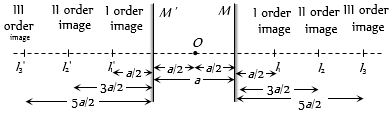
A point object is placed mid-way between two plane mirrors distance $'a'$ apart. The plane mirror forms an infinite number of images due to multiple reflection. The distance between the nth order image formed in the two mirrors is
  • A
    $na$
  • $2na$
  • C
    $na/2$
  • D
    $n^2\, a$

Answer

Correct option: B.
$2na$
b
(b) From above figure it can be proved that separation between nth order image formed in the two mirrors $= 2na$

Need a full question paper?

Generate a complete, print-ready paper with questions like this in minutes — across 16+ boards, with answer keys.

Start Generating Free

Similar questions

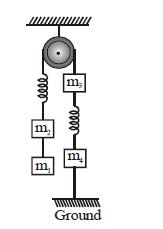
For the system shown in figure, $m_1>m_2>m_3 >m_4$ . Initially, the system is at rest in equilibrium condition. If the string joining $m_4$ and ground is cut, then just after the string is cut :

Statement $I$ $m_1$ ,$m_2$ ,$m_3$ remain stationary.

Statement $II$ The value of acceleration of all the $4$ blocks can be determined.

Statement $III$ Only $m_4$ remains stationary.

Statement $IV$ Only $m_4$ accelerates.

Statement $V$ All the four blocks remain stationary.

Now, choose the correct option.

A projectile is fired from horizontal ground with speed $v$ and projection angle $\theta$. When the acceleration due to gravity is $g$, the range of the projectile is $d$. If at the highest point in its trajectory, the projectile enters a different region where the effective acceleration due to gravity is $g^{\prime}=\frac{g}{0.81}$, then the new range is $d^{\prime}=n d$. The value of $n$ is. . . . .
The distance between the vertex and the centre of mass of a uniform solid planar circular segment of angular size $\theta$ and radius $R$ is given by
A beaker contains $200\, gm$ of water. The heat capacity of the beaker is equal to that of $20\, gm$ of water. The initial temperature of water in the beaker is $20°C.$ If $440\, gm$ of hot water at $92°C$ is poured in it, the final temperature (neglecting radiation loss) will be nearest to........ $^oC$
A piece of marble is projected from earth's surface with velocity of $19.6 \sqrt{2}\,m / s$ at $45^{\circ}.$ $2\,s$ later its velocity makes an angle $\alpha$ with horizontal, where $\alpha$ is $..........$
A body of mass $2\, kg$ is being dragged with uniform velocity of $2\, m/s$ on a rough horizontal plane. The coefficient of friction between the body and the surface is $0.20$. The amount of heat generated in $5 sec$ is ........ $cal$ $(J = 4.2\,joule/cal$ and $g = 9.8\,m/{s^2})$
Both the blocks shown here are of mass $m$ and are moving with constant velocity in direction shown in a resistive medium which exerts equal constant force on both blocks in direction opposite to the velocity. The tension in the string connecting both of them will be : (Neglect friction)
Radiation of two photon energies twice and five times the work function of metal are incident sucessively on the metal surface. The ratio of the maximum velocity of photoelectrons emitted is the two cases will be
A convex lens of focal length $0.5 m$ and concave lens of focal length $1 m$ are combined. The power of the resulting lens will be
For silver, Young's modulus is $7.25 \times {10^{10}}\,N/{m^2}$ and Bulk modulus is $11 \times {10^{10}}\,N/{m^2}$. Its Poisson's ratio will be