Question
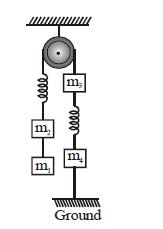
For the system shown in figure, $m_1>m_2>m_3 >m_4$ . Initially, the system is at rest in equilibrium condition. If the string joining $m_4$ and ground is cut, then just after the string is cut :

Statement $I$ $m_1$ ,$m_2$ ,$m_3$ remain stationary.

Statement $II$ The value of acceleration of all the $4$ blocks can be determined.

Statement $III$ Only $m_4$ remains stationary.

Statement $IV$ Only $m_4$ accelerates.

Statement $V$ All the four blocks remain stationary.

Now, choose the correct option.
Answer

Before cutting the string, the tension in string joining $m_{4}$ and ground is $T=\left(m_{1}+m_{2}-m_{3}-m_{4}\right) g$

And the spring force in the spring joing $m_{3}$ and $m_{4}$ is $T-m_{4} g .$

As the string is cut, the spring force do not change instantly, so just after cutting the string the equilibrium of $m_{1}, m_{2}$ and $m_{3}$would be maintained but $m_{4}$ accelerates in upward direction with acceleration given by

$a=\frac{T+m_{4} g-m_{4} g}{m_{4}}$

Need a full question paper?

Generate a complete, print-ready paper with questions like this in minutes — across 16+ boards, with answer keys.

Start Generating Free

Similar questions

Assertion $(A):$ In a meter bridge experiment, null point for an unknown resistance is put inside an enclosure maintained at a higher temperature. The null point can be obtained at the same $p$ as before by decreasing the value of the standard resistance.

Reason $(R):$ Resistance of metal increases with increase in temperature.

A gas is suddenly compressed to one fourth of its original volume. What will be its final pressure, if its initial pressure is $P$
Four equal positive charges are fixed at the vertices of a square of side $L$. $Z$-axis is perpendicular to the plane of the square. The point $z = 0$ is the point where the diagonals of the square intersect each other. The plot of electric field due to the four charges, as one moves on the $z-$ axis.
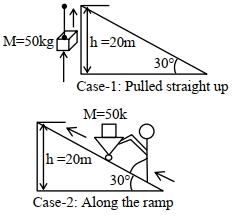
A body of mass $50 \mathrm{~kg}$ is lifted to a height of $20 \mathrm{~m}$ from the ground in the two different ways as shown in the figures. The ratio of work done against the gravity in both the respective cases, will be:
From a newly formed radioactive substance (Half life $2$ hours), the intensity of radiation is $64$ times the permissible safe level. The minimum time after which work can be done safely from this source is ..........$hours$
The magnetic moment of a diamagnetic atom is 
The potential energy of a particle varies with distance $x$ from a fixed origin as $U\, = \,\frac{{A\sqrt x }}{{{x^2} + B}}$ Where $A$ and $B$ are dimensional constants then find the dimensional formula for $A/B$
A light emitting diode $(LED)$ is fabricated using GaAs semiconducting material whose band gap is $1.42 \mathrm{eV}$. The wavelength of light emitted from the $LED$ is:
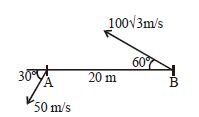
Velocity of two particles $A$ and $B$ separated by distance $20\ m$ apart is as shown in figure then ........ $rad/s$ will be the angular velocity of $B$ with respect to $A$
In a junction diode, the holes are due to