MCQ
A point source emits sound equally in all directions in a non-absorbing medium. Two points P and Qare at distances of 2 m and 3 m respectively from the source. The ratio of the intensities of the waves at P and Q is:
  • A
    $4: 9$
  • B
    $2: 3$
  • C
    $3: 2$
  • D
    $9: 4$

Need a full question paper?

Generate a complete, print-ready paper with questions like this in minutes — across 16+ boards, with answer keys.

Start Generating Free

Similar questions

Initial pressure and volume of a gas are $ P$ and $V$ respectively. First it is expanded isothermally to volume $4V$ and then compressed adiabatically to volume $ V$. The final pressure of gas will be
The temperature of a gas is $ -68^\circ C$. At ...... $^oC$ temperature will the average kinetic energy of its molecules be twice that of at $ -68^\circ C$
Two sound waves of wavelengths $5m$ and $6m$ formed $30$ beats in $3$ seconds. The velocity of sound is  .... $ms^{-1}$
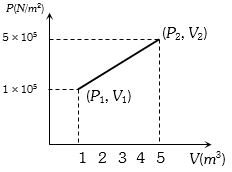
A system changes from the state $({P_1},\;{V_1})$ to $({P_2},{V_2})$ as shown in the figure. What is the work done by the system
If two liquids of same volume but different densities $\rho_1$ and $\rho_2$ are mixed, then density of mixture is given by:
The r.m.s. velocity of a gas at a certain temperature is $\sqrt 2 $ times than that of the oxygen molecules at that temperature. The gas can be
A rocket is fired upward from the earth's surface such that it creates an acceleration of $19.6 \,m/sec^2$. If after $5 \,sec$ its engine is switched off, the maximum height of the rocket from earth's surface would be.........$m$
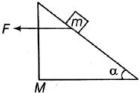
A wooden wedge of mass $M$ and inclination angle $(\alpha)$ rest on a smooth floor. A block of mass $m$ is kept on wedge. A force $F$ is applied on the wedge as shown in the figure such that block remains stationary with respect to wedge. So, magnitude of force $F$ is
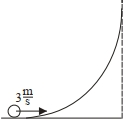
A hollow spherical ball of uniform density rolls up a curved surface with an initial velocity $3\, m / s$ (as shown in figure). Maximum height with respect to the initial position covered by it will be $...........cm$.
Which of the following quantities is zero on an average for the molecules of an ideal gas in equilibrium?