MCQ
A point source emits sound equally in all directions in a nonabsorbing medium, Two points $P$ and $Q$ are at distance of $2 \mathrm{~m}$ and $3 m$ respectively from the source. The ratio of the intensities of the waves at $P$ and $Q$ is
  • $9: 4$
  • B
    $2: 3$
  • C
    $3: 2$
  • D
    $4: 9$

Answer

Correct option: A.
$9: 4$
Intensity $\propto \frac{1}{\text(Distance)^2}\Rightarrow\frac{I_1}{I_2}=\left(\frac{d_2}{d_1}\right)^2=\left(\frac{3}{2}\right)^2=\frac{9}{4}$.

Need a full question paper?

Generate a complete, print-ready paper with questions like this in minutes — across 16+ boards, with answer keys.

Start Generating Free

Similar questions

Weight of $1 \mathrm{~kg}$ becomes $1 / 6$ on moon. If radius of moon is $1.768 \times 10^6 \mathrm{~m}$, then the mass of moon will be
The length of the second pendulum on the surface of earth is $1 m$. The length of seconds pendulum on the surface of moon, where $g$ is $1 / 6$ th value of $g$ on the surface of earth, is
At magnetic poles of earth, angle of dip is
In photoelectric effect if the intensity of light is doubled then maximum kinetic energy of photoelectrons will become
A particle of charge $q$ and mass $m$ moves in a circular orbit of radius $r$ with angular speed $\omega $. The ratio of the magnitude of its magnetic moment to that of its angular momentum depends on
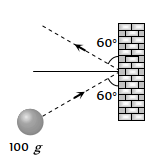
A mass of $100 \mathrm{~g}$ strikes the wall with speed $5 \mathrm{~m} / \mathrm{s}$ at an angle as shown in figure and it rebounds with the same speed. If the contact time is $2 \times 10^{-3} \mathrm{sec}$, what is the force applied on the mass by the wall
Image
The magnifying power of an astronomical telescope for relaxed vision is $16.$ On adjusting, the distance between the objective and eye lens is $34 \mathrm{~cm}$. Then the focal length of objective and eye lens will be respectively
The diameter of the objective of the telescope is $0.1$ metre and wavelength of light is $6000 \mathring A$. Its resolving power would be approximately
A body sliding on a smooth inclined plane requires 4 seconds to reach the bottom starting from rest at the top. How much time does it take to cover one-fourth distance starting from rest at the top
The ratio of de-Broglie wavelengths of molecules of hydrogen and helium which are at temperature $27 C$ and $127 C$ respectively is