Question
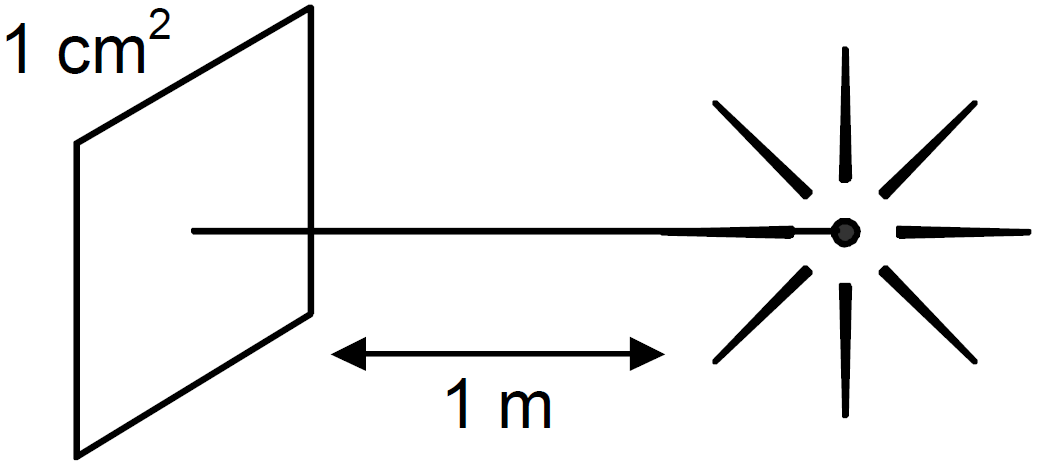
A point source emitting alpha particles is placed at a distance of 1m from a counter which records any alpha particle falling on its 1cm2 window. If the source contains 6.0 × 10¹⁶ active nuclei and the counter records a rate of 50000 counts/ second, find the decay constant. Assume that the source emits alpha particles uniformly in all directions and the alpha particles fall nearly normally on the window.
Answer

Counts received per cm2 = 50000 Counts/sec.
N = N3o of active nucleic = 6 × 10¹⁶
Total counts radiated from the source = Total surface area × 50000 counts/cm2
= 4 × 3.14 × 1 × 104 × 5 × 104 = 6.28 × 10⁹ $\text{Counts}=\frac{\text{dN}}{\text{dt}}$
We know, $\frac{\text{dN}}{\text{dt}}=\lambda\text{N}$
$\lambda=\frac{6.28\times10^9}{6\times10^{16}}=1.0467\times10^{-7}=1.05\times10^{-7}\text{s}^{-1}$

Need a full question paper?

Generate a complete, print-ready paper with questions like this in minutes — across 16+ boards, with answer keys.

Start Generating Free

Similar questions

The Bohr model for the H-atom relies on the Coulomb’s law of electrostatics. Coulomb’s law has not directly been verified for very short distances of the order of angstroms. Supposing Coulomb’s law between two opposite charge +q1, -q2 is modified to
$|\text{F}|=\frac{\text{q}_1\text{q}_2}{(4\pi\in_0)}\frac{1}{\text{r}^2}.\text{r}\geq\text{R}_0$
$=\frac{\text{q}_1\text{q}_2}{(4\pi\in_0)}\frac{1}{\text{R}^2_0}\Big(\frac{\text{R}_0}{\text{r}}\Big)^{\in}.\text{r}\geq\text{R}_0$
Calculate in such a case, the ground state energy of a H-atom, if $\in=0.1,\text{R}_0=1\mathring{\text{A}}$.
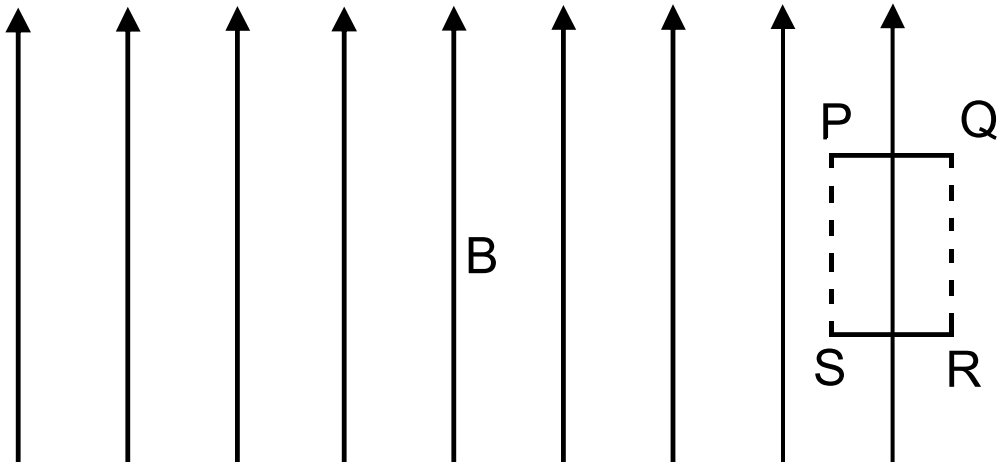
Sometimes we show an idealised magnetic field which is uniform in a given region and falls to zero abruptly. One such field is represented in figure. Using Ampere's law over the path PQRS, show that such a field is not possible.

A proton projected in a magnetic field of 0.020T travels along a helical path of radius 5.0cm and pitch 20cm. Find the components of the velocity of the proton along and perpendicular to the magnetic field. Take the mass of the proton = 1.6 × 10⁻²⁷kg
Given the resistances of $1\ \Omega,\ 2\ \Omega,\ 3\ \Omega,$ how will be combine them to get an equivalent resistance of,
  1. $(11/3)\ \Omega$
  2. $(11/5)\ \Omega$
  3. $6\ \Omega$
  4. $(6/11)\ \Omega?$
The volume of a glass vessel is 1000 cc at 20°C. What volume of mercury should be poured into it at this temperature so that the volume of the remaining space does not change with temperature? Coefficients of cubical expansion of mercury and glass are 1.8 × 10-4 °C and 9·0 × 10-6 °C-1 respectively.
Light is incident from glass $(\mu=1.50)$ to water $(\mu=1.33).$ Find the range of the angle of deviation for which there are two angles of incidence.
A uniform rod of mass m and length l is struck at an end by a force F perpendicular to the rod for a short time interval t. Calculate:
  1. The speed of the centre of mass.
  2. The angular speed of the rod about the centre of mass.
  3. The kinetic energy of the rod.
  4. The angular momentum of the rod about the centre of mass after the force has stopped to act. Assume that t is so small that the rod does not appreciably change its direction while the force acts.
Derive the lens formula $\frac{1}{\text{f}}=\frac{1}{\text{v}}-\frac{1}{\text{u}}$ for a thin concave lens, using the necessary ray diagram.
A rod, when suspended in a magnetic field, stays in the east-west direction. Can we be sure that the field is in the east-west direction? Can it be in the north-south direction?
A heavy ball is suspended from the ceiling of a motor car through a light string. A transverse pulse travels at a speed of 60cm/s on the string when the car is at rest and 62cm/s when the car accelerates on a horizontal road. Find the acceleration of the car. Take g = 10m/s2.