Question
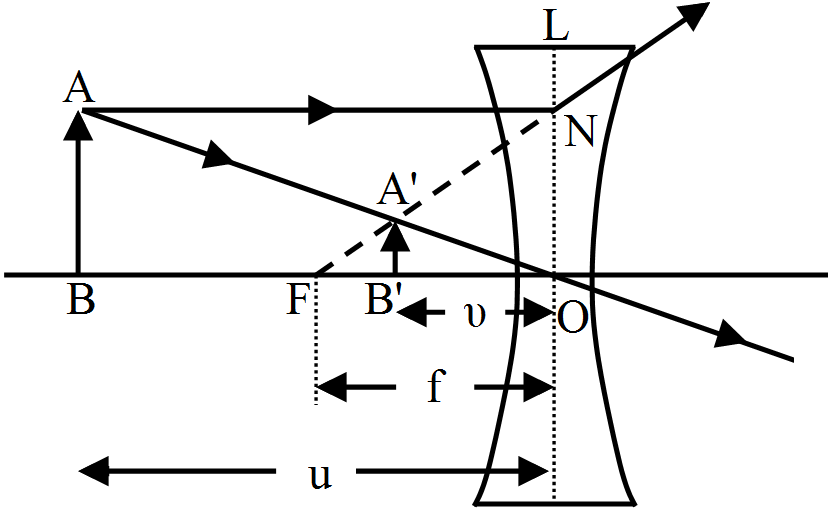
Derive the lens formula $\frac{1}{\text{f}}=\frac{1}{\text{v}}-\frac{1}{\text{u}}$ for a thin concave lens, using the necessary ray diagram.
Answer

The formation of image by a concave lens 'L' is shown in fig. AB is object and A' B' is the image. Triangles ABO and A' B' O are similar

$\frac{\text{AB}}{\text{A}'\text{B}}=\frac{\text{OB}}{\text{OB}'}\dots(\text{i})$

Also triangles NOF and A' B' F are similar

$\frac{\text{NO}}{\text{A}'\text{B}}=\frac{\text{OP}}{\text{FB}'}$

But NO = AB

$\frac{\text{AB}}{\text{A}'\text{B}'}=\frac{\text{OB}}{\text{FB}'}\dots(\text{i})$

Comparing equation (i) and (ii)

$\frac{​\text{OB}​}{\text{OB}'}=\frac{\text{OF}}{\text{FB}'}$

$\Rightarrow\frac{\text{OB}}{\text{OB}'}=\frac{\text{OF}}{\text{OF}-\text{OB}'}$

Using sign conventions of coordinate geometry

OB = -u, OB' = -v, OF = -f

$\frac{-\text{u}}{-\text{v}}=\frac{-\text{f}}{-\text{f}+\text{v}}$

$\Rightarrow\text{uf}-\text{uv}=\text{vf}$

$\Rightarrow\text{uv}=\text{uf}-\text{uf}$

Dividing throughout by uvf, we get

$\frac{1}{\text{f}}=\frac{1}{\text{v}}-\frac{1}{\text{u}}$

This is the required lens formula.

Need a full question paper?

Generate a complete, print-ready paper with questions like this in minutes — across 16+ boards, with answer keys.
Start Generating Free

Similar questions

The magnetic field inside a long solenoid having 50 turns/cm is increased from 2·5 × 10.3T to 2.5T when an iron core of cross-sectional area 4cm2 is inserted into it. Find:
  1. The current in the solenoid.
  2. The magnetization I of the core.
  3. The pole strength developed in the core.
Write characteristics of different components of electromagnetic waves and describe them.
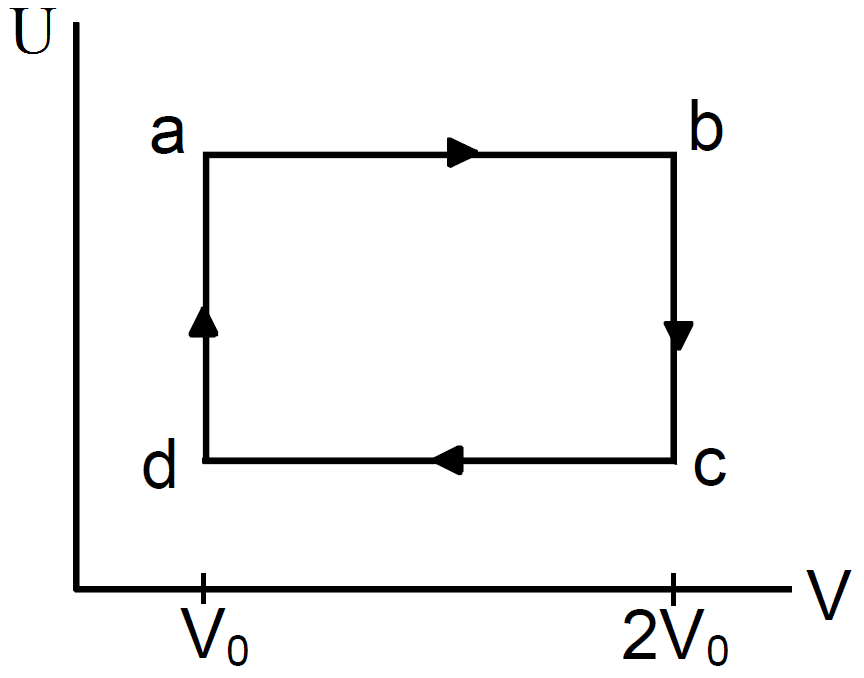
Figure. shows the variation in the internal energy U with the volume V of 2.0mol of an ideal gas in a cyclic process abcda. The temperatures of the gas at b and c are 500K and 300K respectively. Calculate the heat absorbed by the gas during the process.

Suppose the space between the two inner shells of the previous problem is filled with a dielectric of dielectric coastant K. Find the capacitance of the system between A and B.
One day Chetan’s mother developed a severe stomach ache all of a sudden. She was rushed to the doctor who suggested for an immediate endoscopy test and gave an estimate of expenditure for the same. Chetan immediately contacted his class teacher and shared the information with her. The class teacher arranged for the money and rushed to the hospital. On realising that Chetan belonged to a below average income group family, even the doctor offered concession for the test fee. The test was conducted successfully.
Answer the following questions based on the above information:
  1. Which principle in optics is made use of in endoscopy?
  2. Briefly explain the values reflected in the action taken by the teacher.
  3. In what way do you appreciate the response of the doctor on the given situation?
Suppose the block of the previous problem is pushed down the incline with a force of 4N. How far will the block move in the first two seconds after starting from rest? The mass of the block is 4kg.
A capacitor stores $50\mu\text{C}$ charge when connected across a battery. When the gap between the plates is filled with a dielectric, a charge of $100\mu\text{C}$ flows through the battery. Find the dielectric constant of the material inserted.
a. Draw graphs showing the variations of inductive reactance and capacitive reactance with the frequency of the applied ac source.
b. Draw the phasor diagram for a series RC circuit connected to an ac source.
c. An alternating voltage of 220 V is applied across a device X, a current of 0.25 A flows, which lag behind the applied voltage in phase by $\frac{\pi}{2}$ radian. If the same voltage is applied across another device Y, the same current flows but now it is in phase with the applied voltage.
i. Name the devices X and Y.
ii. Calculate the current flowing in the circuit when the same voltage is applied across the series combination of X and Y.
An icebox almost completely filled with ice at 0°C is dipped into a large volume of water at 20°C. The box has walls of surface area 2400cm2, thickness 2.0mm and thermal conductivity $0.06\text{Wm}^{-1}{^{\circ}}\text{C}^{-1}.$ Calculate the rate at which the ice melts in the box. Latent heat of fusion of ice $= 3.4\times10^5\text{Jkg}^{-1}.$
The resistance of an iron wire and a copper wire at 20°C are $3.9\Omega$ and $4.1\Omega,$ respectively. At what temperature will the resistance be equal? Temperature coefficient of resistivity for iron is $5.0\times10^{-3}\text{K}^{-1}$ and for copper, it is $4.0\times10^{-3}\text{K}^{-1}.$ Neglect any thermal expansion.