Question
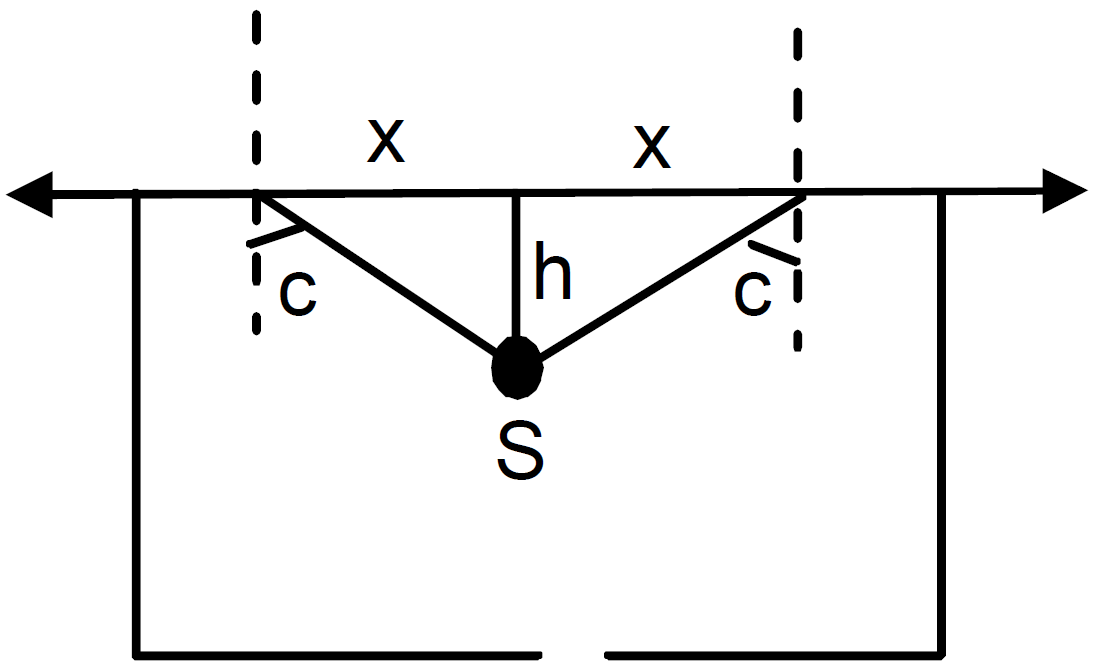
A point source is placed at a depth h below the surface of water (refractive index = μ).
  1. Show that light escapes through a circular area on the water surface with its centre directly above the point source.
  2. Find the angle subtended by a radius of the area on the source.
Answer

  1. Let, x = radius of the circular area
$\frac{\text{x}}{\text{h}}=\tan\theta_\text{C}$ (where C is the critical angle)

$\Rightarrow\frac{\text{x}}{\text{h}}=\frac{\sin\theta_\text{C}}{\sqrt{1-\sin^2\theta_\text{C}}}=\frac{\frac{1}{\mu}}{\sqrt{1-\frac{1}{\mu^2}}} \ \Big(\because \ \sin\theta_\text{C}=\frac{1}{\mu}\Big)$

$\Rightarrow\frac{\text{x}}{\text{h}}=\frac{1}{\sqrt{\mu^2-1}}$ or $\text{x}=\frac{\text{h}}{\sqrt{\mu^2-1}}$

So, light escapes through a circular area on the water surface directly above the point source.
  1. Angle subtained by a radius of the area on the source, $\theta_\text{C}=\sin^{-1}\Big(\frac{1}{\mu}\Big)$

Need a full question paper?

Generate a complete, print-ready paper with questions like this in minutes — across 16+ boards, with answer keys.

Start Generating Free

Similar questions

Does short-sightedness (myopia) or long-sightedness (hypermetropia) imply necessarily that the eye has partially lost its ability of accommodation? If not, what might cause these defects of vision?
About 5% of the power of a 100 W light bulb is converted to visible radiation. What is the average intensity of visible radiation
  1. at a distance of 1m from the bulb?
  2. at a distance of 10 m?
Assume that the radiation is emitted isotropically and neglect reflection.
A Young's double slit apparatus has slits separated by 0.28mm and a screen 48cm away from the slits. The whole apparatus is immersed in water and the slits are illuminated by the red light ($\lambda=700\text{nm}$ in vacuum). Find the fringe-width of the pattern formed on the screen.
In RL and RC series AC circuits the resonance phenomenon isn't possible. Why?
A farsighted person cannot see objects placed closer to 50cm. Find the power of the lens needed to see the objects at 20cm.
In discussing Doppler effect, we use the word "apparent frequency". Does it mean that the frequency of the sound is still that of the source and it is some physiological phenomenon in the listener's ear that gives rise to Doppler effect? Think for the observer approaching the source and for the source approaching the observer.
A uniformly charged conducting sphere of 2.4 m diameter has a surface charge density of $80.0\ μC/m^2$.
  1. Find the charge on the sphere.
  2. What is the total electric flux leaving the surface of the sphere?
Give the SI unit and definition of electric charge and also write down the smaller unit.
A hydrogen atom in a state having a binding energy of 0.85eV makes transition to a state with excitation energy 10.2eV (a) Identify the quantum numbers n of the upper and the lower energy states involved in the transition. (b) Find the wavelength of the emitted radiation.
What conclusion can you draw from the following observations on a resistor made of alloy manganin?
Current A
Voltage V
Current A
Voltage V
0.2
0.4
0.6
0.8
1.0
2.0
3.94
7.87
11.8
15.7
19.7
39.4
3.0
4.0
5.0
6.0
7.0
8.0
59.2
78.8
98.6
118.5
138.2
158.0