Question
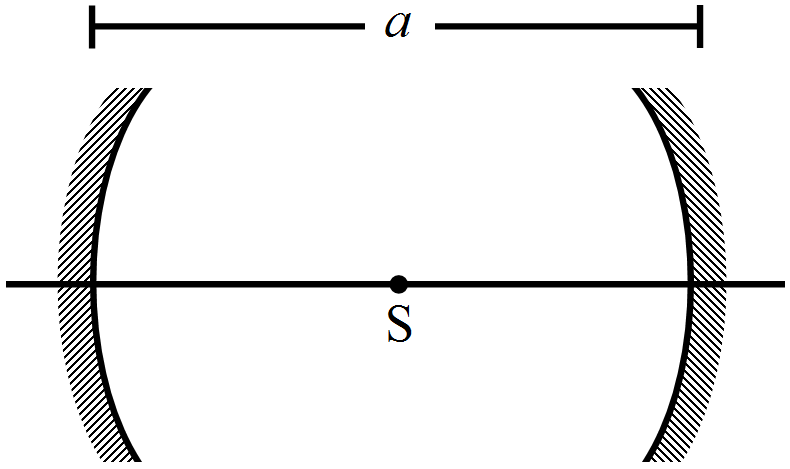
A point source S is placed midway between two converging mirrors having equal focal length f. Find the values of d for which only one image is formed.
Answer


Both the mirrors have equal focal length f.
They will produce one image under two conditions.
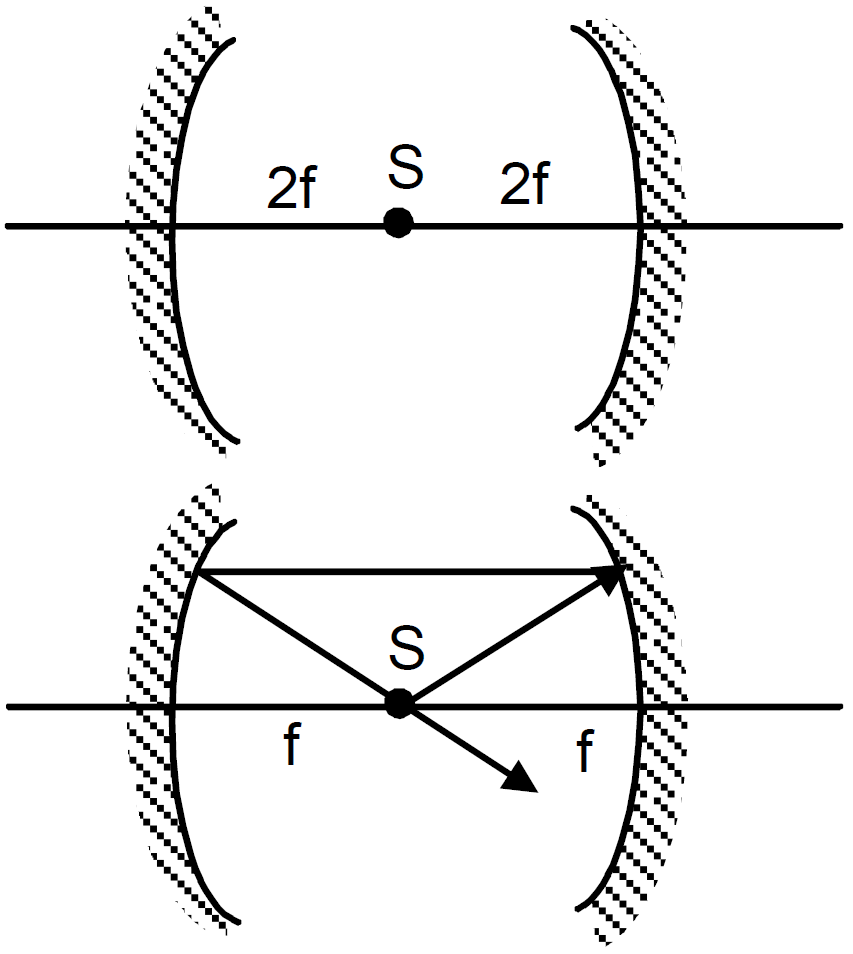
Case I: When the source is at distance ‘2f’ from each mirror i.e. the source is at centre of curvature of the mirrors, the image will be produced at the same point S. So, d = 2f + 2f = 4f.
Case II: When the source S is at distance ‘f’ from each mirror, the rays from the source after reflecting from one mirror will become parallel and so these parallel rays after the reflection from the other mirror the object itself. So, only sine image is formed.
Here, d = f + f = 2f

Need a full question paper?

Generate a complete, print-ready paper with questions like this in minutes — across 16+ boards, with answer keys.
Start Generating Free

Similar questions

Find the speed at which the kinetic enei:gy of a particle will differ by 1% from its nonrelativistic value $\frac{1}{2}\text{m}_0\text{v}^2$
Derive an expression for equivalent capacitance of three capacitors when connected
i. in series and
ii. in parallel.
A piano wire A vibrates at a fundamental frequency of 600Hz. A second identical wire B produces 6 beats per second with it when the tension in A is slightly increased. Find the ratio of the tension in A to the tension in B.
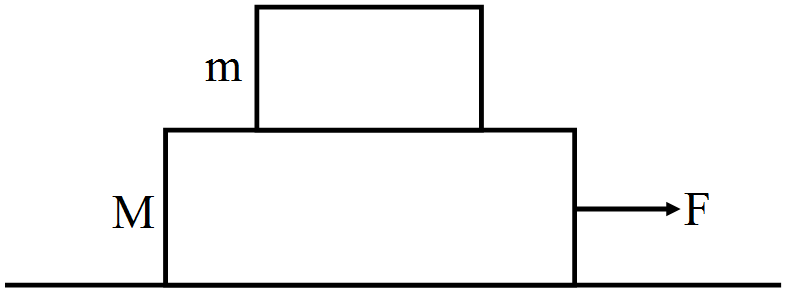
A block of mass m is kept over another block of mass M and the system rests on a horizontal surface figure. A constant horizontal force F acting on the lower block produces an acceleration $\frac{\text{F}}{2(\text{m+M})}$ in the system, the two blocks always move together.
  1. Find the coefficient of kinetic friction between the bigger block and the horizontal surface.
  2. Find the frictional force acting on the smaller block.
  3. Find the work done by the force of friction on the smaller block by the bigger block during a displacement d of the system.
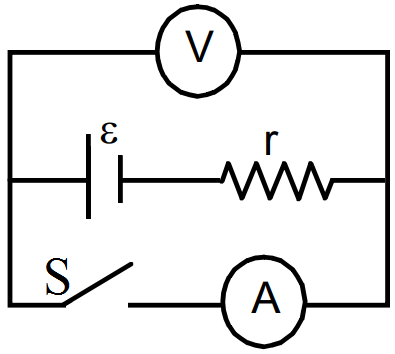
Figure. shows an arrangement to measure the emf $\epsilon$ and internal resistance r of a battery. The voltmeter has a very high resistance and the ammeter also has some resistance. The voltmeter reads 1.52V when the switch S is open. When the switch is closed, the voltmeter reading drops to 1.45V and the ammeter reads 1.0A. Find the emf and the internal resistance of the battery.
Figure shows a square loop of edge a made of a uniform wire. A current i enters the loop at the point A and leaves it at the point C. Find the magnetic field at the point P which is on the perpendicular bisector of AB at a distance $\frac{\text{a}}{4}$ from it.
A rectangular frame of wire abcd has dimensions $32\ cm \times 8.0\ cm$ and a total resistance of $2.0\Omega.$ It is pulled out of a magnetic field $B = 0.020T$ by applying a force of $3.2 \times 10^{-5}N\ ($figure$)$. It is found that the frame moves with constant speed. Find
The energy from the sun reaches just outside the earth's atmosphere at a rate of $1400\ W/m^2.$ The distance between the sun and the earth is $1.5 \times 10^{11}m.$
  1. Calculate the rate at which the sun is losing its mass.
  2. How long will the sun last assuming a constant decay at this rate? The present mass of the sun is $2 \times 10^{80}\ kg.$
Explain oscillating action of a n-p-n transistor with circuit diagram.
Consider the fission of $^{238}_{92}\text{U}$ by fast neutrons. In one fission event, no neutrons are emitted and the final end products, after the beta decay of the primary fragments, are  $^{140}_{58}\text{Ce}$ and   $^{99}_{44}\text{Ru}.$ Calculate $Q$ for this fission process.
The relevant atomic and particle masses are:
$\text{m}(^{238}_{92}\text{U})=238.05079\text{ u}$
$\text{m}(^{140}_{58}\text{Ce})=139.90543\text{ u}$
$\text{m}(^{99}_{44}\text{Ru})=98.90594\text{ u}$