Question
Derive an expression for equivalent capacitance of three capacitors when connected
i. in series and
ii. in parallel.

Answer

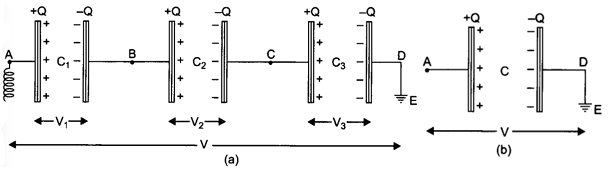
i. In fig. (a) three capacitors of capacitances $C_1, C_2, C_3$ are connected in series between points $A$ and $D$.
Image

In series first plate of each capacitor has charge +Q and second plate of each capacitor has charge -Q i.e., charge on each capacitor is Q.
Let the potential differences across the capacitors $C_1, C_2, C_3$ be $V_1, V_2, V_3$ respectively. As the second plate of first capacitor $C _1$ and first plate of second capacitor $C _2$ are connected together, their potentials are equal. Let this common potential be $V _{ B }$ Similarly the common potential of second plate of $C _2$ and first plate of $C _3$ is $V _{ C }$. The second plate of capacitor $C _3$ is connected to earth, therefore its potential $V_D=0$. As charge flows from higher potential to lower potential, therefore $V_A>V_B$ $> V _{ C }> V _{ D }$.
For the first capacitor, $V _1= V _{ A }- V _{ B }=\frac{Q}{C_1} \ldots$ (i)
For the second capacitor, $V _2= V _{ B }- V _{ C }=\frac{Q}{C_2} \ldots$ (ii)
For the third capacitor, $V _3= V _{ C }- V _{ D }=\frac{q}{c_3} \ldots$ (iii)
Adding (i), (ii) and (iii), we get
$V _1+ V _2+ V _3= V _{ A }- V _{ D }=Q\left[\frac{1}{C_1}+\frac{1}{C_2}+\frac{1}{C_3}\right] \ldots$ (iv)
If V be the potential difference between A and D, then
$V _{ A }- V _{ D }= V$
$\therefore$ From (iv), we get
$V =\left( V _1+ V _2+ V _3\right)=Q\left[\frac{1}{C_1}+\frac{1}{C_2}+\frac{1}{C_3}\right] \ldots( v )$
If in place of all the three capacitors, only one capacitor is placed between A and D such that on giving it charge Q, the potential difference between its plates become V, then it will be called equivalent capacitor. If its capacitance is C, then
$V =\frac{Q}{C} \ldots( vi )$
Comparing (v) and (vi), we get
$\frac{Q}{C}=Q\left[\frac{1}{C_1}+\frac{1}{C_2}+\frac{1}{C_3}\right]$ or $\frac{1}{C}=\frac{1}{C_1}+\frac{1}{C_2}+\frac{1}{C_3} \ldots$ (vii)
Thus in series arrangement, "The reciprocal of equivalent capacitance is equal to the sum of the reciprocals of the individual capacitors."

Need a full question paper?

Generate a complete, print-ready paper with questions like this in minutes — across 16+ boards, with answer keys.
Start Generating Free

Similar questions

Answer the following question:
It is necessary to use satellites for long distance TV transmission. Why?
The temperature and pressure at Simla are $15.0^\circ C$ and $72.0\ cm$ of mercury and at Kalka these are $35.0^\circ C$ and $76.0\ cm$ of mercury. Find the ratio of air density at Kalka to the air density at Simla.
A certain element emits $\text{K}_\alpha$ X-ray of energy 3.69keV. Use the data from the previous problem to identify the element.
A point source emitting alpha particles is placed at a distance of $1m$ from a counter which records any alpha particle falling on its $1\ cm^2$ window. If the source contains $6.0 \times 10^{16}$ active nuclei and the counter records a rate of $50000$ counts/ second, find the decay constant. Assume that the source emits alpha particles uniformly in all directions and the alpha particles fall nearly normally on the window.
The current $−$ voltage characteristic of an ideal $p-n$ junction diode is given by $\text{i}=\text{i}_0\Big(\text{e}^{\frac{\text{eV}}{\text{kT}}}-1\Big)$ where, the drift current $i_0$ equals $10\mu\text{A}.$ Take the temperature $T$ to be $300K.$
  1. Find the voltage $V_0$ for which $\text{e}^{\frac{\text{eV}}{\text{KT}}}=100.$ One can neglect the term $1$ for voltages greater than this value.
  2. Find an expression for the dynamic resistance of the diode as a function of $V$ for $V > V_0$.
  3. Find the voltage for which the dynamic resistance is $0.2\Omega.$
​​​​​​​
Define the term magnetic moment of a current loop. Write the expression for the magnetic moment when an electron revolves at a speed v around an orbit of radius ‘r’ in hydrogen atom.
Total charge $-Q$ is uniformly spread along length of a ring of radius $R. A$. small test charge $+q$ of mass $m$ is kept at the centre of the ring and is given a gentle push along the axis of the ring.
  1. Show that the particle executes a simple harmonic oscillation.
  2. Obtain its time period.
​​​​​
Ram is a  student of class X in a village school. His uncle gifted him a bicycle with a dynamo fitted in it. He was very excited to get it. While cycling during night, he could light the bulb and see the objects on the road. He however, did not know this device works. He asked this question to his teacher. the teacher considered it an opportunity to explain the working to the whole class.
Answer the following question:
  1. State the principle and working of a dynamo.
  2. Write two values each displayed by Ram and his school teacher.
A small particle travelling with a velocity u collides elastically with a spherical body of equal mass and of radius r initially kept at rest. The centre of this spherical body is located a distance (p < r) away from the direction of motion of the particle. Find the final velocities of the two particles.

[Hint: The force acts along the normal to the sphere through the contact. Treat the collision as onedimensional for this direction. In the tangential direction no force acts and the velocities do not change].
What is the
  1. Momentum,
  2. Speed, and
  3. De Broglie wavelength of an electron with kinetic energy of $120 eV.$