Question
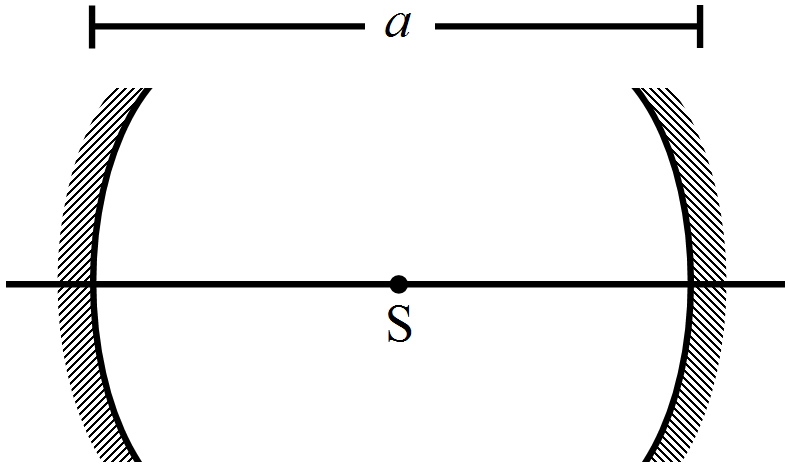
A point source S is placed midway between two converging mirrors having equal focal length f. Find the values of d for which only one image is formed.
Answer


Both the mirrors have equal focal length f.

They will produce one image under two conditions.

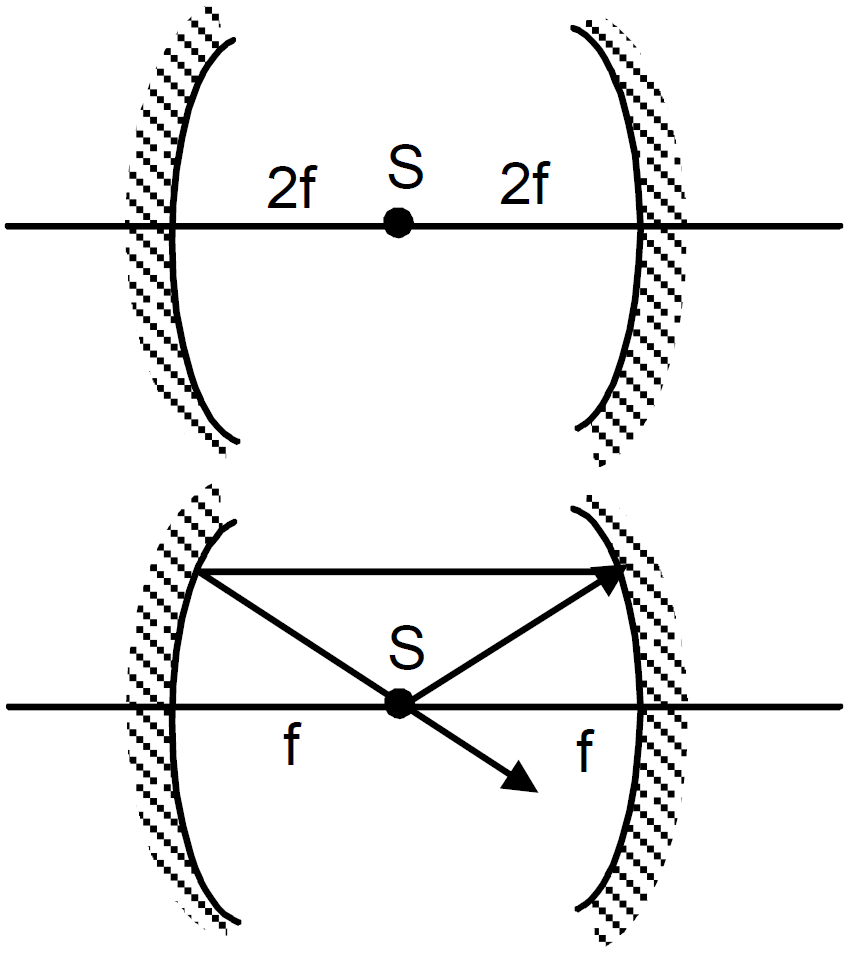
Case I: When the source is at distance ‘2f’ from each mirror i.e. the source is at centre of curvature of the mirrors, the image will be produced at the same point S. So, d = 2f + 2f = 4f.

Case II: When the source S is at distance ‘f’ from each mirror, the rays from the source after reflecting from one mirror will become parallel and so these parallel rays after the reflection from the other mirror the object itself. So, only sine image is formed.

Here, d = f + f = 2f

Need a full question paper?

Generate a complete, print-ready paper with questions like this in minutes — across 16+ boards, with answer keys.
Start Generating Free

Similar questions

What is a voltmeter? How can a galvanometer be converted into a voltmeter of given range? Explain.
For an LCR circuit driven at frequency $\omega$, the equation reads $\text{L}\frac{\text{di}}{\text{dt}}+\text{Ri}+\frac{\text{q}}{\text{C}}=\text{v}_\text{i}=\text{v}_\text{m}\sin\omega\text{t}$.
  1. Multiply the equation by i and simplify where possible.
  2. Interpret each term physically.
  3. Cast the equation in the form of a conservation of energy statement.
  4. Intergrate the equation over one cycle to find that the phase difference between v and i must be acute.
A wire in the form of a tightly wound solenoid is connected to a DC source, and carries a current. If the coil is stretched so that there are gaps between successive elements of the spiral coil, will the current increase or decrease? Explain.
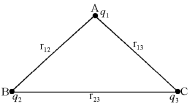
Write the definition of electrostatic at any point. Also write its S.I. units. As shown in the figure, three points charges $q_1$, $q _2$ and $q _3$ are placed at points $A, B$ and $C$ respectively. Drive an expression for the electrostatic potential energy of this system.

Image
A turn of radius 20m is banked for the vehicles going at a speed of 36 km/h. If the coefficient of static friction between the road and the tyre is 0.4, what are the possible speeds of a vehicle so that it neither slips down nor skids up?
A particle of mass m and charge q is released from the origin in a region in which the electric field and magnetic field are given by
$\overrightarrow{\text{B}}=-\text{B}_0\overrightarrow{\text{j}}$ and $\overrightarrow{\text{E}}=\text{E}_0\overrightarrow{\text{k}}.$ Find the speed of the particle as a function of its z-coordinate.
Four equal charges 2.0 × 10-6C each are fixed at the four corners of a square of side 5cm. Find the Coulomb force experienced by one of the charges due to the rest three.
A parallel-plate capacitor of capacitance $5\mu\text{F}$ is connected to a battery of emf 6V. The separation between the plates is 2mm:
  1. Find the charge on the positive plate.
  2. Find the electric field between the plates.
  3. A dielectric slab of thickness 1mm and dielectric constant 5 is inserted into the gap to occupy the lower half of it. Find the capacitance of the new combination.
  4. How much charge has flown through the battery after the slab is inserted?
A horizontal cesium plate ($\phi$ = 1.9eV) is moved vertically downward at a constant speed u in a room full of radiation of wavelength 250 run and above. What should be the minimum value of u so that the vertically upward component of velocity is nonpositive for each photoelectron?
Compute induced current and induced charge in electromagnetic induction and also write Fleming's right hand rule.